The best UGC video hook strategy I've found for niche products is to open on the buyer's exact objection, stated out loud or on screen in the first three seconds. The skeptic who holds that doubt stops scrolling, because the video just said what they were thinking.
I found this breaking down outlier creator videos frame by frame across several niche categories. Most creator hooks chase curiosity or entertainment with quick cuts, loud audio, or odd visuals. The ones that fit niche products do something plainer: they name the reason the viewer wouldn't buy.
That sounds backwards. Why remind someone why they'd pass on your product?
Because naming the exact reason they're hesitant earns credibility fast. It proves you understand their specific problem, and once you've done that, the video has permission to resolve the objection.
I saw this over and over across those breakdowns. Niche businesses face very specific skepticism. A buyer looking at a premium dog toy assumes it'll be destroyed in ten minutes. A buyer looking at a plant based wellness supplement assumes it won't actually move the needle on their symptoms. A buyer looking at custom framing assumes they can't tell a good frame from a cheap one online.
If your ad ignores that doubt, the buyer scrolls on. If it names the doubt in the first three seconds, the buyer stays to see whether you've got a real answer.
The creative mechanism
There are three main ways to make the objection the opening scene.
1. The verbal statement
The simplest version: the creator says the objection straight to camera, in the exact words the buyer has in their head. The phrasing has to sound like a person, not a brand. For example, "I thought this was going to be another cheap toy my dog destroys in five minutes." That lines the creator up with the skeptical viewer, and the rest of the video proves the assumption wrong.
2. The visual demonstration of failure
Sometimes the objection is better shown than said. Instead of a talking head, the video opens on the exact scenario the buyer is trying to avoid. That might be a dog tearing apart a generic toy, with a persistent on-screen caption like "Toy #5 this month." The visual carries the objection and pulls in anyone who's lived that scene.
3. The category mislabel
This one puts the product in the wrong context to name the objection indirectly. It plays on the buyer's assumption that your product belongs in a cheaper tier. For a premium kitchen tool, the creator might open with, "I thought this belonged in the junk drawer." It voices the dismissal the buyer was about to make, and the rest of the video lifts the product out of that category by showing what it actually does.
If you'd rather have a team script and test these hooks with you, that's what our creative systems work for niche brands is built for.
Next step
Get creator videos built around the doubt your buyer already has.
See how we build creative systems for niche brandsWhat this looks like in practice
I broke down several outlier videos frame by frame to see how this plays out in the wild. If you want the method for finding videos like these, I wrote up how to find a creative angle from outlier videos.
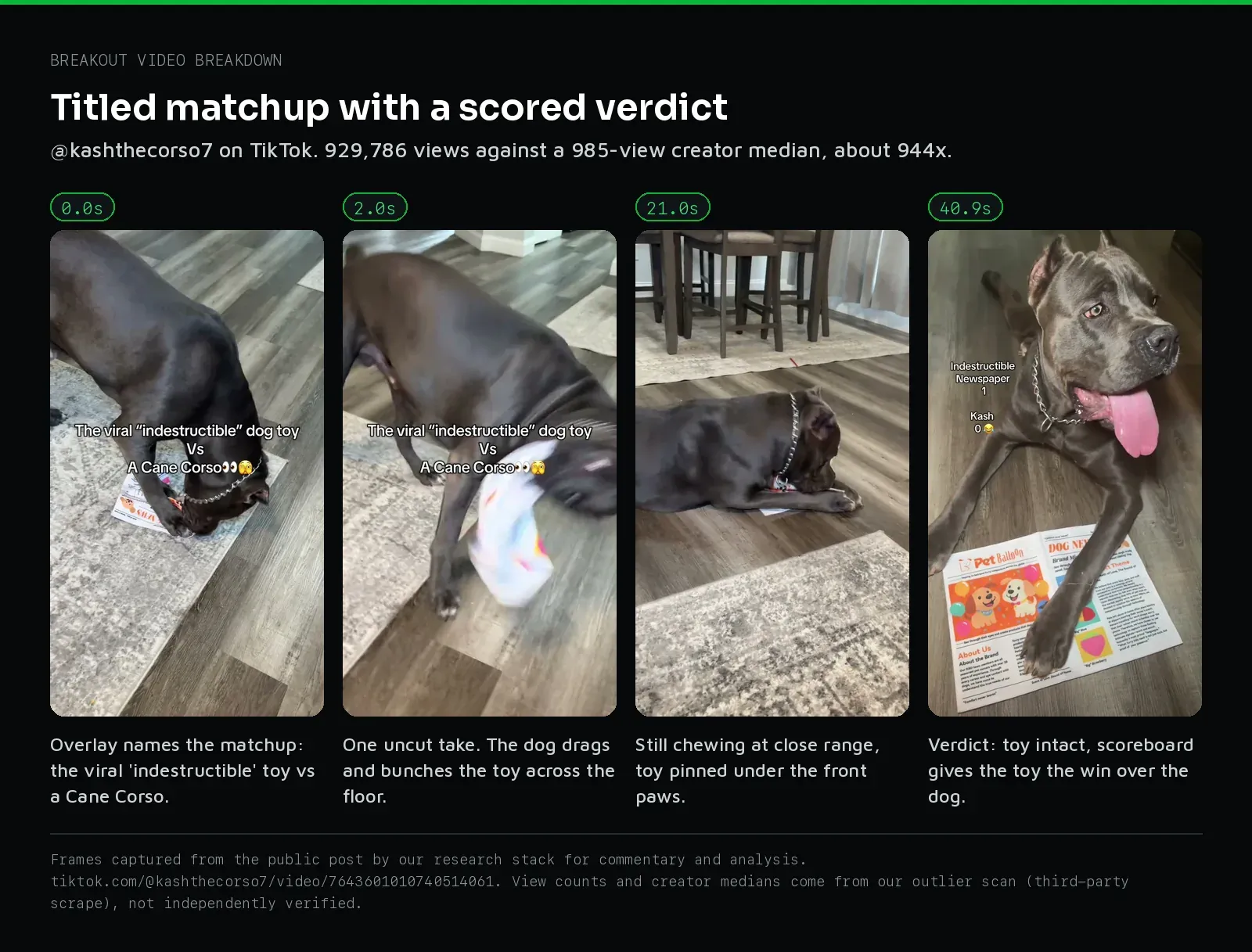
A dog chew brand: One concept I'd brief uses the visual demonstration of failure: open on a large dog gnawing on a chew, shot top down, with a caption reading "Toy #5 this month." It names the doubt visually. Owners of destructive dogs have bought so many failed toys that they no longer believe durability claims. They expect to lose money again. The real pattern I'd build it from comes from @kashthecorso7, whose video opens on the overlay "The viral 'indestructible' dog toy Vs A Cane Corso" and ends on a scoreboard giving the toy the win, one uncut take that pulled 929,786 views against a creator median of 985, about 944x.
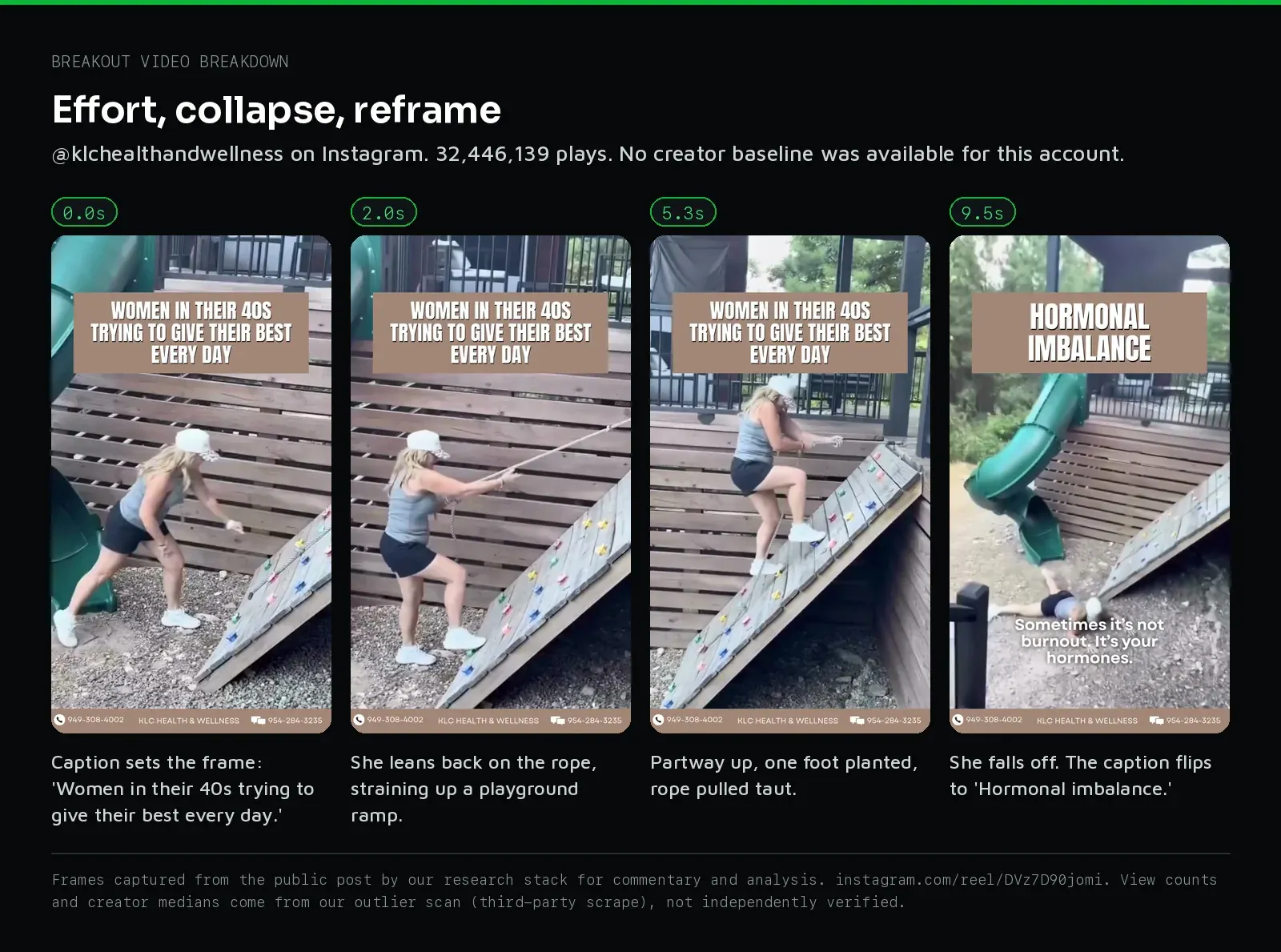
A women's hormone wellness brand: One concept I'd brief plays the same effort-collapse structure with a jar lid: a woman strains to open it and fails, and the caption reads "same jar. same hands." It reframes a self-blamed change in strength as a body signal before the brand ever enters the frame. The real video I'd build it from is from @klchealthandwellness: a woman strains up a playground rope-climb ramp, falls about 9 seconds in, and the caption flips from an effort line to "HORMONAL IMBALANCE," with the subtext "Sometimes it's not burnout. It's your hormones." That reel pulled 32.4M plays. The viewer who's quietly concluded she's just getting weak or lazy stops scrolling.
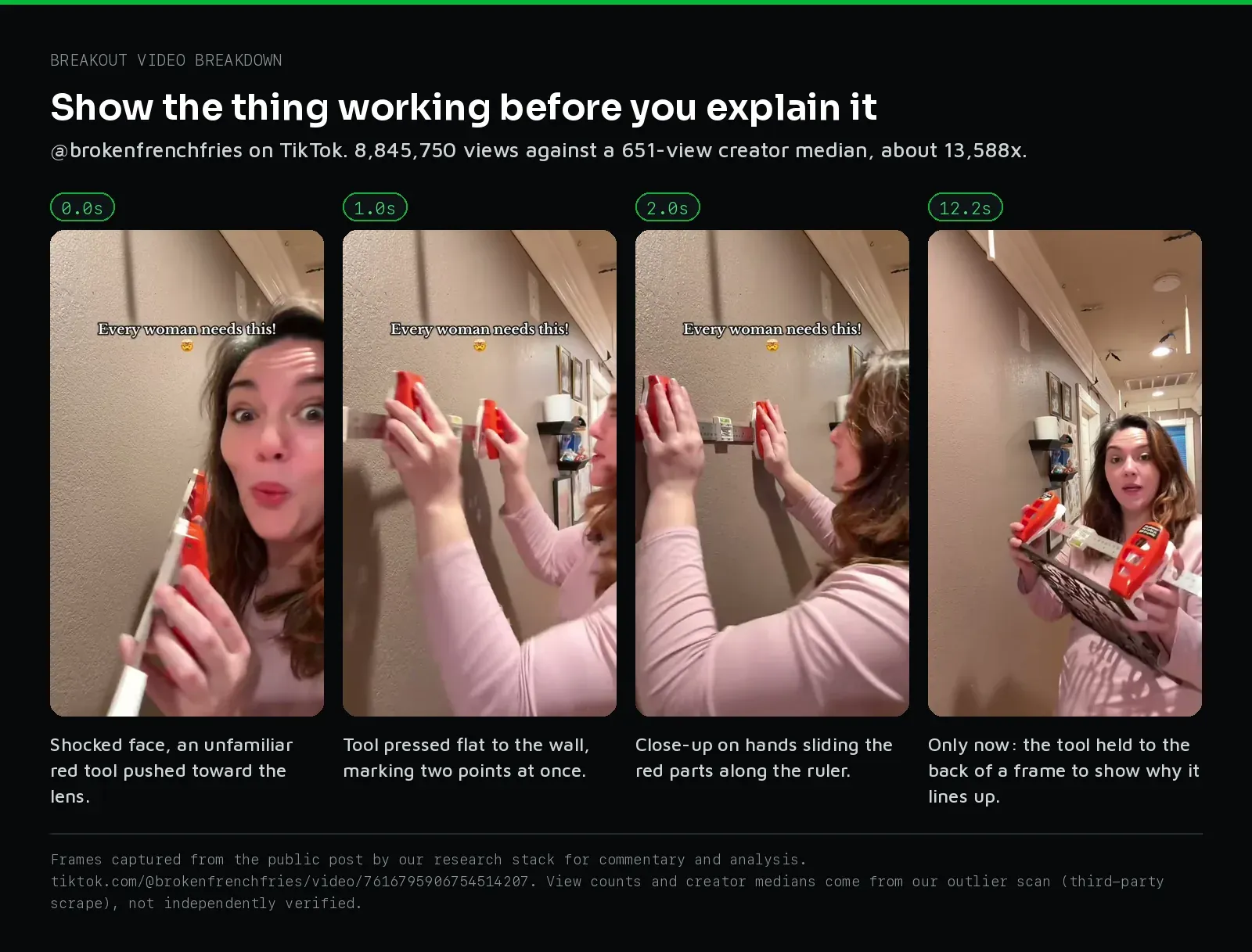
A custom picture frame company: The real video comes from @brokenfrenchfries: it opens on an unfamiliar red hanging tool pressed to the wall, marking two points and sliding along a ruler, working before anyone explains what it is. Only around 12 seconds in does the tool get held to the frame to show why it lines up. That pattern pulled 8.8M views against a creator median of 651, about 13,588x. The idea I'd pitch for a frame company: lead with a stunning, perfectly hung piece in the first second and hold the explanation of the mounting system until the end. The buyer's objection is that they can't tell a good frame from a cheap one online, and showing the undeniable result first makes them ask how it was done.
The same hormone wellness brand, a second concept: Here the creator holds up the product and reads the ingredient list skeptically before endorsing it. The buyer's objection is that they're paying a premium for a word on a bottle and can't tell if they're being played. With the creator acting as the skeptic who wants proof from the back label, the video mirrors the buyer's exact hesitation. The creator only endorses the product after checking the label, which gives the viewer permission to trust it.
The adaptation boundary
When you adapt this for your own brand, you need to know what you can borrow and what has to stay original.
You can borrow the mechanism: stating the objection in the first three seconds, the visual demonstration of failure, the pinned misbelief caption. Those structures work across categories.
But the objection itself has to be your buyer's. You can't guess what they're worried about, and you can't invent an objection because it's convenient to solve. If you sell a low carb baking product, the objection isn't that it's hard to make. It's that it'll taste like cardboard. You have to use their actual words.
A generic objection kills the hook. The whole thing works because the viewer feels understood. Miss the nuance of their doubt and you just look like an ad trying too hard.
A practical test you can run
Start small. Don't overhaul your whole creative library.
First, find the single biggest objection your sales or customer service team hears. It's usually the reason people give right before they ask for a refund, or the question that shows up most in comments.
Next, script three different hooks for the same core video. Hook one is the verbal statement. The creator looks at the camera and says the objection out loud. Hook two is the visual demonstration of failure. Show the frustrating alternative and use a short text overlay to name the pain. Hook three is the category mislabel. The creator dismisses the product the same way a skeptical buyer would.
Brief a creator to film all three hooks plus one consistent body for the rest of the video. The body should directly address and resolve the objection raised in the hooks.
Run the three variations as separate ads against your standard control creative. Watch the three second view rate and the hold rate. You'll see quickly which version of the objection lands with your audience.
What makes this test fail
It fails when brands soften the objection.
Marketing teams get nervous about saying negative things about their own product, so they rush to the solution. Instead of a raw line like, "I thought this was going to taste like chalk," they script something sanitized like, "I was looking for a healthy snack that still tastes great."
The sanitized version has no stopping power. It sounds like marketing copy, and the viewer knows right away they're watching an ad.
Let the creator sound genuinely skeptical. They have to sit in the doubt for those first three seconds. If the objection doesn't feel a little uncomfortable to approve, it's probably not strong enough to stop the scroll.
Next steps
If you're running generic lifestyle ads that get clicks but no buyers, change the structure of the creative. Stop trying to entertain everyone and talk directly to the skeptics. Then read what a three-video creator test should prove before you judge the results.
---
FAQ
Should my ad mention why people don't buy my product?
Yes, if it's the doubt they already have. You aren't listing flaws, you're saying the thought out loud before they scroll past on it. Ignoring it doesn't make it go away, and naming it gives the video permission to answer it.
Does opening an ad with a negative hurt conversions?
Not when the negative is a real objection. The viewer who holds that doubt stops scrolling because the video just said what they were thinking. Once you've got them, the rest of the video resolves the doubt for exactly the people who were on the fence.
How fast should a UGC hook state the objection?
In the first three seconds. The creator can say it to camera or you can put it on screen as text. Either way, the objection is the hook, not a setup for it.
Can the objection hook be on-screen text only?
Yes. A pinned caption that states the misbelief sometimes works better than spoken words. It stays in front of the viewer the whole time, so they keep watching for the answer.
What if buyers have more than one objection?
Test them separately. Don't cram three objections into one video. Build one hook around price, one around durability, one around taste, and let the numbers show you which doubt is blocking the most sales.