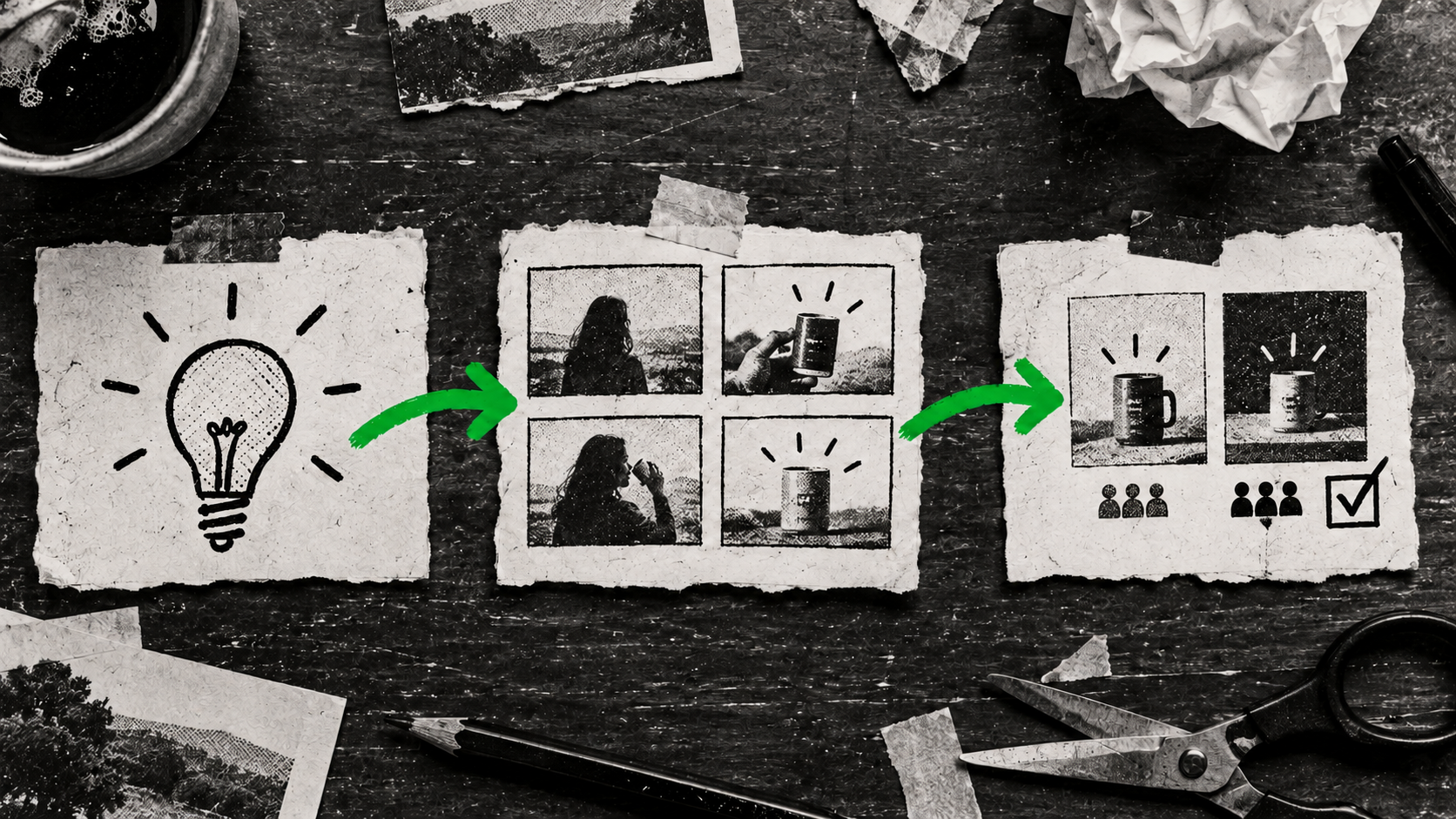
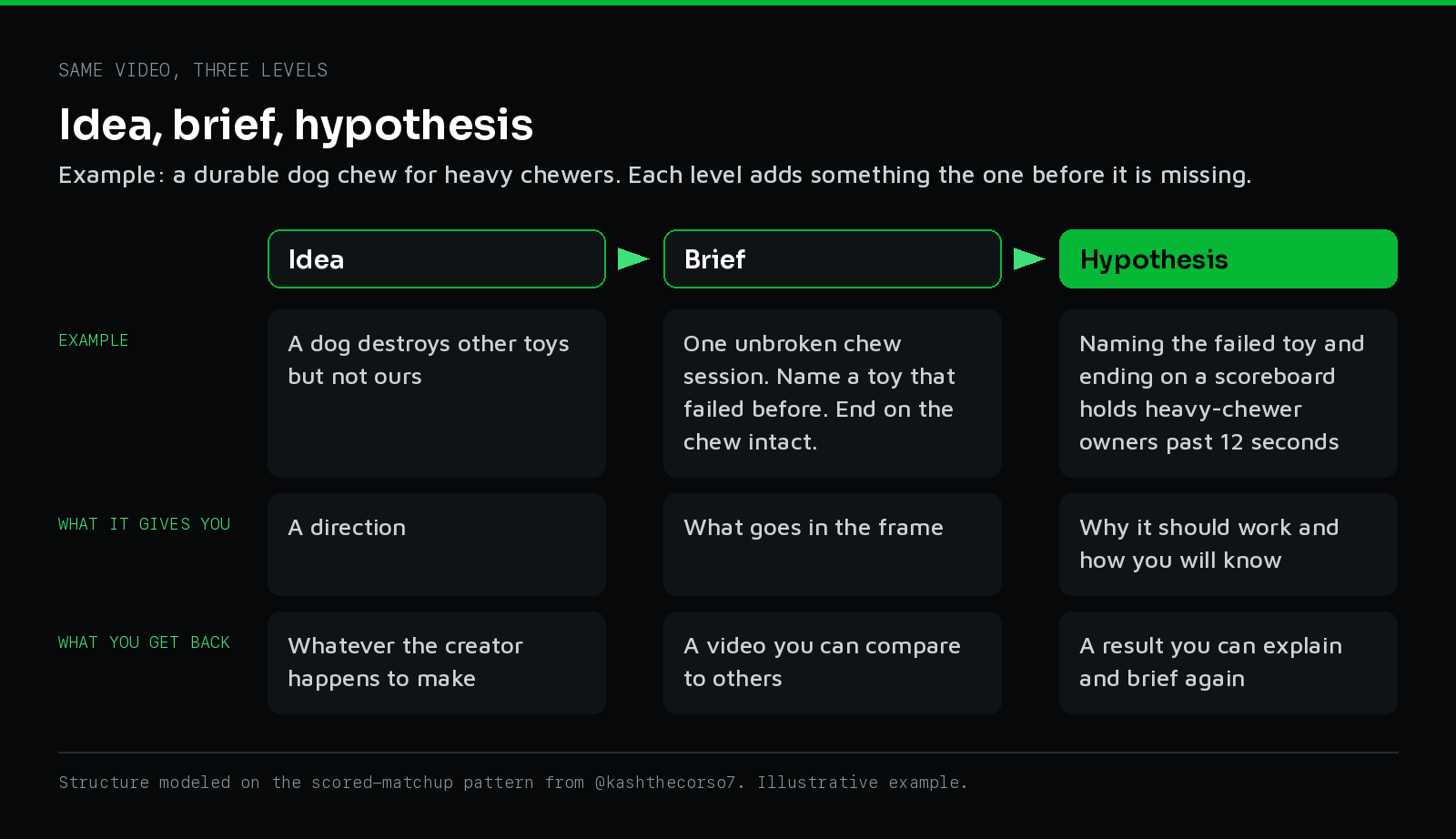
A UGC idea is a spark, a creative brief is the instruction set for filming it, and a testable ad hypothesis is a prediction about what the video will do to your buyer. Only the hypothesis tells you what the test is for and how you'd know it worked, so it's the only level where a flop still teaches you something.
I broke down outlier creator videos frame by frame across several niche product categories, and the same pattern kept showing up. The brands that scale short-form video aren't lucky. They're running a different creative system than the brands that struggle.
Most operators treat these three things as interchangeable words for "what we want the creator to make." They aren't. Each one needs different information and produces a different output. When you run three creator videos without a hypothesis, you can measure the result but you can't explain it. And you can't improve what you can't explain.
If you're a niche business owner trying to scale paid social or organic video, this is where your budget either compounds or leaks. Operators who brief at the idea level get inconsistent results because they're relying on the creator to figure out the marketing strategy. Operators who brief at the hypothesis level can iterate. The data from a hypothesis-structured test is directional and useful even when the video underperforms.
Here's what that looks like across three product categories.
Example 1: The Heavy Dog Chew
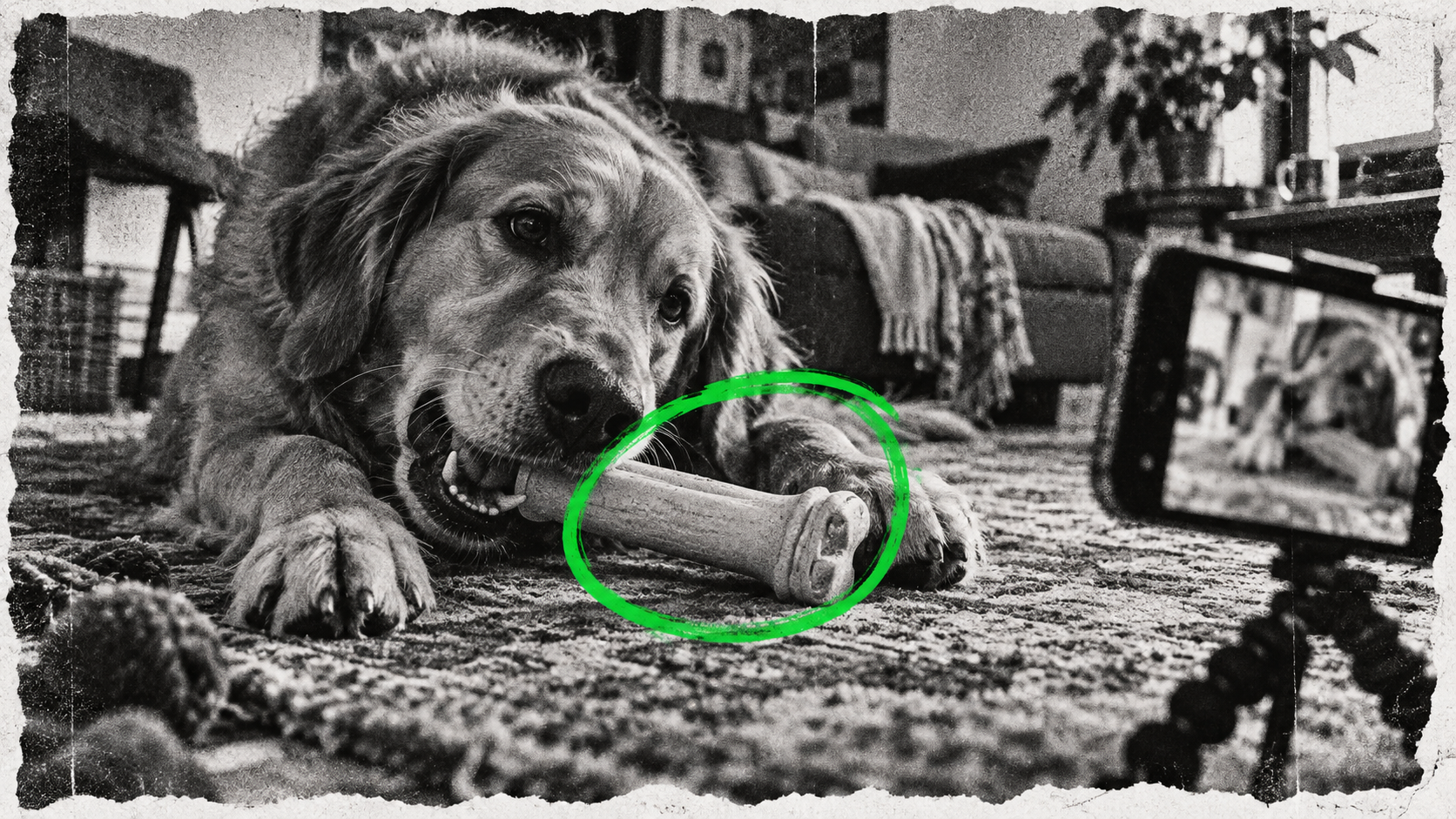
A dog chew brand sells a durable product for heavy chewers. The buyer wants a long-lasting chew that survives heavy use. The main objection is doubt: they've bought toys that broke instantly, so they don't believe durability claims anymore.
IDEA: "Let's do a video where a dog destroys other toys but not ours."
This is a spark. It isn't wrong, but it isn't executable. Hand it to one creator and you might get a funny montage of a dog shredding a stuffed bear. Hand it to another and you get a boring monologue with your product in hand. Two totally different videos, and you've learned nothing about your buyer.
BRIEF: "Film your dog's chew session in one unbroken take and show the product at the end intact. The caption should reference a previous toy that didn't survive."
This is an instruction set. It tells the creator exactly what to put in the frame and removes the guesswork. But it still doesn't tell you why you're running the test.
HYPOTHESIS: "A dog owner who has spent money on toys that failed will hold retention past the 12-second mark if the video names that failure in the caption (Toy #5) and shows the resolution (intact chew, scoreboard) at the end. Expected mechanism: doubt named in frame 1, proof confirmed in final frame. Test variable: presence vs. absence of scoreboard overlay."
This is a prediction. It connects the visual mechanic to the buyer's tension and names the metric you'll measure: retention past 12 seconds.
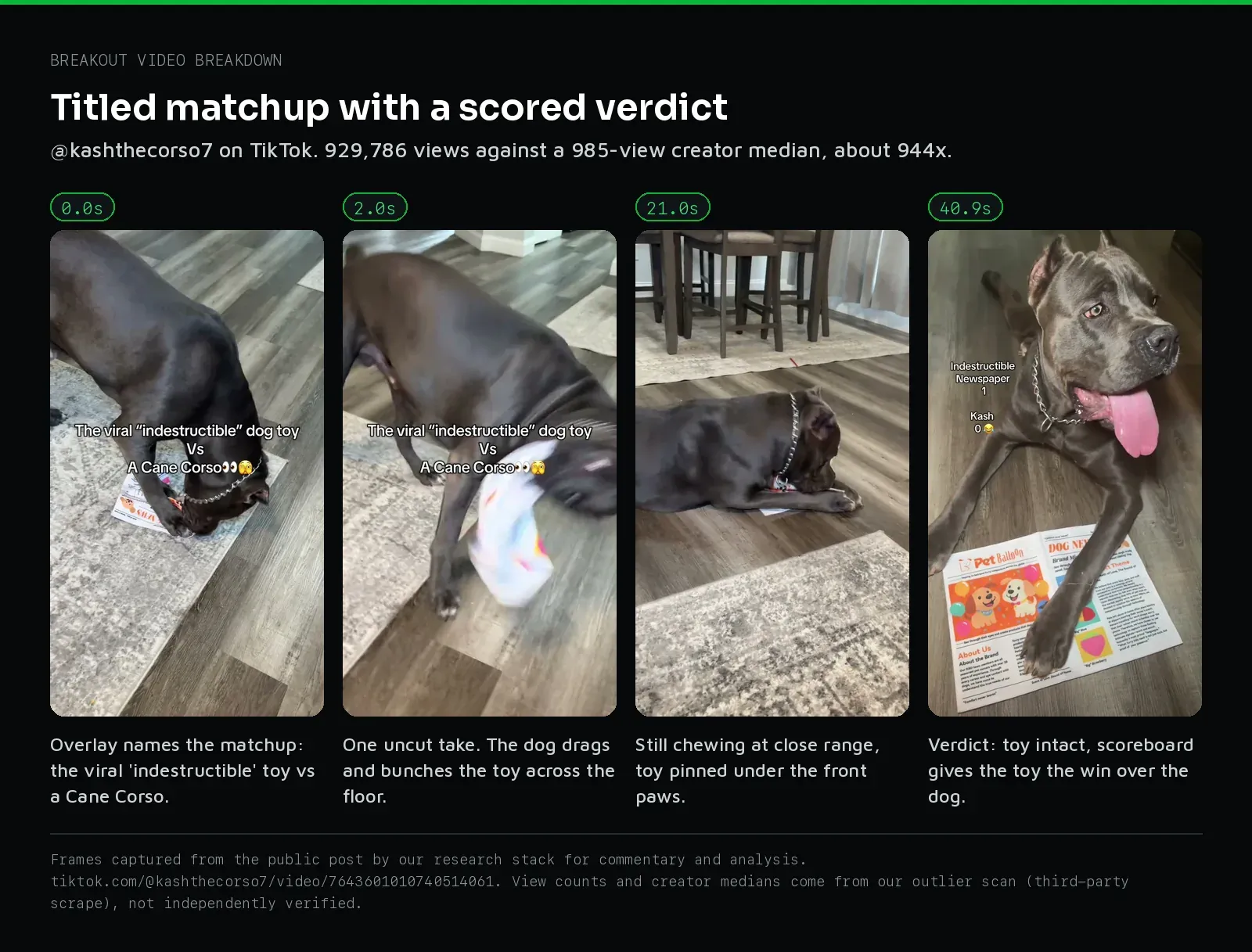
I saw this mechanic in @kashthecorso7's TikTok. The overlay reads "the viral 'indestructible' dog toy vs a Cane Corso," and the whole thing runs as one uncut take: the dog chews and drags the toy, and it ends with the toy intact under the dog's paws and a scoreboard overlay giving the toy the win. Per our outlier scan it pulled 929,786 views, about 944x the account's usual median.
The hypothesis is that the scoreboard gives a skeptical buyer a clear verdict, and that's what holds attention past the setup. That jump from brief to prediction is the core of how we build creative systems for niche brands.
Next step
Get creator videos built around the doubt your buyer already has.
See how we build creative systems for niche brandsExample 2: Custom Picture Frames
A custom picture frame company wants to sell gallery float moulding. The buyer wants their art and space to feel intentional. The main objection is that they can't tell a good frame from a cheap one in a photo.
IDEA: "Let's show how high-quality our frames look on a wall."
This idea leads to generic, polished lifestyle content. It doesn't touch the buyer's doubt. The buyer already knows what a wall looks like.
BRIEF: "Show the finished wall of frames in the first second. Don't explain anything. In the last ten seconds, show how you checked the frames with a straightedge."
This is a better brief. It uses a specific mechanism, proof first and reason last, and it forces the creator to show the finished result before any talking.
HYPOTHESIS: "Moving the frame-squareness claim to the end and leading with the finished wall will hold watch time better than a tutorial that explains first, because the viewer is retained by an unpaid explanation."
This hypothesis names the retention engine. The viewer stays to learn why the thing they already watched work actually worked.
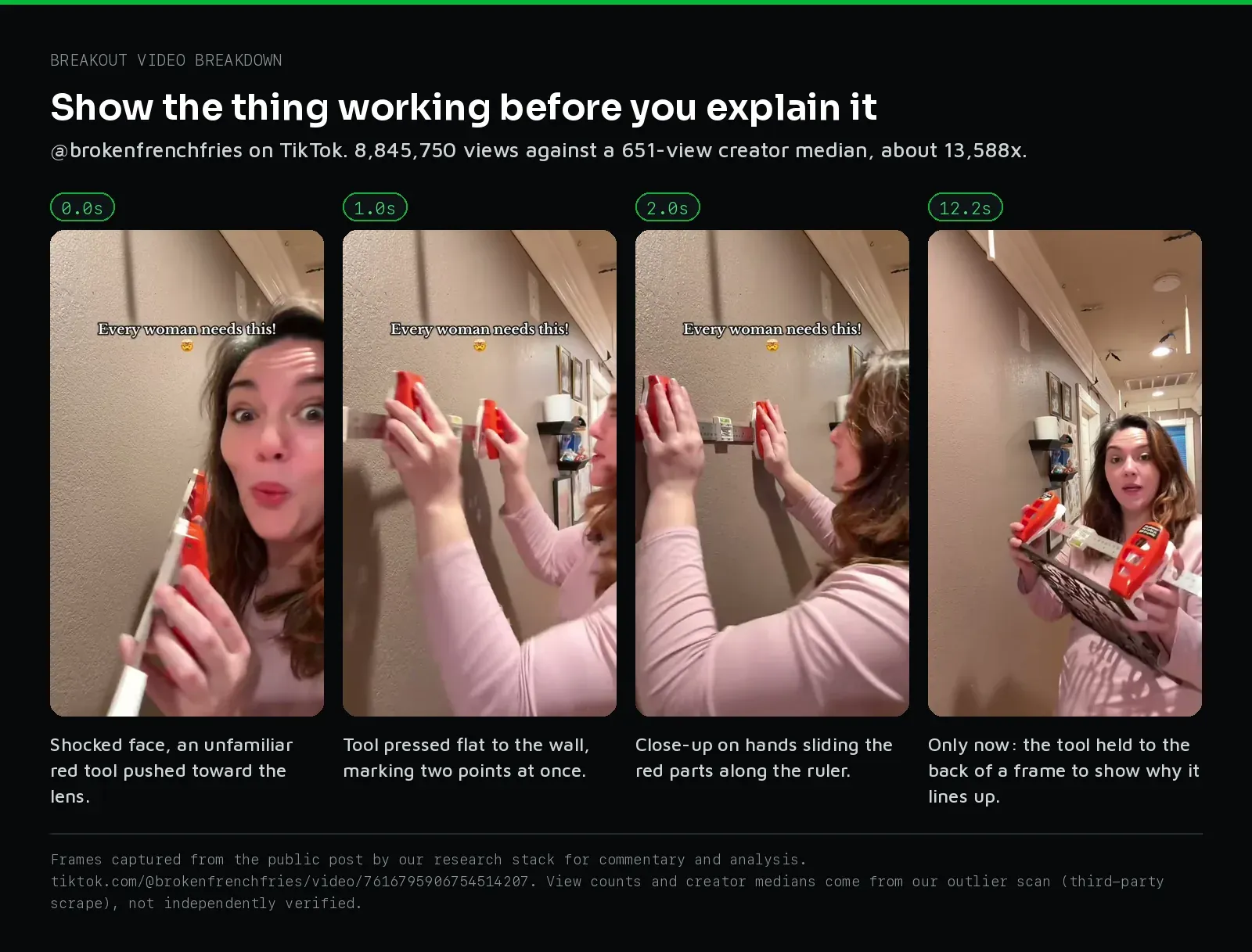
I saw this pattern in @brokenfrenchfries's TikTok. A woman pushes an unfamiliar picture-hanging tool at the camera, presses it to the wall to mark two points at once, and only about twelve seconds in holds it to the back of the frame to show why it works, before explaining to camera. Per our outlier scan it pulled 8.8 million views, about 13,588x the account's median.
The hypothesis tests whether withholding the explanation is what holds attention. If watch time collapses before the explanation, you know the withheld reason wasn't worth staying for.
Example 3: Women's Hormone Wellness
A women's hormone wellness brand sells plant-based supplements and coaching. The buyer wants to restore hormone balance naturally. The main objection is doubt that a natural supplement can actually move hormones and produce a noticeable shift.
IDEA: "Let's get a creator to talk about how much more energy they have now."
This is the default idea for every wellness brand. It's a spoken claim, and spoken claims trigger the buyer's skepticism immediately.
BRIEF: "Film yourself trying to open a jar that you normally open easily. Show your hands straining and shaking. Don't cut the camera. When you finally give up, overlay a text caption that asks if hormone changes are making everyday tasks harder."
This brief requires physical proof. It creates an effort-then-visible-collapse sequence.
HYPOTHESIS: "A small everyday change filmed unbroken, then reframed as a question, will earn more qualified discussion than a spoken symptom list because the viewer sees the moment before it's explained. Test variable: the text overlay reframing the struggle."
This hypothesis predicts that physical strain is a stronger hook than a spoken claim, and that reframing the failure removes self-blame, so viewers ask questions instead of scrolling past.
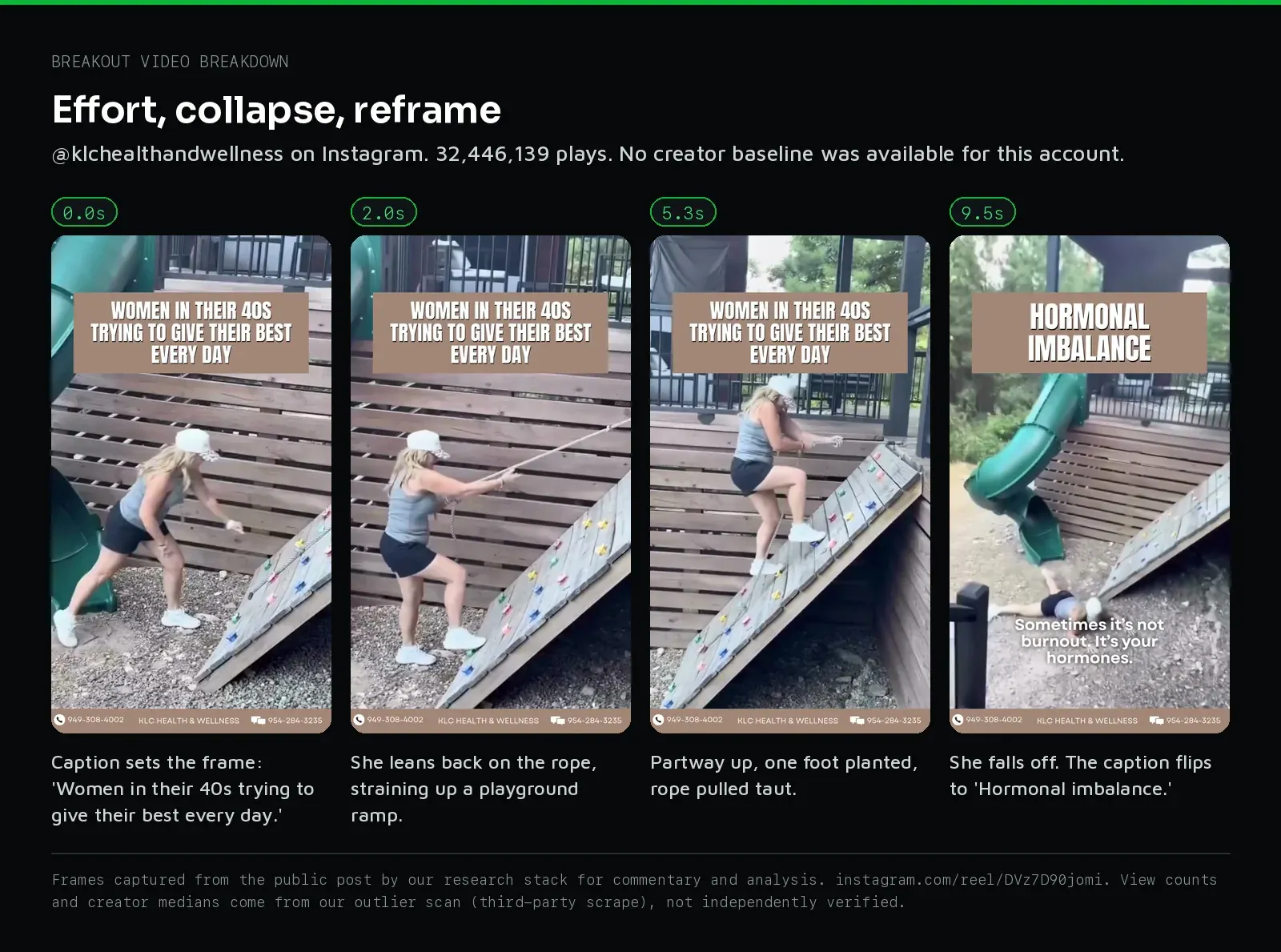
I saw this physical demo in @klchealthandwellness's Instagram reel. Captioned "Women in their 40s trying to give their best every day," a woman pulls herself up a playground rope-climb ramp, strains, and falls off around nine seconds in. The caption then flips to "HORMONAL IMBALANCE," with the subtext "Sometimes it's not burnout. It's your hormones." Per our outlier scan it pulled 32.4 million plays.
The collapse works as a wordless argument that no caption has to prove. Reframing the effort as a diagnosable cause is what makes it worth sharing.
The Adaptation Boundary
When you build creative systems, you have to know what you can borrow and what has to stay original.
You can borrow the mechanism: the withheld-identity cold open, the destroy-the-object proof, the proof-first, reason-last structure. These are structural patterns that hold human attention.
You can't borrow the specific brand claim, the precise visual proof, or the creator's authenticity. Those have to stay original to your brand and your buyer's specific objections.
If you sell dog chews, you can borrow the "Score It Against The Worst Chewer" mechanism. But you have to use your actual product and address your buyer's specific fear about synthetic ingredients or heavy chewing.
A Practical Test You Can Run
Here's how to put this into practice this week.
Pick the single biggest objection your buyers have. Don't pick a feature. Pick a fear.
Write down one visual, physical action that would prove that fear wrong without anyone speaking a word. If the fear is durability, the action is physical destruction. If the fear is quality, the action is an extreme macro close-up of a joint or seam.
Build a brief that asks three different creators to film that exact physical action in the first three seconds of the video. I've written up what a three-video creator test should prove if you want the scoring side of this.
Write down your hypothesis. Predict what will happen to retention and comments if the visual proof lands.
Run the test.
Why The Test Will Fail
If this test fails, it'll likely be for one of three reasons.
First, you briefed an idea instead of an action. You asked the creator to "show quality" instead of "film the fourth corner of the frame." The creator guessed what you meant and guessed wrong.
Second, the visual proof wasn't ambiguous or interesting enough to hold attention. The viewer understood exactly what was happening in second one and had no reason to stay for second four.
Third, you didn't have a clean hypothesis, so you changed multiple variables at once. You used different hooks, different products, and different creators, and when the video flopped, you had no idea which variable caused it.
The difference between scaling ad spend and burning it is the discipline of the hypothesis. If you're not sure which objection to build it around, start with why a creator brief should open on the buyer's doubt.