UGC creator strategy for niche physical products works when each video names the one doubt that stops your buyer and tests it on camera with a result they can see. Polished unboxings and lifestyle montages don't do that, which is why they blend into every competitor's feed and don't convert.
Most brands briefing creator videos still ask for those same three things: an authentic unboxing, a lifestyle montage, a polished explainer. They end up with a hard drive full of videos that look exactly like everyone else's.
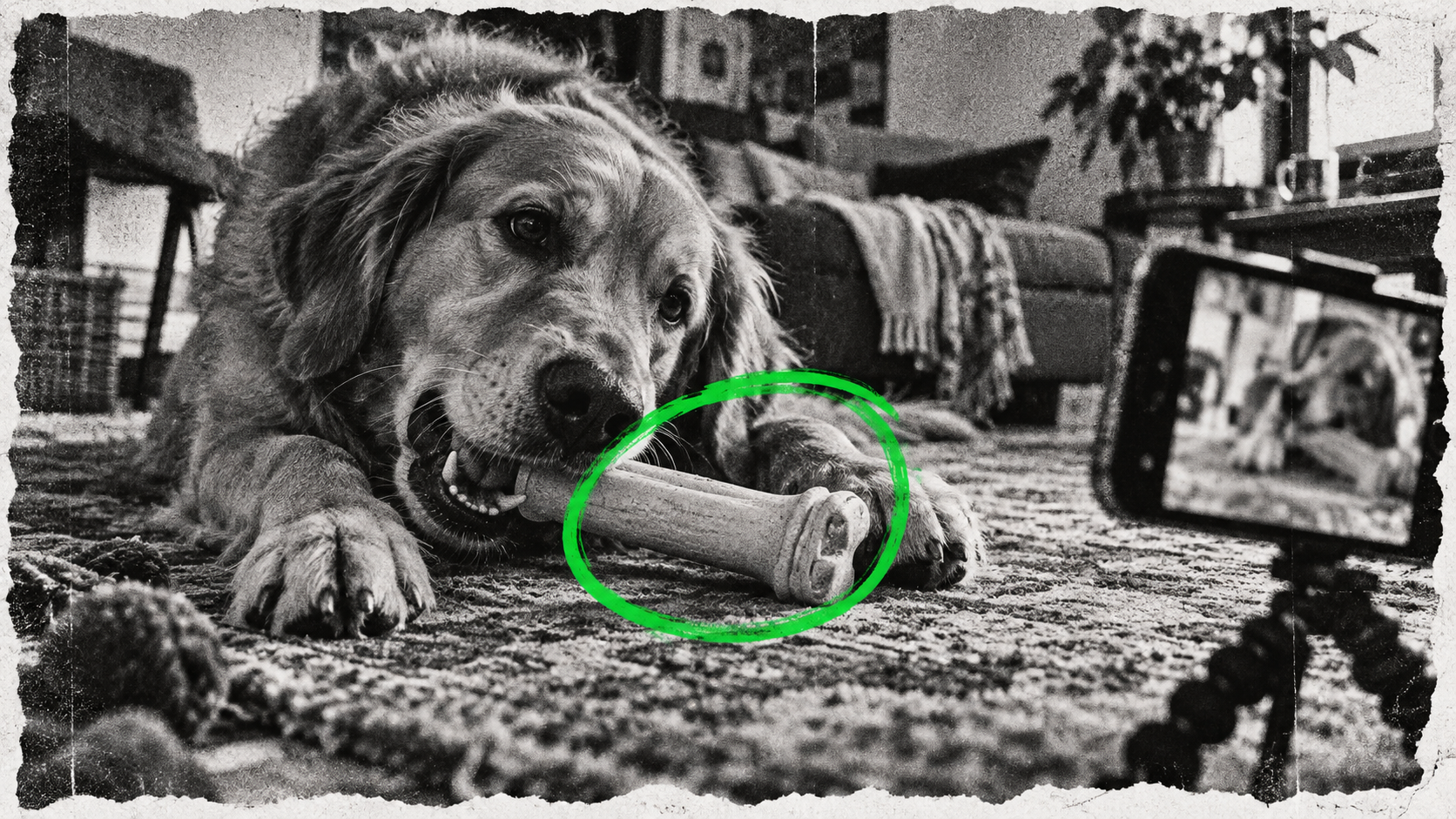
When we built creator concepts for a dog chew brand, I looked closely at what actually drove breakout attention in the category. The buyer's desire was simple: give their dog a long-lasting, flavor-driven chew that satisfies its urge to chew.
Their doubt was just as strong. They didn't believe the chew would last with a heavy or destructive chewer. They'd been burned before.
They didn't want aspiration. They wanted proof.
What the outlier research showed
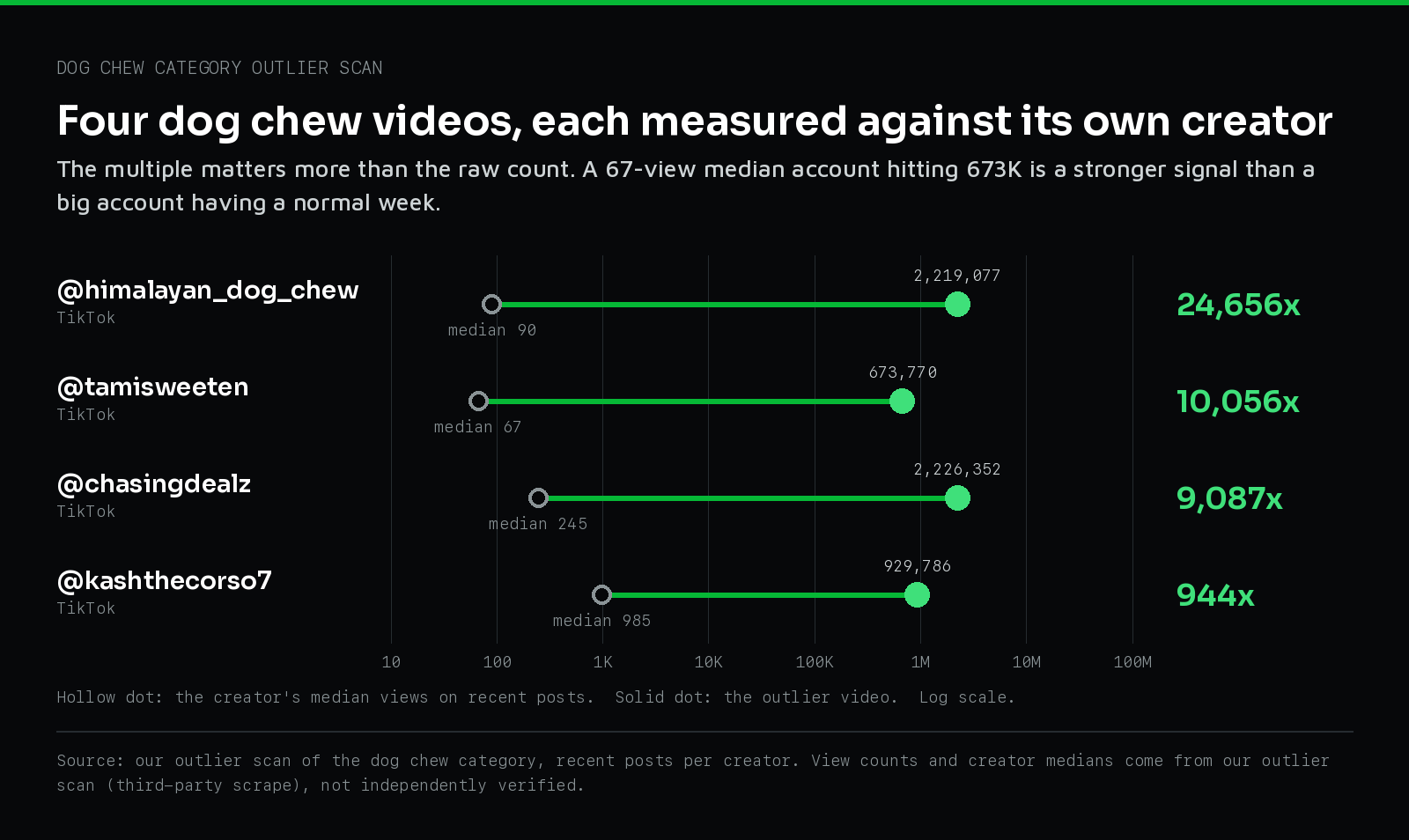
I ran our outlier scan across a batch of dog chew creator videos and measured each one against its creator's own median, so a small account's breakout counts as much as a big account's. (I walk through that method in how to find a creative angle from outlier videos.) The winners weren't high-production aesthetic shots.
The first was a video from @kashthecorso7. Per our outlier scan it pulled 929,786 views, about 944x the account's usual median. It ran as a titled matchup, "the viral 'indestructible' dog toy vs a Cane Corso," in one uncut take, ending with the toy intact under the dog's paws and a scoreboard overlay giving the toy the win.
The second was a withheld-identity cold open. A video from @himalayan_dog_chew opens on two unlabeled chew sticks on a kitchen counter, no packaging in frame, with an overlay that reads "If you've never heard of a..." then "Let me tell you in under 30 seconds." The packaging only shows up about 14 seconds in. Per our outlier scan it pulled 2.2 million views against a creator median of about 90.
The shared mechanism was clear. The creator named or withheld the exact detail the buyer doubts, tested the product against that doubt on camera, and showed a visible result.
Breakout content in this category wasn't driven by polished aspiration. It was driven by surprisingly credible delivery. If you want that research run on your own category and turned into concepts, here's how we build creative systems for niche brands.
Next step
Get creator videos built around the doubt your buyer already has.
See how we build creative systems for niche brandsWhat we built to test the pattern
We took those mechanics and built three distinct concepts for the brand to test. All three attack the same doubt from different angles.
Concept 1: The Chew Autopsy
This is an idea I pitched, built on a destroy-the-object proof mechanic. It's not a video that exists yet.
The angle: a chew that never changes shape isn't the safe one. The safe one wears down evenly, and you can only tell by looking inside. I'd brief a hook where the creator saws a well-chewed product in half on a tray and holds the cross-section to the lens.
This hits the buyer's tension directly. Owners can't tell whether a chew is wearing down safely or shredding into pieces their dog swallows. Cut it open and the wear pattern becomes the evidence. That's a directional hypothesis, untested.
Concept 2: The Wrong Aisle Test
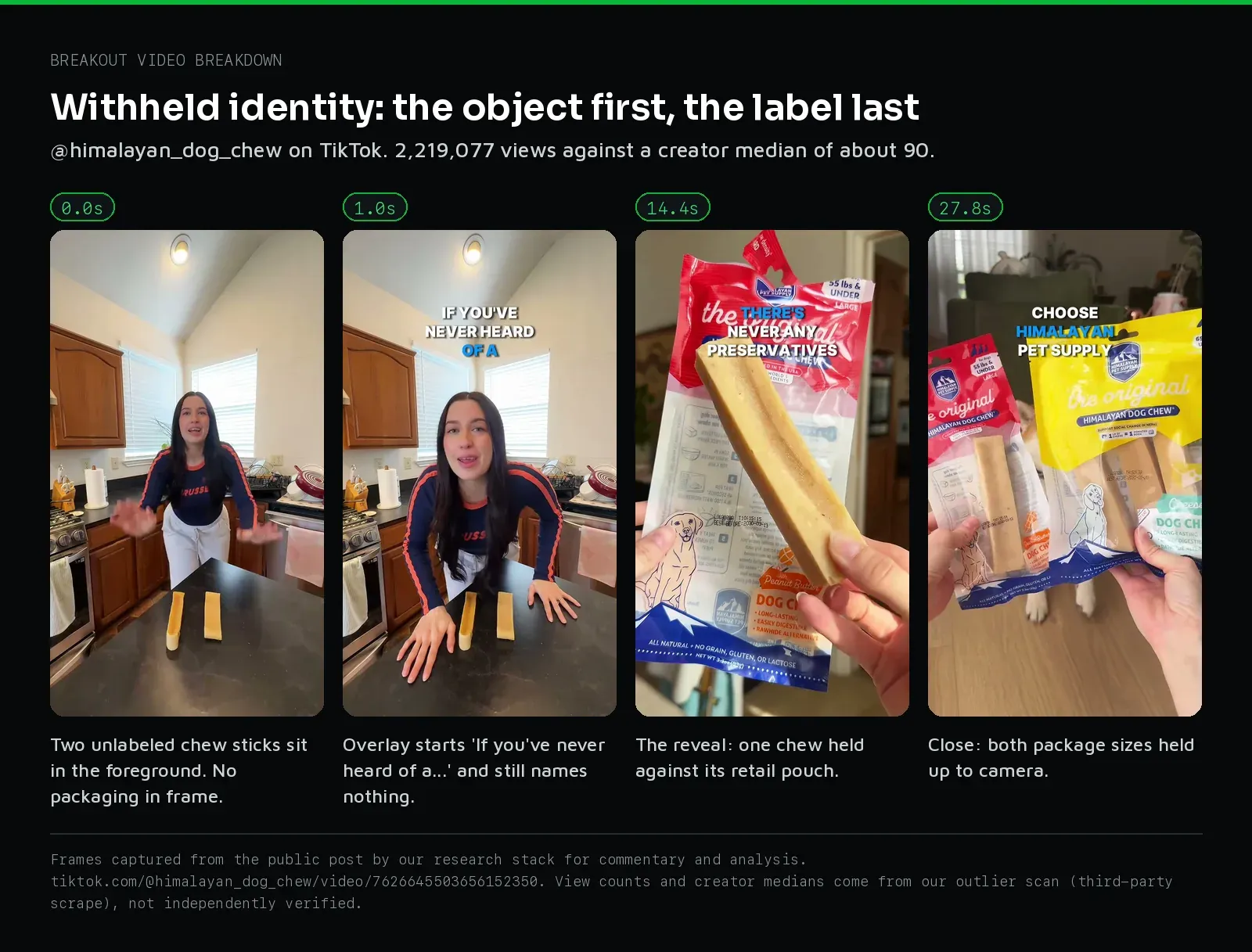
This is another concept I pitched, adapted from the withheld-identity cold open in the @himalayan_dog_chew video.
The angle: you can't tell a real chew from a filler chew by looking at it, which means the label you trust is doing no work. I'd brief the creator to set the product on a counter beside two genuinely food-derived items of similar color and size, no packaging in frame, then ask a stranger to point to the one that isn't food.
People buy on the label. Take the label away and they guess wrong. The original video withholds identity to hold attention; this version turns it into a street-style interaction. It's a directional hypothesis, untested.
Concept 3: Score It Against The Worst Chewer
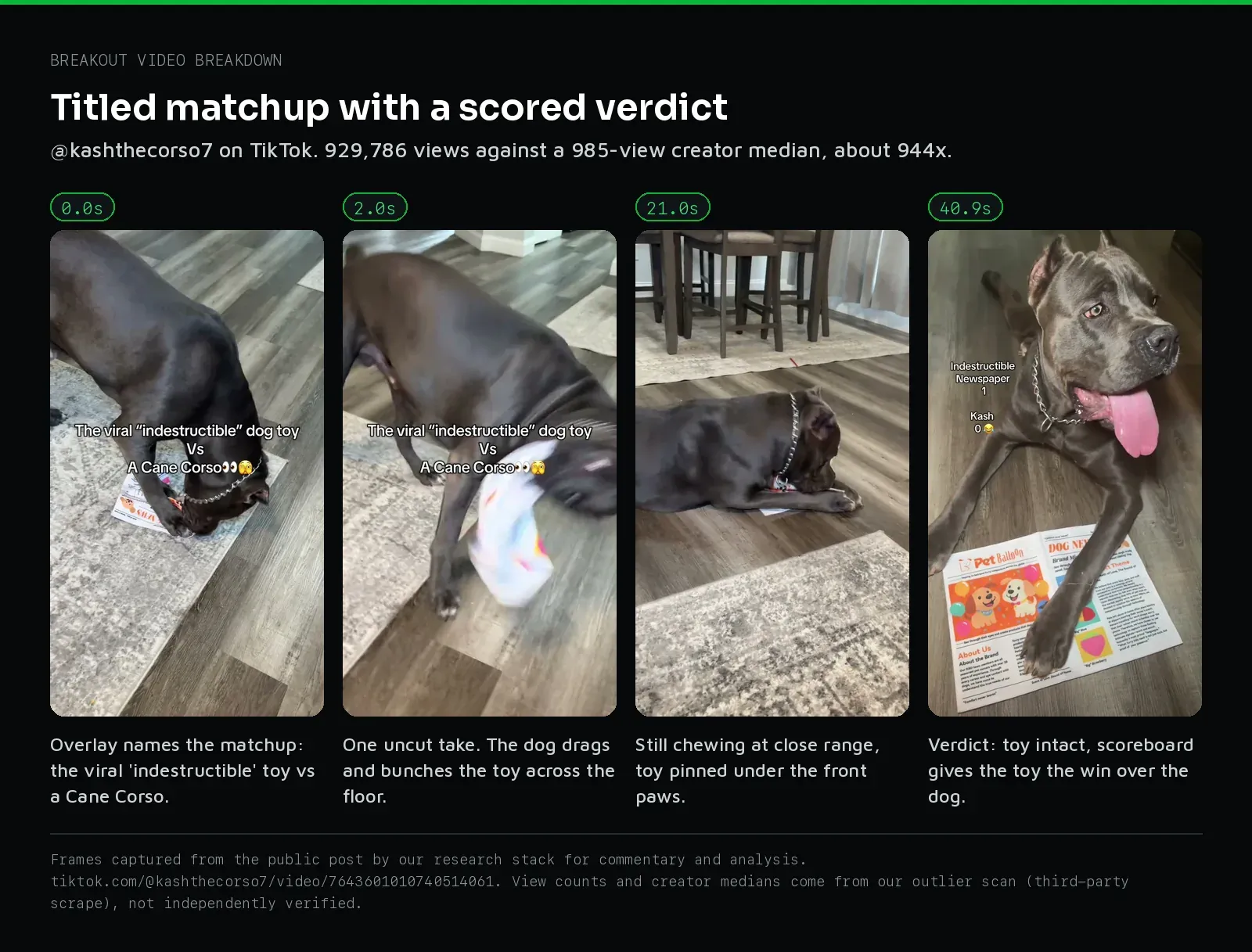
This is a titled-matchup-with-scoreboard concept, adapted directly from the @kashthecorso7 pattern.
Owners of destructive dogs have bought so many failed toys that they don't believe any durability claim anymore. We framed the concept around a named matchup: the product versus the dog who eats everything. The creator films one long take of the dog working the chew, ending on a flat-lay of the intact product and a scoreboard overlay.
The buyer isn't paying for a toy that survives. They're buying back the money they keep spending on replacements every month.
The adaptation boundary
The part I found most useful was watching the same structural mechanics carry over to completely different categories.
For a custom picture frame company, the buyer's doubt was different. They couldn't tell a good frame from a cheap one in a photo. I pitched a component-first macro assembly concept called The Fourth Corner: show the frame being joined, because the tension is mechanical.
For a women's hormone wellness brand, the doubt was whether plant-based supplements could actually move hormones. I pitched an effort-collapse-reframe concept called Two Weeks, Same Clothes: the creator struggles with a jar lid she used to open easily, reframing the physical change as a hormone signal rather than personal laziness.
The boundary is strict. The mechanical format (the cold open, the physical proof, the reframe) transfers across industries. The doubt has to stay original to the brand.
Paste a dog chew concept onto a picture frame and it fails. Pull out the structural reason people watched the dog chew video and map it to the picture frame buyer's specific doubt, and it has a real shot.
How to run this on your own product
You don't need a big production budget to win with creator video. You need a sharper read on what your buyer is afraid of. Here's the order I'd work in.
- Write the doubt in one sentence. Not a feature, a fear. "It won't last with my dog" is a doubt. "Long-lasting chew" is a claim nobody believes.
- Scan your category for outliers. Pull roughly a dozen breakout videos and measure each against its creator's own median, not raw views. A small account that jumps far past its usual numbers tells you more than a big account doing big-account numbers.
- Name the mechanism, not the topic. For each outlier, write down what the creator did in the first few seconds: withheld the product, staged a matchup, cut something open. That's the part you can reuse.
- Pitch three concepts against the same doubt. Each one should prove the same thing a different way, so the test tells you which proof people believe, not which topic they like.
- Read the comments as data. When people argue about whether the test was fair, the doubt is live. When they ask where to buy, the proof landed.
Your buyers expect you to gloss over their objection. When a creator names that fear in the first three seconds and spends the rest of the video visibly testing it, you earn their attention.
What would make the test fail
A test like this only works if the execution is honest.
If the Chew Autopsy looks staged, viewers will assume you altered the product. If the Wrong Aisle Test uses obvious trickery, the audience scrolls past. If the dog in the Worst Chewer matchup clearly isn't a heavy chewer, the comments will tear the claim apart.
The test fails when you pick looking good over looking credible. Let the creator show the mess, the effort, and the real result. That's what buys trust. Before you spend on creators, get clear on what a three-video creator test should prove so you know what a win looks like.
---
FAQ
What's the best UGC creator strategy for a niche physical product?
Start with the buyer's biggest doubt, not the product's features. Write that doubt in one sentence, then brief a creator to test it on camera with a result the viewer can see. The two breakout dog chew videos I broke down frame by frame both worked this way.
Why do some tiny creator accounts get millions of views on a product video?
Because the video delivers credible proof, not polish. Per our outlier scan, a @himalayan_dog_chew video pulled 2.2 million views against a creator median of about 90. It kept the product's identity hidden for the first 14 seconds, so the question stayed open long enough to hold attention.
Should I send my product to creators for unboxing videos?
Not as your main test. A generic unboxing doesn't answer the doubt that stops people from buying. If the doubt is durability, show the product surviving a real test. If it's quality, show what's inside.
How do I test UGC video concepts without a big budget?
Run three concepts that attack the same doubt from different angles, with a small group of creators who fit each concept. Keep production simple. Then watch retention and the comments to see which version people actually believe.
Can a creator video format from one industry work in another?
The format transfers. The doubt doesn't. A withheld-identity cold open from a dog chew video can work for a picture frame, but only if you swap in the picture frame buyer's own doubt.