
The angle in an outlier video isn't the format, the length, or the vibe. It's the mechanism underneath: the specific way the video opens a doubt and then resolves it on camera. Name that mechanism, check your product can genuinely deliver it, and brief creators on the mechanism instead of the reference video.
I see brands skip that step all the time. We built our own research stack to surface these patterns for any brand or competitor niche. It pulls creator performance data, computes per-creator outlier ratios, and maps which video mechanics actually drove the breakout. The data told a consistent story across dog chews, picture frames, women's wellness, and keto food.
For a dog chew brand, we isolated an outlier video that hit 929,786 views for a creator whose median post gets 985 views, roughly 944x. Most operators who look at a video like that ask the wrong question: "How do we make something like that?" They copy the format, match the length, chase the vibe, and get none of the results.
The problem with copying the execution
If you run a niche brand and you're trying to scale paid social or a creator pipeline, you know the frustration. You see a competitor ad that clearly works, or a creator video that blows up. You send it to your team or agency and say, "Make us one of these."
The result always feels like a knock-off. It looks like an ad trying to be a TikTok, or an actor pretending to be a real customer. The views are bad, the CPA is worse, and you're left wondering why the same format worked for them and failed for you.
You copied the execution. You didn't adapt the mechanism. Finding the mechanism and turning it into briefs your creators can run is the core of our Creative Systems and social media marketing work for niche brands, including social media marketing for food and CPG brands.
Next step
Get creator videos built around the doubt your buyer already has.
See how we build creative systems for niche brandsExtracting the mechanism
Our outlier scan uses a narrow definition of success. We don't look for "viral" videos in absolute terms. We look for videos that beat the creator's own median reach by a wide margin. That filters for the mechanic, not the audience size.
| Creator & Category | Raw Views / Plays | Creator Median | Outlier Multiple | Surface Execution (Do Not Copy) | Transferable Mechanism (Brief This) |
|---|---|---|---|---|---|
| :--- | :--- | :--- | :--- | :--- | :--- |
| @himalayan_dog_chew (Pet Chews) | 2,219,077 views | ~90 views | ~24,656x | Two yak-milk sticks sitting on a kitchen counter. | Withheld-Identity Cold Open: Show the unlabeled object for 14 seconds before revealing packaging. |
| @brokenfrenchfries (Hanging Tool) | 8,845,750 views | 651 views | ~13,588x | Red plastic tool pressed against a white drywall surface. | Proof First, Reason Last: Demonstrate the tool solving the problem 12 seconds before explaining it. |
| @kashthecorso7 (Dog Toy) | 929,786 views | 985 views | ~944x | A Cane Corso chewing a newspaper-print plush toy. | Titled Matchup With Scoreboard: Name a contested claim in frame 1, run one uncut take, tally the score. |
| @essexgallery (Picture Framing) | 31,917,921 plays | 140,994 plays | ~226x | Wiping museum glass with a microfiber cloth. | Invisible-Object Proxy Motion: Use hand interaction with an unseen surface to prove optical clarity. |
| @obsessedwithcashews (Baked Goods) | 1,834,043 views | 10,514 views | ~174x | Hand squeezing a slice of glazed loaf cake. | The Squeeze Test: Compress the product on camera to prove moisture and crumb before anyone takes a bite. |
Once we find a real outlier, we name the mechanism. What does the video open on? What doubt does it name? What's the visual resolution? What happens in the first three seconds?
Here's how that works on three real videos.
Example 1: The scored-matchup mechanic
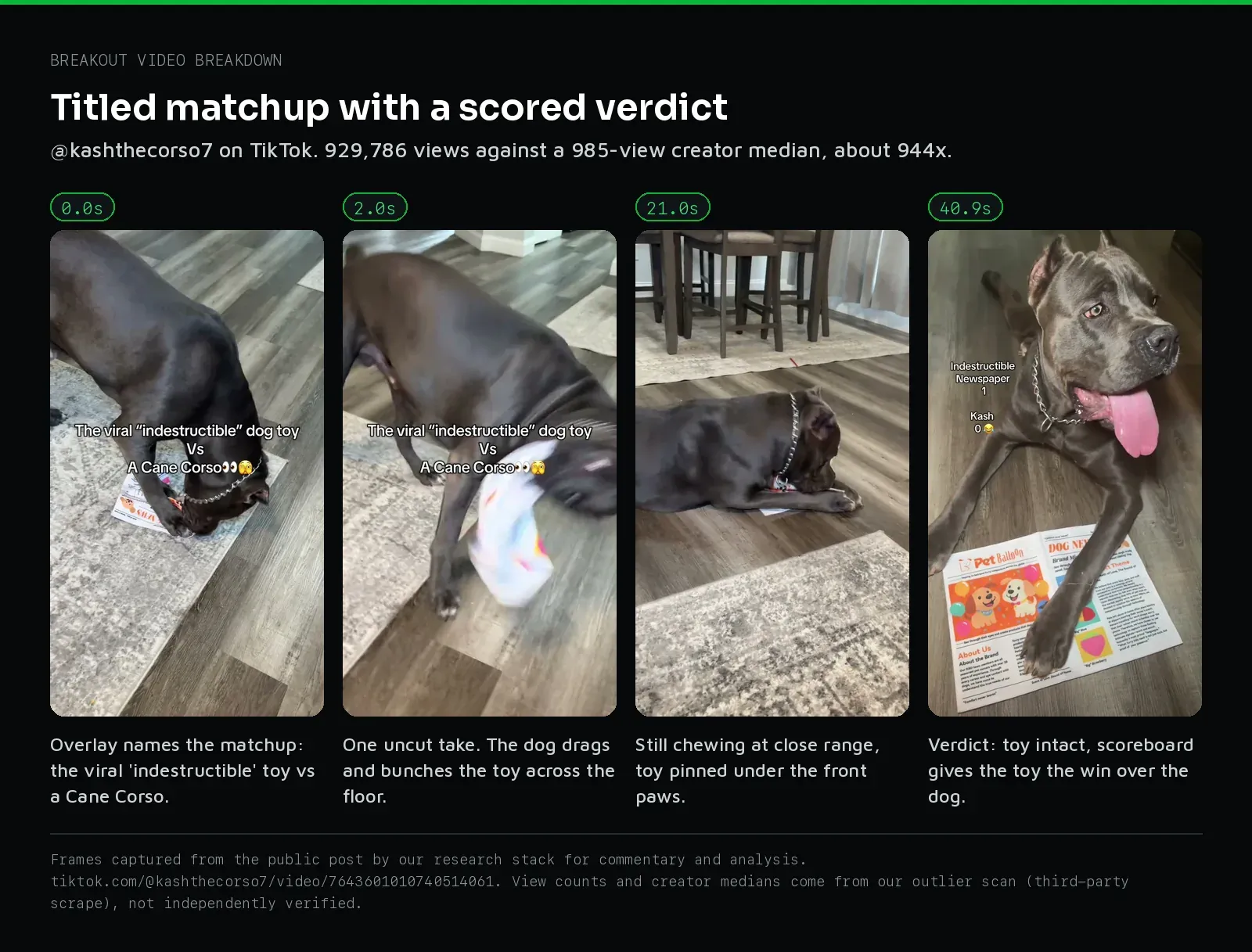
In our dog chew research, the standout was a real post from @kashthecorso7. It hit 929,786 views for a creator whose median post gets 985 views, about 944x.
The execution is a Cane Corso chewing and dragging a newspaper-print plush toy in one uncut take. If you copy the execution, you just point a camera at a dog.
The mechanic is a titled matchup with a scoreboard. The overlay reads "The viral 'indestructible' dog toy Vs A Cane Corso." The video names a contested claim in the title, runs one uninterrupted take as the test, and closes on a scoreboard overlay: "Indestructible Newspaper 1 / Kash 0." The open loop is precise, and the scoreboard gives a clear resolution moment worth watching to.
Example 2: The effort-collapse-reframe mechanic
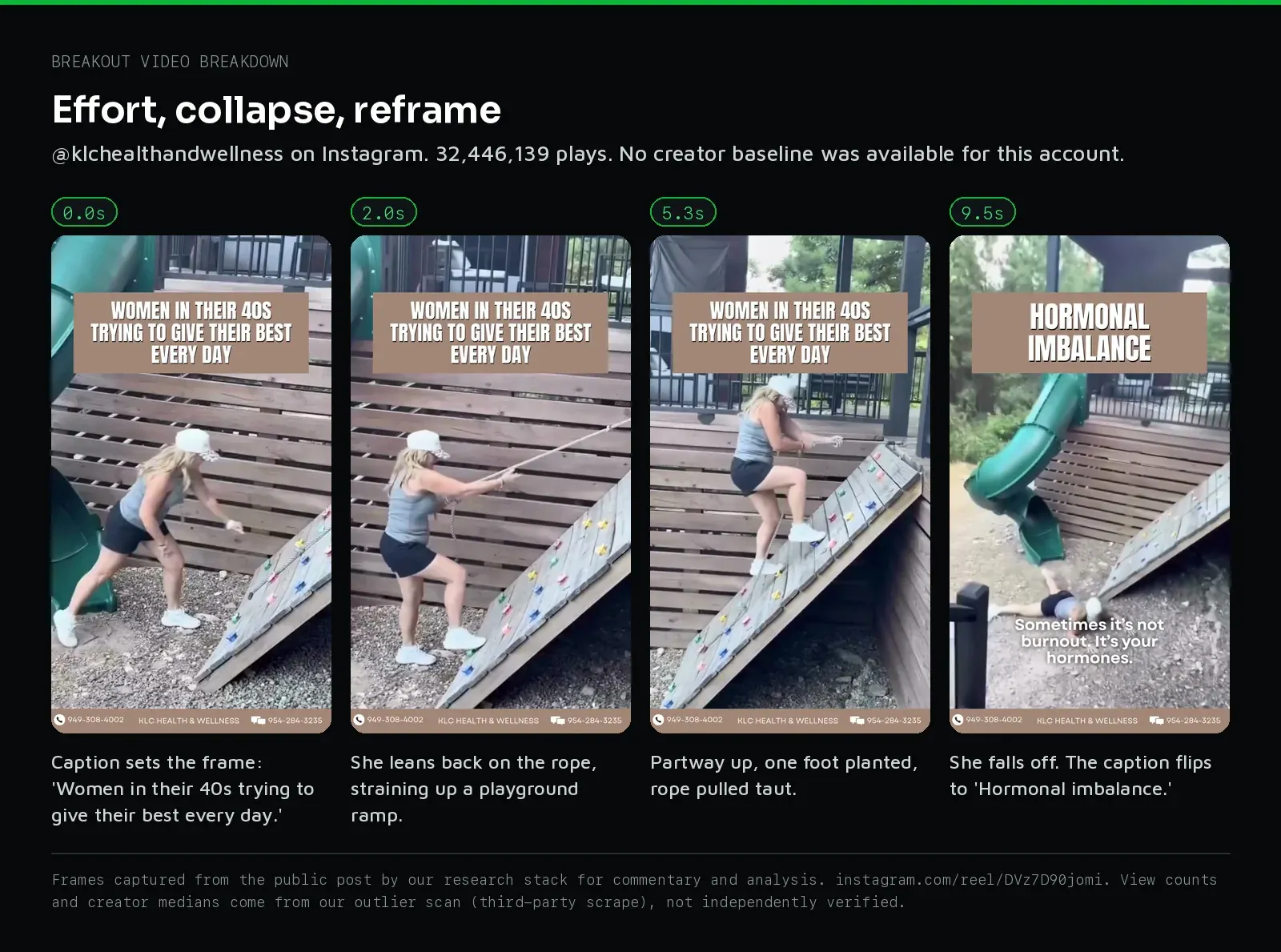
For a women's hormone wellness brand, we looked at an Instagram reel from @klchealthandwellness that pulled 32.4 million plays.
The execution is a woman pulling herself up a playground rope-climb ramp. She strains, and at around nine and a half seconds she falls off. The caption flips to "HORMONAL IMBALANCE," with the subtext "Sometimes it's not burnout. It's your hormones."
The mechanic is effort, then visible collapse. The caption pivots at the moment of failure, reframing a self-blamed struggle (physical weakness) as a question worth taking to a qualified professional (hormonal imbalance). The struggle builds anticipation, and the fall works as a wordless argument no caption has to prove.
Example 3: The invisible object proxy motion
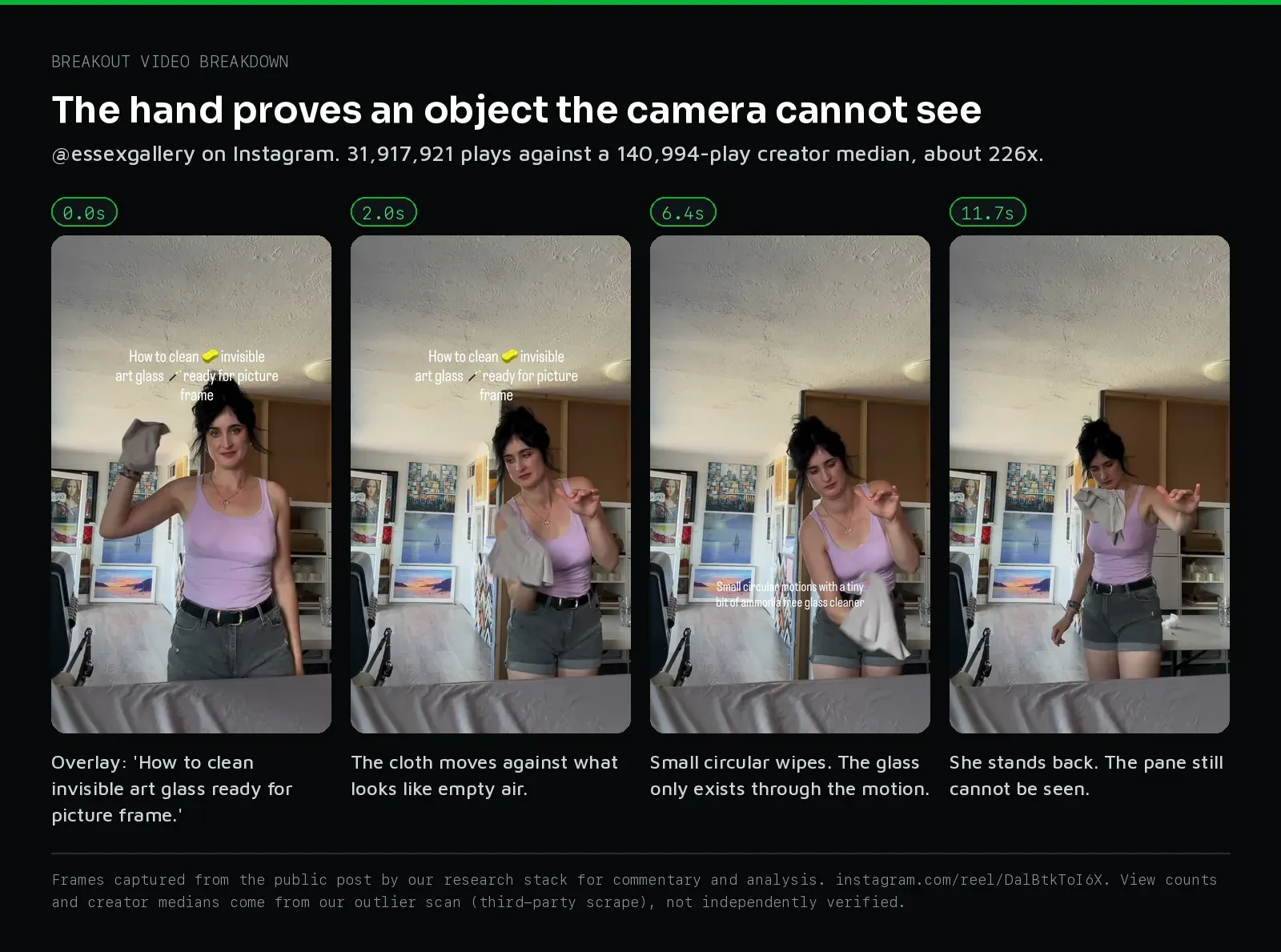
In research for a custom picture frame company, we found an Instagram reel by @essexgallery titled "How to clean invisible art glass ready for picture frame." It pulled 31.9 million plays against a creator median of 140,994, about 226x.
The execution is a cloth wiping glass the camera can't see. The mechanic is hand motion against an invisible object. The gap between what the hand is doing and what the eye can resolve creates an open question, and the viewer stays to close it. The hand motion is the only proof the glass exists at all.
A custom picture frame company can borrow this mechanic. It could show hand motion against a bare wall before the frame appears. That's a concept we pitched, not footage that exists. What the brand can't do is copy the video. A stranger cleaning glass does nothing for a frame shop.
The adaptation boundary
The most important rule in this process is the adaptation boundary. What can you borrow as a mechanism, and what has to stay original to the brand?
An outlier ratio is a per-creator signal, not a universal benchmark. A creator with 500 followers getting 10,000 views is a genuine outlier. A creator with 2 million followers getting 50,000 views is a flop. The mechanism is what caused the 500-follower creator to break out.
Once you've extracted that mechanism, ask a hard question: does our product genuinely support this mechanic?
If the answer is "sort of, if the creator performs it right," the mechanic won't transfer. The product has to actually do the thing the mechanic requires. For the scored matchup to work, your dog toy has to survive the session. For the effort-collapse reframe to work, your wellness program has to address the underlying cause of the struggle.
A practical test you can run
You can run this on your own category this week.
Step 1: Find the true outliers. Don't start at the top of the feed by absolute views. Find creators in your niche with small-to-medium followings, somewhere between 1,000 and 100,000 followers. Look for the single video in their history with 10x to 50x their normal views. That ratio is the signal.
Step 2: Name the mechanic. Ignore the product for a minute. Describe the structural driver in one sentence. Is it a withheld-identity cold open where the product isn't labeled until the final frame? A macro texture-destruction hook where the demolition is the visual payoff? A blind ranking where the viewer expects one winner and gets another? Write it in plain language before you think about your product.
Step 3: Ask the transfer question. Does your product genuinely, physically support this mechanic? If it requires a visible destruction test, can your product pass one? If it requires a before-and-after shift, is that shift filmable in one take? If the answer is "sort of, if we set up the shot carefully," it won't transfer cleanly.
Step 4: Brief the mechanism, not the execution. Don't attach the outlier video and say "do something like this." Describe the mechanism in plain language. Tell the creator to run a scored matchup between your product and the buyer's biggest fear. Tell them to name the thing stopping the sale in frame one and then prove it wrong without narration. Then let them execute it in their own setting and voice. That's how you get a native-feeling video instead of a knock-off. I walk through the full format in how to brief a creator video for your product.
Step 5: Judge mechanism completion before engagement. When the footage comes back, your first question is whether the mechanic actually completed. Did the video hold the withheld product to the final frame? Did the scoreboard appear at the end? Did the effort-collapse look real? If the mechanism didn't fire, the video won't work no matter how good the creator looks on screen.
What counts as a genuine outlier
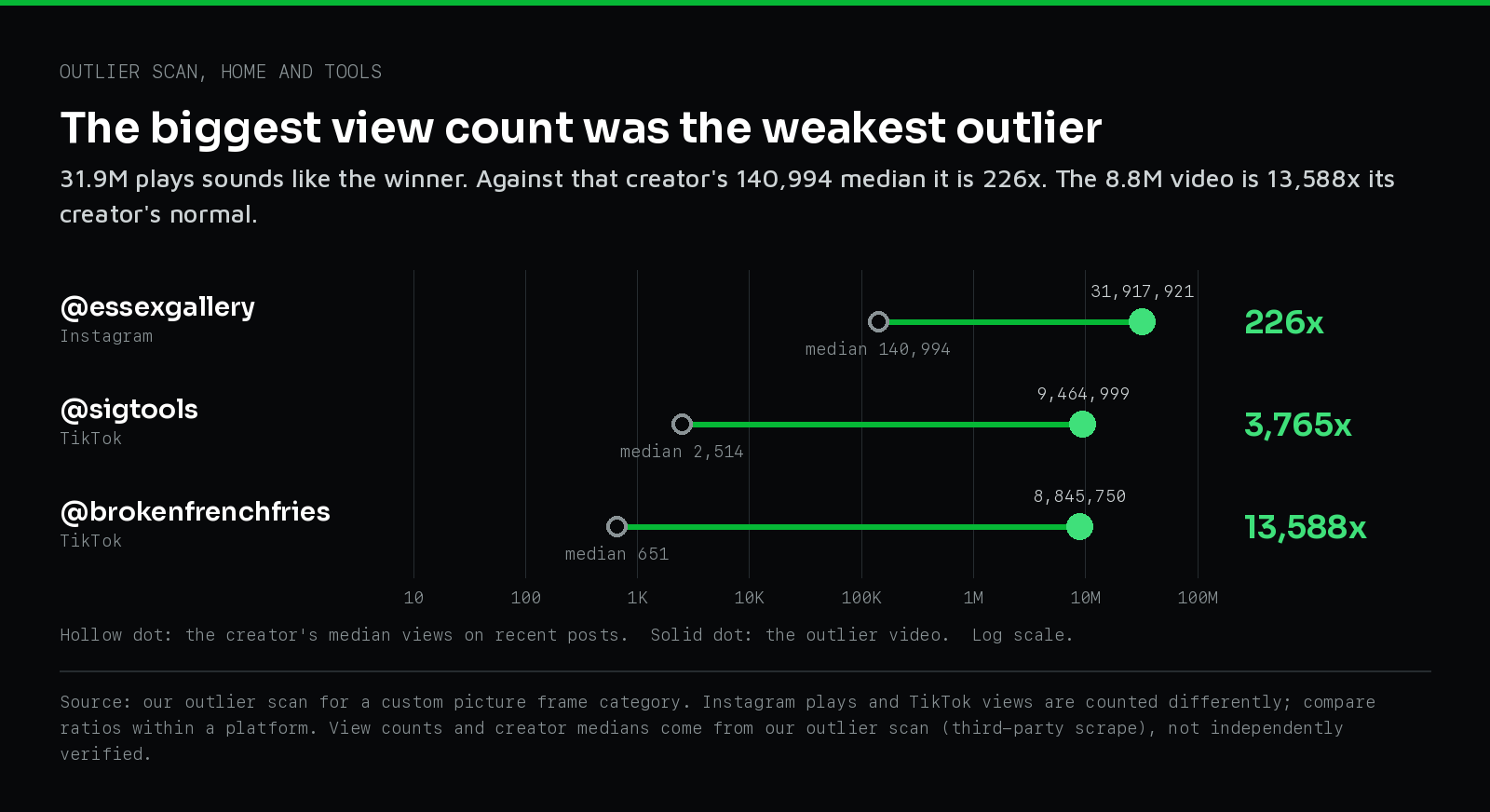
This comes up constantly, so I want to be clear. The outlier ratio is a per-creator metric, not a category average, and a huge raw view count doesn't automatically mean a huge multiple.
If you pull a TikTok with 2.2 million views and assume it's a category outlier, you may be wrong. The creator might have 10 million followers and usually get 3 million views per video. That 2.2 million view video is actually underperforming.
The @essexgallery reel is the clearest example. It pulled 31.9 million plays, one of the biggest raw numbers in our scan, but that creator's median is already 140,994 plays. The multiple works out to about 226x, the weakest outlier in the set. Compare a picture-hanging tool video from @brokenfrenchfries: 8.8 million views against a median of 651, about 13,588x. The smaller video is the bigger outlier. Raw reach tells you what got seen. The ratio tells you what actually broke pattern for that creator.
One more caution: TikTok views and Instagram reel plays are counted differently. Only compare ratios within the same platform.
What makes the test fail
This test fails when you flinch.
It fails when you brief a destroy-the-object proof, then tell the creator to keep the logo perfectly lit the whole time. A credible test turns into an obvious commercial.
It fails when you brief a scored matchup, then get nervous about naming a real opponent and compare your product to "other leading brands." That removes all the tension. Specificity is what makes the mechanic work. "Toy number five this month" beats "other toys that didn't survive."
It fails when you forget you're borrowing a psychological lever, not a shot list. The lever is the open loop created by a named doubt and a visible resolution. Strip the doubt and there's no open loop. Hide the resolution and there's no payoff. If your product is hard to make visual in the first place, start with creator formats that work for boring products.