To brief a creator for a product video, start with the buyer's doubt, not the product's feature. Name the doubt, then have the creator show the feature resolving it in a way the viewer can see with their own eyes, not just hear described.
I broke down outlier creator videos frame by frame across several product categories while mapping what actually drives creative performance for niche brands. The pattern was frustrating. Most operators who brief a creator just send a feature list and a link to their product page. The creator reads it, paraphrases the marketing copy, and the video sounds exactly like every other ad in the category.
You pay for the video. You run it as an ad. It doesn't convert. The dashboard shows a high skip rate and zero purchases.
You have a product with a specific feature that makes it better than the competition, and you need the buyer to understand that feature immediately. But when you ask a creator to explain the feature, the viewer swipes away because they can smell a pitch in the first second. Across every category I analyzed, the briefs that produce watchable videos start from the doubt. The feature is the answer. Breakout content isn't being driven by polished aspiration. It's being driven by surprisingly credible delivery.
Start with the doubt, not the feature
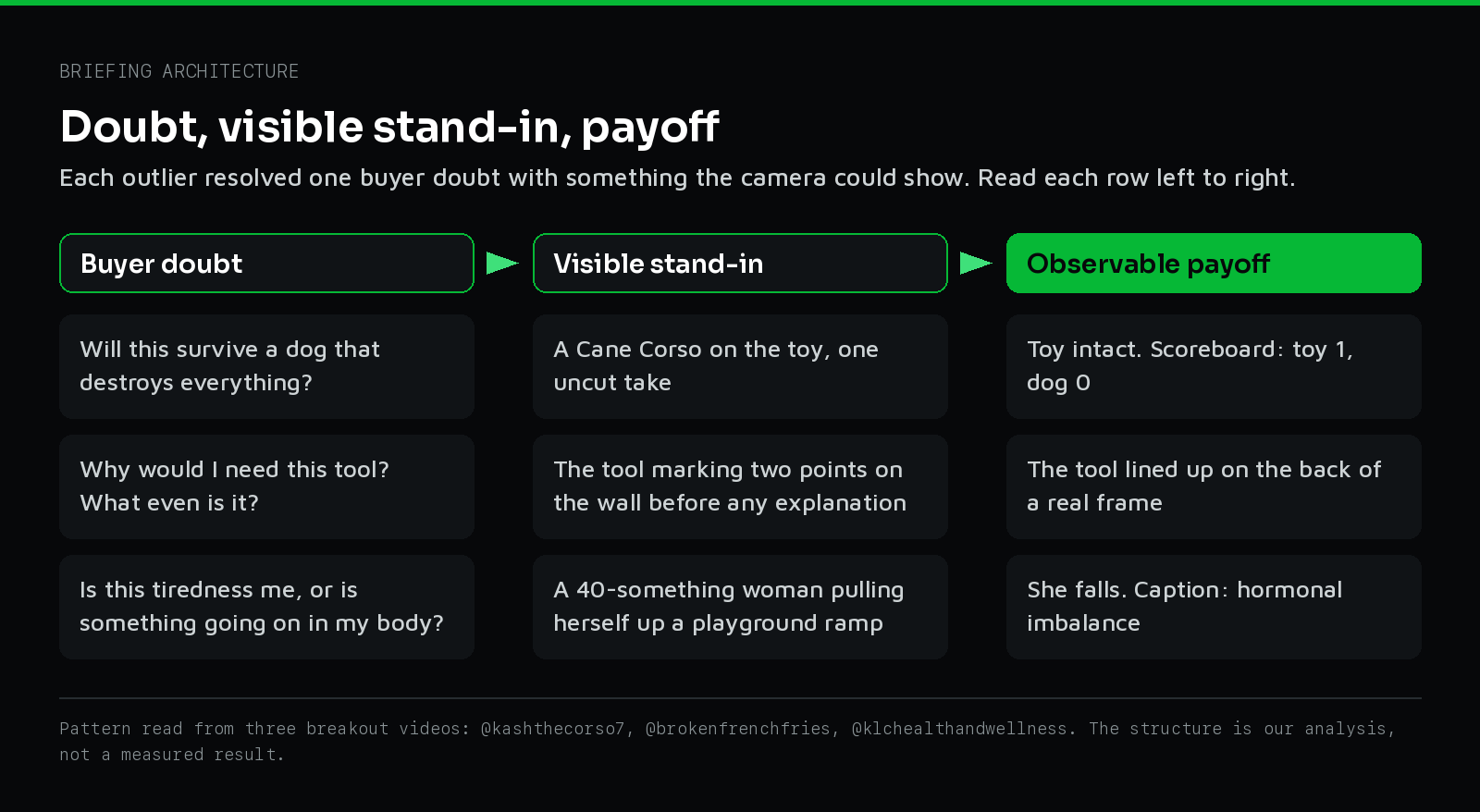
When you lead with a feature, you ask the viewer to care about your product. When you lead with their doubt, you validate a suspicion they already hold.
If you sell a heavy-duty dog chew, the feature is the dense nylon material. The buyer's doubt is the uncertainty that the chew will actually last with their destructive dog. They've bought toys before. The toys have shattered. They don't believe durability claims anymore.
If your brief tells the creator to talk about the premium nylon, you get a boring video. If your brief tells the creator to physically cut the chew apart to show how it wears down safely, you get a watchable demonstration of proof.
That doubt-first brief is the starting point for every creative system we build for niche brands.
Next step
Get creator videos built around the doubt your buyer already has.
See how we build creative systems for niche brandsEvidence from the feed
I tracked this pattern across multiple brand categories. The winners all anchor on a specific visual proof that targets a stated doubt.
1. The titled matchup with a scored verdict
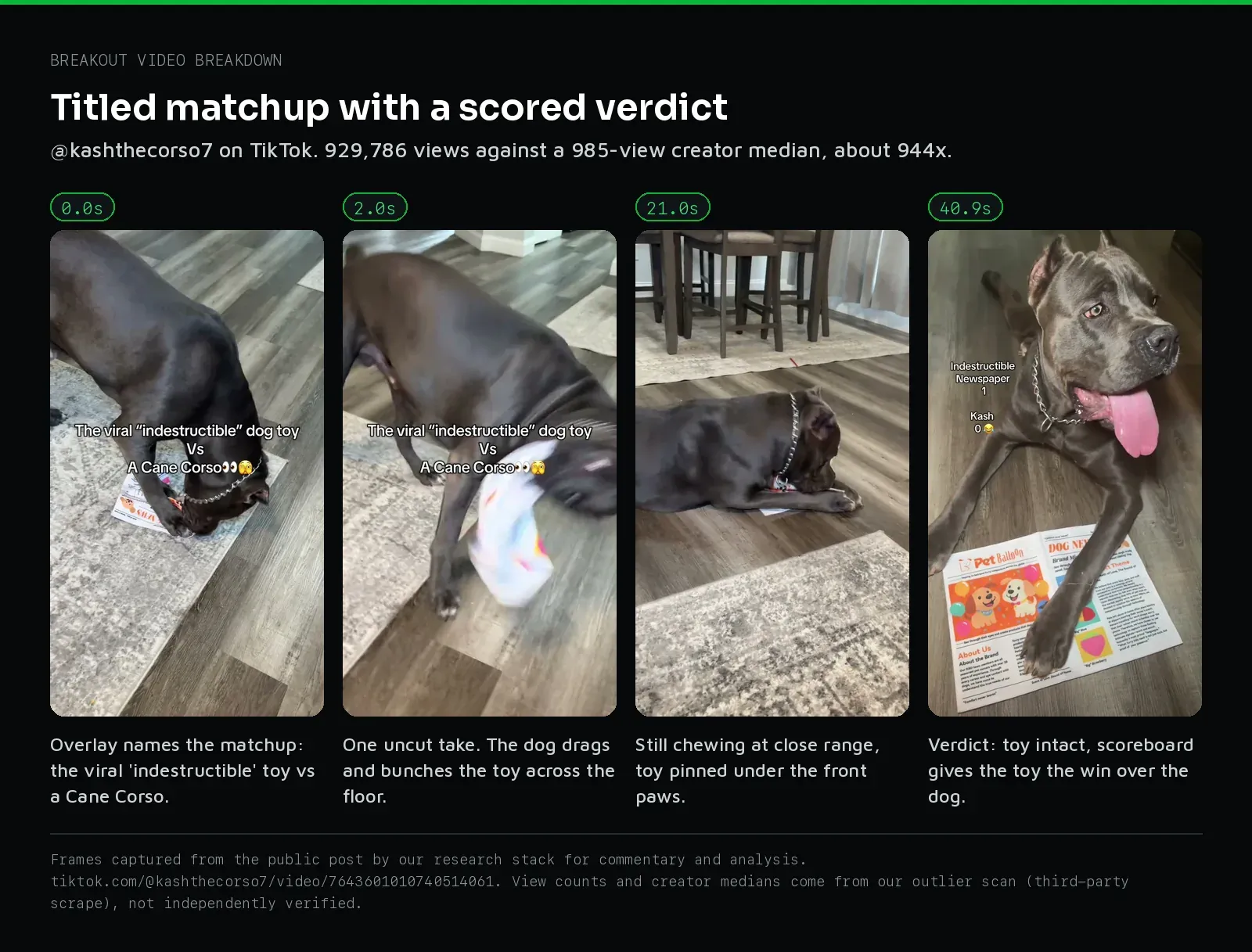
A video from creator @kashthecorso7 puts a name on the doubt in the opening overlay: "The viral 'indestructible' dog toy Vs A Cane Corso." The creator doesn't need to list product features. It's one uncut take of a Cane Corso chewing and dragging the toy, ending at about 41 seconds with the toy intact under the dog's paws and a scoreboard overlay: "Indestructible Newspaper 1 / Kash 0."
A Cane Corso is a power breed, so viewers already have a stake in the matchup before anything happens. My read is that the scoreboard made a non-event legible as a result. The video went to 929,786 views against a creator median of 985, about 944x. The product surviving was the payoff to the doubt stated in the first frame.
2. The destroy-the-object proof
Here's a concept I'd pitch for a dog chew brand: the "Chew Autopsy." It's untested, adapted from the same matchup instinct that made the @kashthecorso7 video work. The idea is that a creator takes a well-worn chew and saws it in half on camera on a cutting board.
The doubt is that owners can't tell whether a chew is being safely worn down or splintering into dangerous pieces. The visual proof would be holding the cross-section to the lens. The wear pattern itself becomes the evidence. You wouldn't need to claim the product is safe. The debris and the solid interior prove it. This is a brief idea, not a video that exists yet, but it puts the proof right in front of the lens.
3. Proof first, reason last
For a custom picture frame company, the buyer's doubt is that they can't tell a good frame from a cheap one in a photo. They buy a cheap frame, and their gallery wall looks wrong.
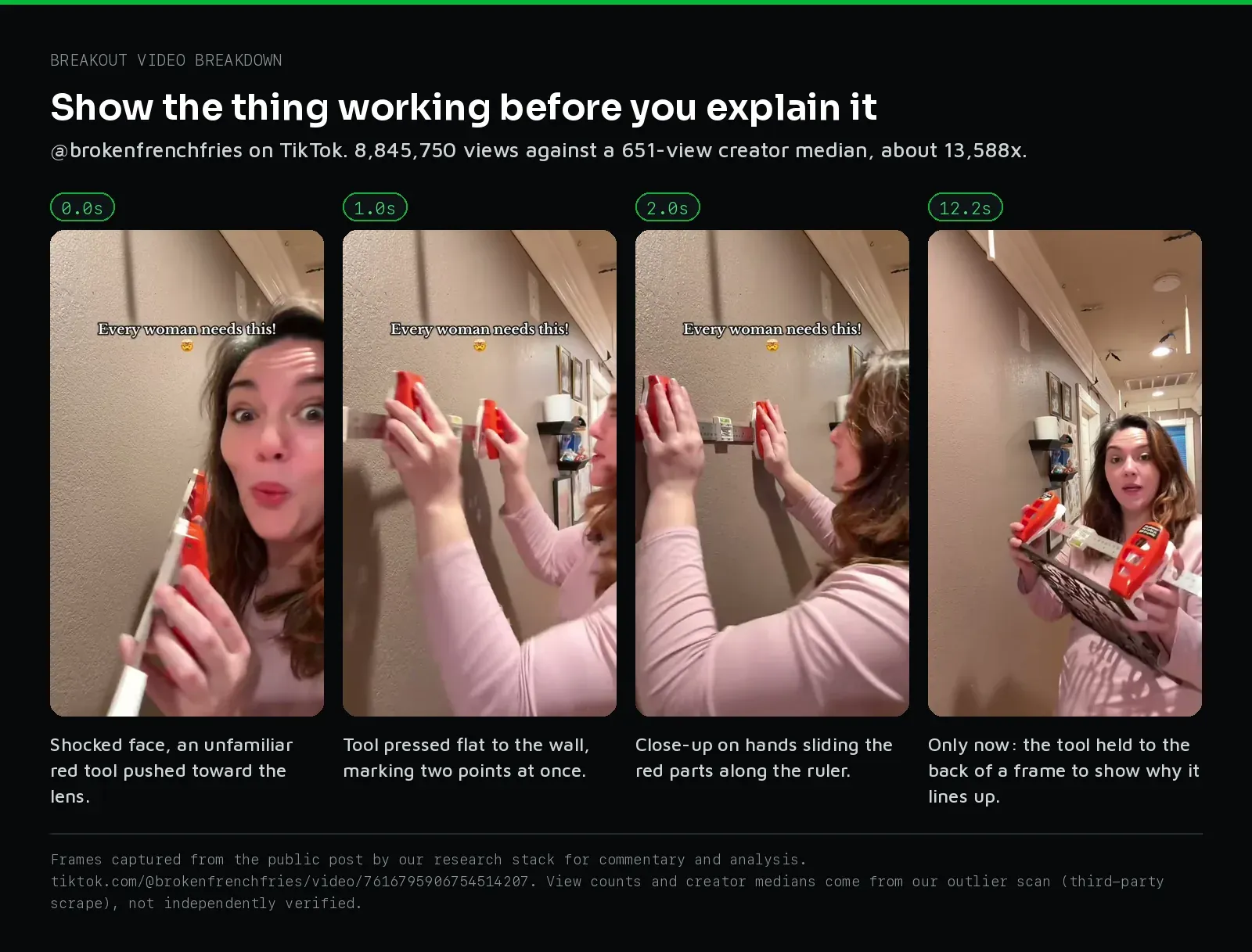
A real video from creator @brokenfrenchfries shows the mechanic. She has a shocked look on her face and presses an unfamiliar red picture-hanging tool to the wall, marking two points at once, then slides its parts along a ruler. She only holds it to the back of a frame to show why it lines up about 12 seconds in, then explains it to camera. This is "proof first, reason last": the video went to 8.8M views, about 13,588x her median.
When you show the unfamiliar thing working before you explain it, you buy the time needed to explain the feature. The viewer stays to find out what they just watched. Map that same pattern to a finished, straight gallery wall, and the effect holds: show the result before the reasoning.
4. Effort, collapse, reframe
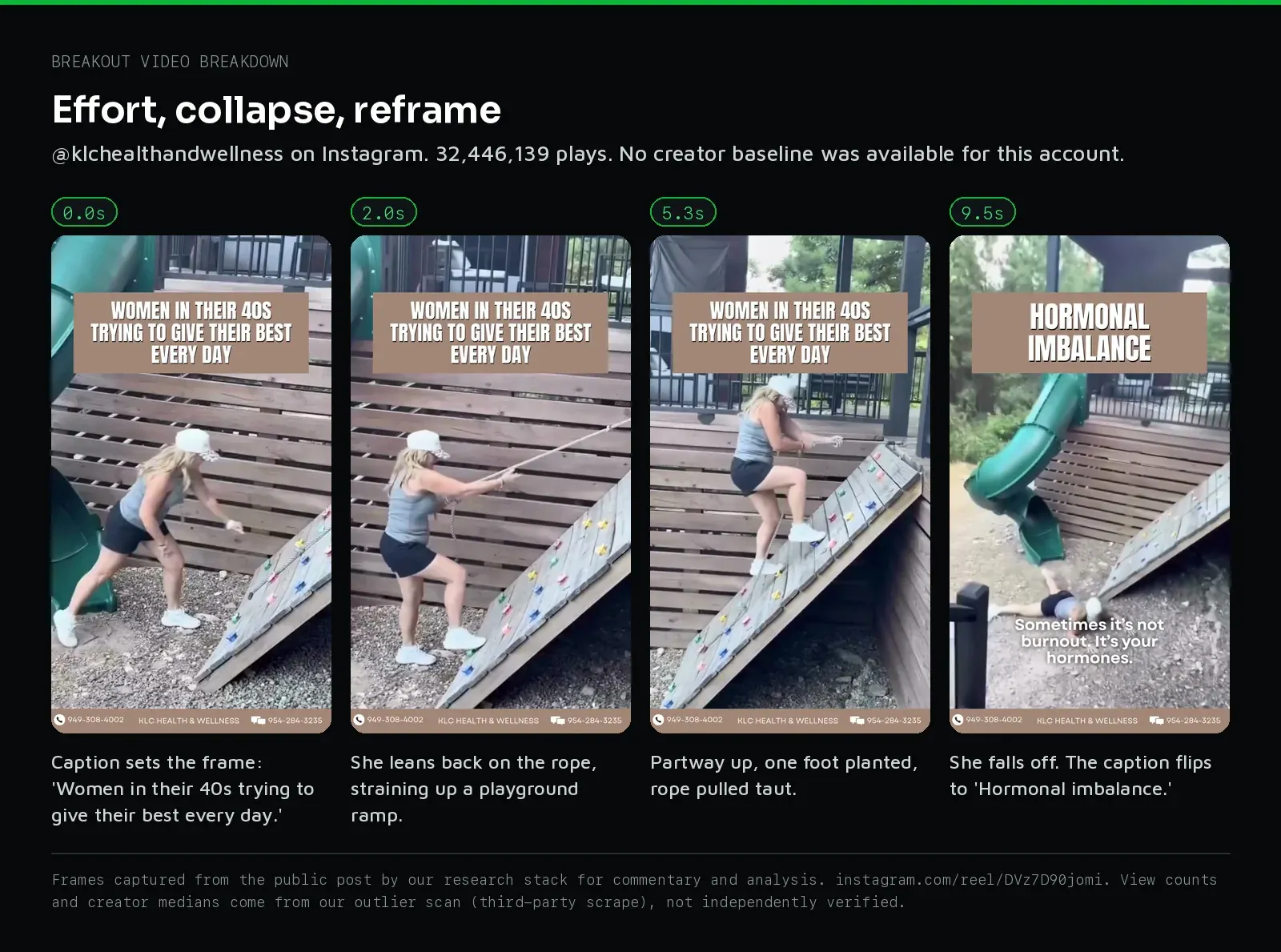
For a women's hormone wellness brand, the doubt is that natural supplements can actually move hormones. A reel from @klchealthandwellness, captioned "Women in their 40s trying to give their best every day," opens with a woman pulling herself up a playground rope-climb ramp. She strains, and at about 9.5 seconds she falls off. The caption then flips to "HORMONAL IMBALANCE," with the subtext: "Sometimes it's not burnout. It's your hormones." The reel went to 32.4M plays.
The familiar task fails visibly. The caption reframes the failure as a body signal. The doubt is named. The viewer who blames themselves for being tired or weak suddenly has a new lens to view their problem. In a brief for a brand, that is the moment the product enters, as the answer to the specific struggle they just watched.
The adaptation boundary
You can borrow these mechanics. You can't borrow the exact scripts.
The adaptation boundary defines what transfers across categories and what must stay original to your brand. The transferable unit is the mechanic. The withheld-identity cold open works whether you are selling a dog chew or a picture frame. The destroy-the-object proof works for anything durable. The proof-first, reason-last structure works for any visual transformation.
What must stay original is the specific doubt your buyer holds. You can't invent a doubt. You have to pull it from your support tickets, sales calls and reviews.
If you use a titled matchup with a scored verdict, the opponent has to be the exact thing your buyer hates. If you use the invisible object proxy motion, the hand gesture has to map to how your product is actually used. Don't just copy a viral format and paste your product into it. Map the mechanic to your buyer's specific tension.
A practical test you can run
You can test this approach with your next creator brief. Stop asking for a 30-second product review. Brief a skeptic-reversal diary instead.
- Identify the doubt. Write down the number one reason people hesitate to buy your product.
- Design the proof. Ask yourself what physical action would prove that doubt wrong in three seconds.
- Write the hook. Draft a single caption that states the doubt openly.
- Send the brief. Ask the creator to film the proof and read the hook. Don't give them a script for the rest of the video. Let them explain what happened in their own words.
Run this test with three creators. Give each creator two hook variations. Keep the product call-to-action identical across all of them. Publish them and watch the retention graphs. You are looking for the moment the viewer understands the proof.
What would make the test fail
This test will fail if you don't actually prove the claim visibly. If the creator just holds the product and talks about how they used to be skeptical, you have changed nothing. The doubt must be resolved on camera.
It will also fail if you soften the hook. Brands get nervous when a creator says something negative in the first second. They ask the creator to smile more or sound more enthusiastic. When you do that, you destroy the credibility of the setup. The creator must sound like a practical skeptic, not a paid spokesperson.
Finally, the test will fail if the visual proof is confusing. If the viewer has to read a paragraph of text to understand what the creator is demonstrating, they will scroll away. The physical action must be self-explanatory. The cross-section of the dog chew makes sense instantly. The straight picture frames make sense instantly.
Stop briefing features. Start briefing doubts. Your creators will make better videos, and your buyers will finally understand why your product matters.
---