Write the brief around the one doubt that stops your buyer from purchasing, not around the product category. Name the visual proof that answers that doubt, give the creator a premise, and leave the ending open, so they test the product on camera instead of pitching it.
I got here by breaking down outlier videos frame by frame across several product categories, roughly a dozen per category scan. Most creator briefs lead with the product category, the SKU, a bulleted feature list, and a tone-of-voice guide. The creator reads that, sets up the camera, and makes a product video.
That brief puts the creator in the position of a spokesperson. They aren't a problem-solver or a skeptic. They're a salesperson, so the video sounds like an ad. The hook feels contrived, the feature callouts feel rehearsed, and the call to action feels forced.
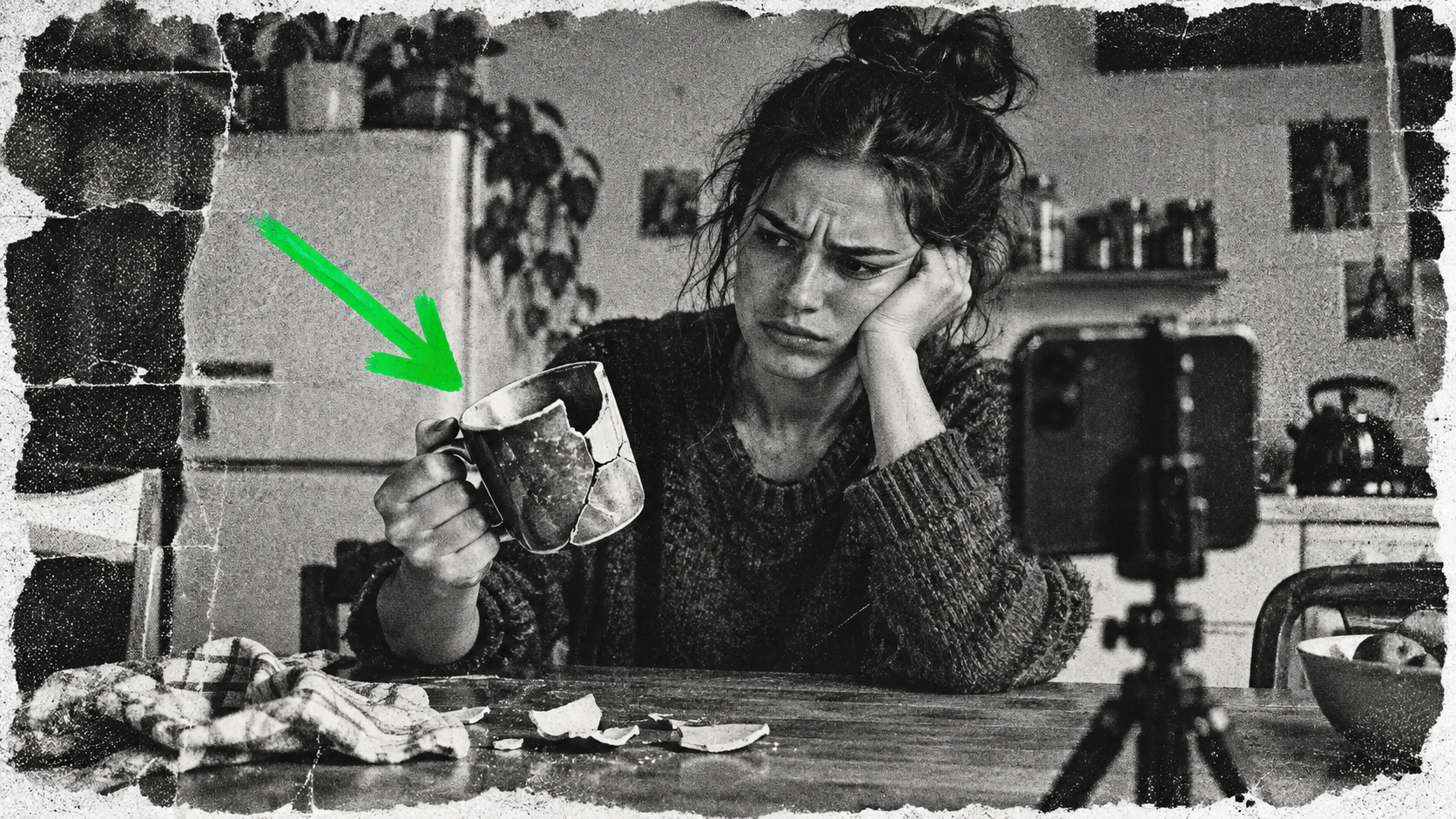
The minority of videos that drove sustained conversion had a different structure. They didn't start with the product. They started with a question. The creator was an investigator: they had a specific doubt, ran a test, and reported the outcome. They weren't selling on behalf of the brand. They were resolving a question on camera for the viewer.
The problem with product-first briefs
If you run a niche business or manage growth for a specific product, you're solving a trust problem. Buyers are skeptical of paid social and creator content. They know when they're being pitched.
When you hand a creator a brief that says "Highlight our proprietary technology and premium materials," you're telling them to pitch. They have to bridge the gap between their natural persona and your messaging, and they usually do it by getting overly enthusiastic and reading your talking points. The viewer hears the cadence of an ad and scrolls.
You don't need another spokesperson. You need a witness: someone who can show that the product does what it claims. To get that, you have to change the input you give the creator. This doubt-first brief is how we build creative systems for niche brands that have to earn trust before they sell.
Next step
Get creator videos built around the doubt your buyer already has.
See how we build creative systems for niche brandsThe mechanism: organize around the doubt
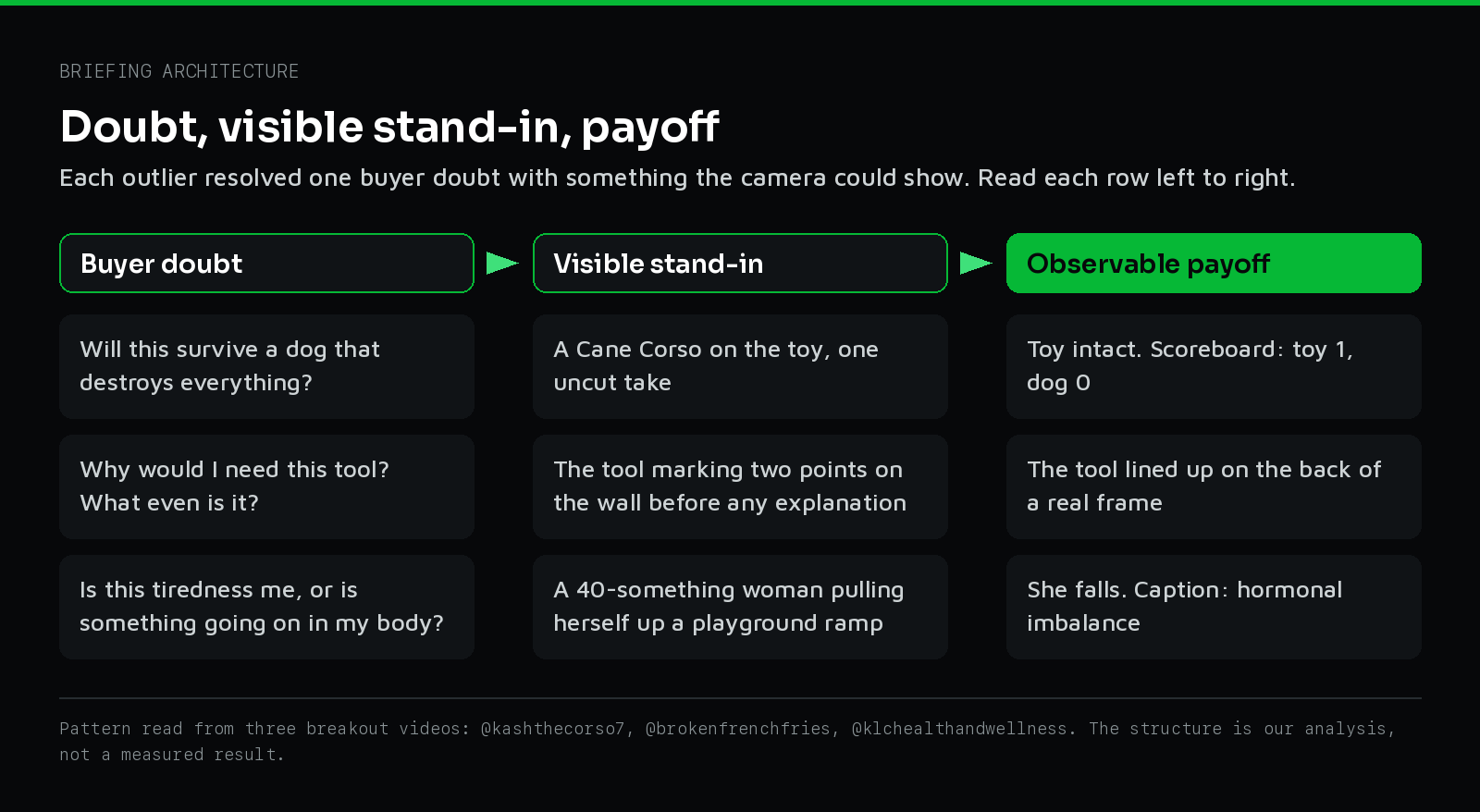
A brief organized around the buyer's doubt puts the creator in the position of someone who had that same doubt, tested the product, and found out what happened.
That's a structural rewrite of the assignment, not a wording change. The video follows a simple arc: here's the hypothesis, here's the experiment, here are the results. That format is native to social platforms. It holds attention because the viewer wants to know how the test resolves. They aren't waiting for the pitch to end. They're waiting for the proof.
How to restructure your next brief
Here's how I'd rewrite a product-first brief. If you want the full brief template beyond the doubt, I've laid it out in how to brief a creator video for your product.
1. Lead with the primary doubt, not the product name Instead of opening with "This campaign is for our new line of durable gear," open with the exact skepticism your best buyers have before they purchase. For example: "People think all gear in this category falls apart after one month of heavy use. We need you to test if that's true for this item."
2. Describe the physical proof the product provides Don't list features. List the observable evidence that proves the product works. If your product is waterproof, don't write "highlight the waterproof membrane." Write "show water beading off the surface and leaving a bone-dry interior." Give the creator the visual requirement, not the technical spec.
3. Give the creator the opening premise Give them a framing device, not a script. The premise gives the creator a reason to be filming in the first place. Tell them the scenario, and let them choose the words.
4. Leave the conclusion open Let the creator be the witness, not the advocate. Don't mandate "This is the best product I've ever used." Ask them to describe what happened during the test and what surprised them. Viewers trust a hesitant, measured approval far more than a loud guarantee.
Three examples of doubt-based briefs
Here's how the shift changes the brief across three categories.
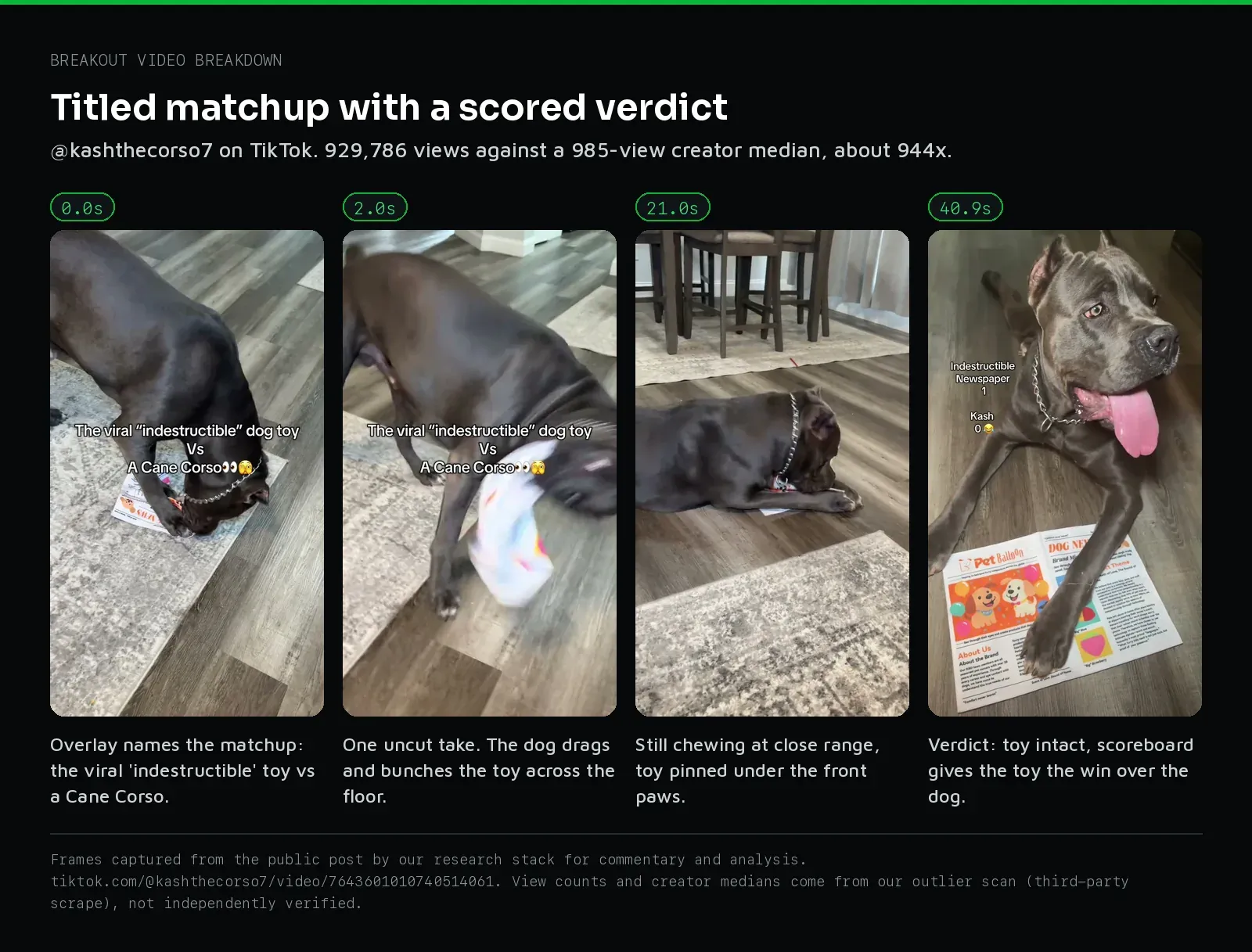
For a dog chew brand * The old way: "Highlight our durable nylon material and bacon flavor." * The doubt: "Will this actually hold up to an aggressive chewer, or will it be destroyed in ten minutes?" * The proof: One concept worth briefing: score the chew against the dog's own history, top-down shot, the chew still whole under the dog's paws, closing on a caption like "Toy #5 this month." The scoring structure borrows from a real video, @kashthecorso7's TikTok, where a Cane Corso chews and drags a third-party toy for one uncut take that ends on a scoreboard overlay giving the toy the win. That video hit 929,786 views, about 944x the creator's median. * The premise: "Test this against your dog's previous record for destroying a toy."
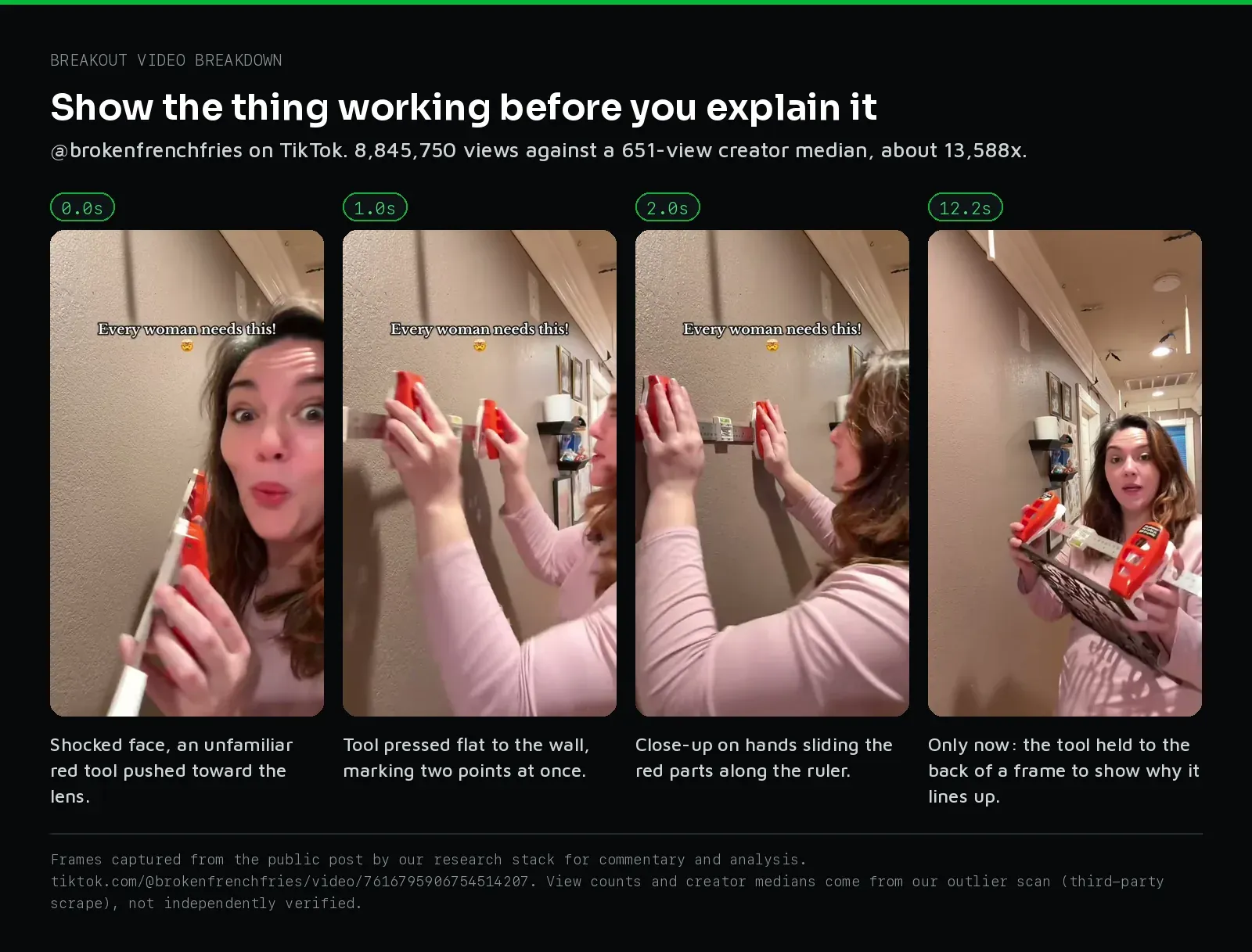
For a premium picture frame brand * The old way: "Talk about our magnetic mounting system and premium finishes." * The doubt: "Will these actually hang straight without me having to hire help or use a laser level?" * The proof: A concept worth testing: show six frames already hung straight in one continuous shot, then reveal the single tool used only at the end. It's adapted from a real video, @brokenfrenchfries's TikTok, where an unfamiliar hanging tool is pressed to the wall and shown working before anyone explains what it is. That video hit 8.8 million views, about 13,588x the creator's median. * The premise: "Show the flawless result first, then reveal the single tool you didn't need to use."
For a performance sleep brand * The old way: "Mention our breathable fabric and ergonomic support layers." * The doubt: "Sleep gear is just expensive marketing, a different pillow won't change how I feel tomorrow." * The proof: An untested idea for this category: have the creator track one measurable metric, like sleep-tracking data or morning energy, over a set period and report what changed. I haven't seen this pattern proven in a real video yet, so treat it as a hypothesis to test, not a result to expect. * The premise: "Track one specific metric for one week with your current setup, then swap to this and report the difference."
What to borrow and what to keep original
When you apply this to your own brand, there's a clear line between what you borrow and what has to stay yours.
Borrow the mechanism. Structuring a brief around a skeptical question and a physical test works for software, physical goods, and services. You can lift the four-step structure as is.
The visual proof has to stay original. You can't fake the evidence. If you adapt the picture frame premise but your product still needs a laser level, the video fails. The proof has to match what your product can actually do. If it can't survive a stress test on camera, don't build the brief around a stress test. Find the doubt your product actually resolves.
A practical test you can run this week
You don't need a big budget to test this. If you have an upcoming creator round, split the brief.
Give half your creators the standard product-first document. Give the other half a one-page brief built around the primary buyer doubt and the required visual proof. Give them the premise, but don't give them a script.
When the videos come back, watch them side by side. The standard brief tends to produce a slick, slightly unnatural pitch. The doubt-based brief tends to produce a grounded, documentary-style evaluation. Run both in your ad accounts and measure which one holds retention past the first three seconds and drives actual pipeline.
Why this test might fail
This approach isn't bulletproof. I see it fail in execution three ways.
First, you pick a fake doubt. If you choose a skepticism nobody has because it's easy to disprove, the video feels hollow. "People think our software is too colorful" isn't a real doubt. "People think our software takes three months to implement" is. Name the actual reason people say no.
Second, you script the creator anyway. If you give them a doubt-based premise and then a mandatory script for how to express that doubt, you've killed the format. The creator has to use their own vocabulary.
Third, you don't define the visual proof. If you ask a creator to prove a claim but don't tell them what physical action or visual evidence demonstrates it, they'll default to talking to the camera. Talking isn't proving. The brief has to demand a visual demonstration.
Once you've named the doubt, the next step is getting it on screen fast. I break that down in using the buyer's objection as the opening scene.
---
FAQ
How do I write a UGC creator brief that doesn't sound like an ad?
Start the brief with the one doubt your buyer has before they purchase, not the product features. Then name the visual proof that answers that doubt, give the creator a premise to film, and leave the conclusion open. The creator ends up testing the product on camera instead of pitching it.
What should I include in a creator product brief?
Include four things: the buyer's primary doubt, the physical proof the camera has to capture, an opening premise, and an open ending. Skip the feature list and the tone guide. Tell the creator what the viewer needs to see, not what they need to say.
Why do my creator videos look like ads?
Usually it's the brief. If it leads with features and brand messaging, the creator has no choice but to act as a spokesperson and read your talking points. A brief built around a buyer's doubt turns them into someone running a test, which reads very differently.
Should I give creators a script?
No. Give them a premise and the proof you need on camera, then let them use their own words. A mandatory script kills the thing that makes a doubt-based video work, which is a real reaction to a real test.
How do I test whether a doubt-based brief works better?
Split your next creator round. Half the creators get your usual product-first brief and half get a one-page brief built around the buyer's doubt and the required visual proof. Run both and compare which holds retention past the first three seconds and drives real pipeline.