
Contents
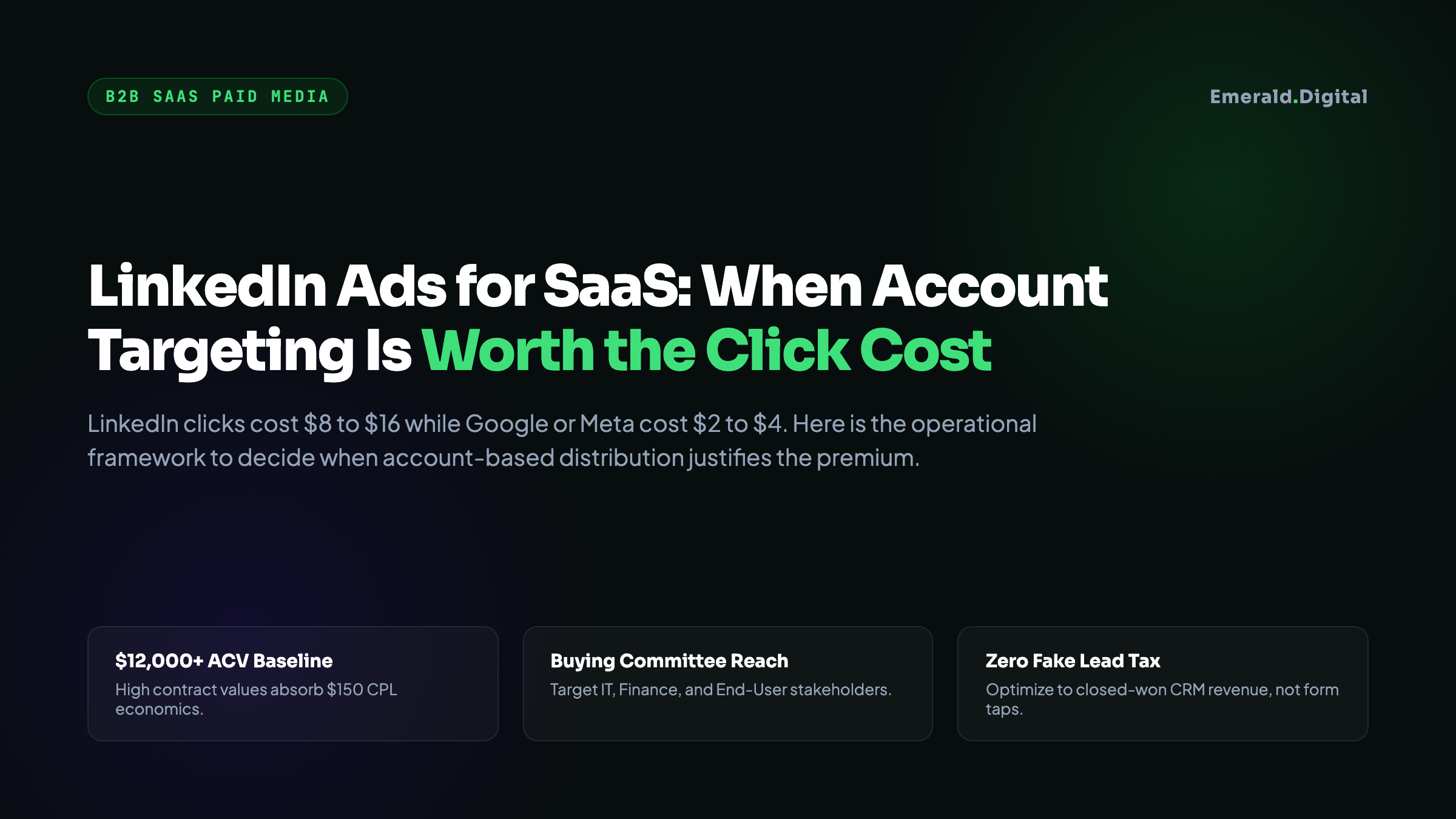
Every B2B SaaS marketing leader eventually faces the same budget debate. A performance media buyer compares channel benchmarks and points out that LinkedIn cost-per-click rates average between $8 and $16, while Meta and Google display deliver clicks for $1.50 to $3.50.
On a spreadsheet that only measures cost-per-click and raw lead volume, LinkedIn looks like an inefficient way to burn capital.
Then you look at the CRM data.
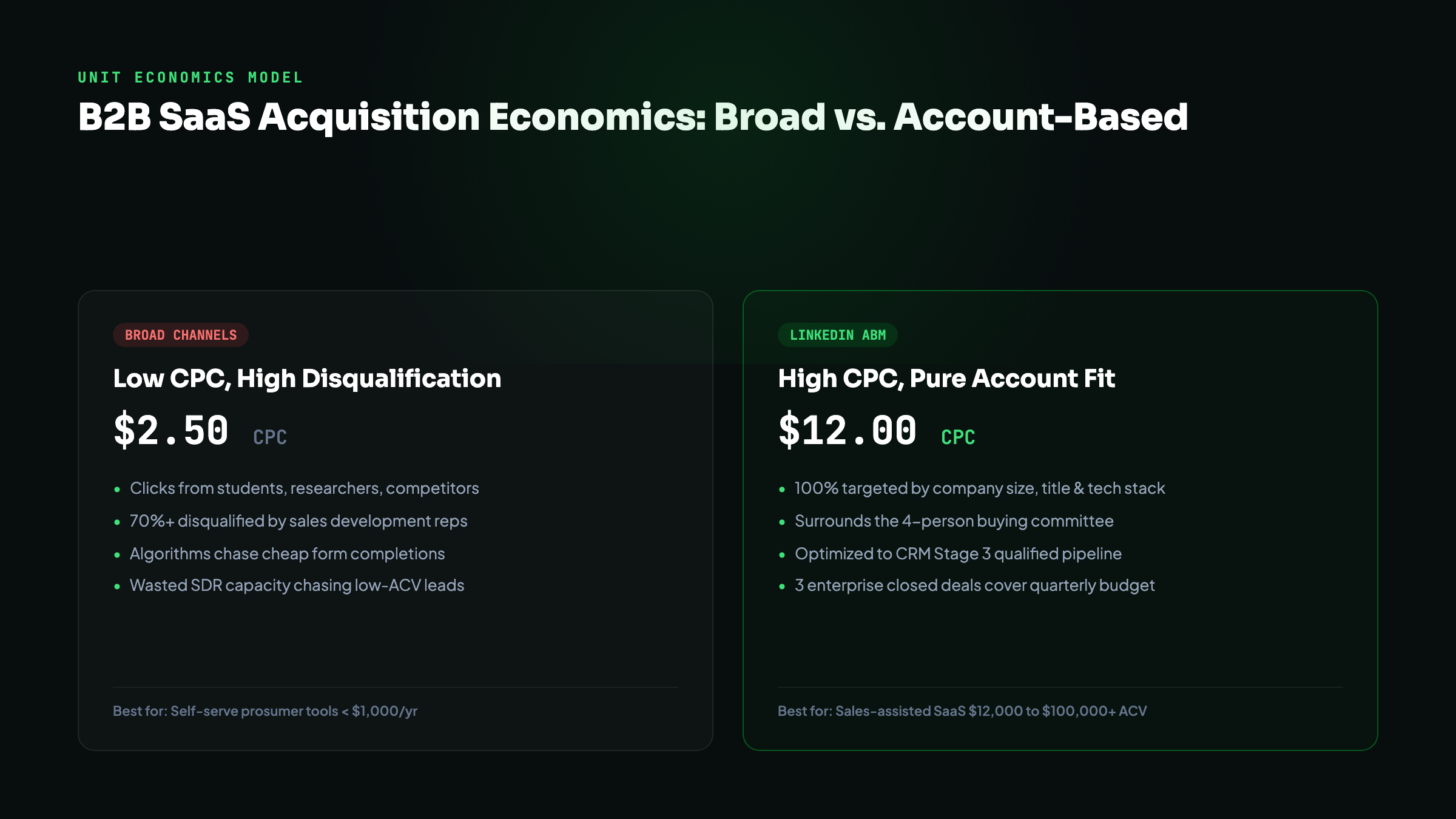
On cheaper broad channels, 70% of your incoming demo requests come from freelancers, students, or companies with three employees who cannot afford your annual contract value (ACV). Your sales development reps spend 20 hours a week wading through disqualified leads, while the enterprise accounts on your target account list have never heard of your brand.
LinkedIn Ads is not a cheap traffic channel. It is an account-based distribution engine. You are not buying clicks; you are paying a premium to guarantee that your message lands exclusively in front of the VP of Engineering, Chief Information Security Officer, or Head of Finance at companies with 250 to 5,000 employees.
The question is never whether LinkedIn clicks are expensive. The question is whether your software economics and sales motion justify the premium.
The unit economics of B2B SaaS LinkedIn Ads
Before spending budget on LinkedIn Campaign Manager, evaluate your software acquisition model against this operational baseline:
1. The $12,000 ACV Threshold
If your product sells for $49 to $200 per month on a self-serve credit card checkout, LinkedIn Ads will almost always fail to generate a positive payback period. When your cost-per-lead averages $120 to $250, and only 10% to 15% of those leads convert to paid accounts, your Customer Acquisition Cost (CAC) quickly exceeds the lifetime value of the customer.
Self-serve products belong on high-intent search, organic content, and conversion-optimized landing pages. LinkedIn Ads earns its keep when your deal size exceeds $12,000 to $50,000+ per year, where acquiring three new logos pays for the entire quarter's ad spend.
2. Multi-Stakeholder Buying Committees
In enterprise B2B SaaS, a single individual rarely swipes a corporate card to buy your platform. An enterprise deal involves:
- The End User (evaluates daily workflow usability).
- The Department Head (manages operational budget and team KPIs).
- The Security or IT Lead (demands SOC 2 compliance, SSO, and data encryption).
- The Finance Lead (audits payback period and contractual terms).
LinkedIn is the only ad network that allows you to target all four stakeholders within the same 500 target accounts simultaneously, serving tailored messaging to each role across the sales cycle.
The LinkedIn Ads qualification scorecard
Use this scorecard before launching a dedicated LinkedIn paid program:
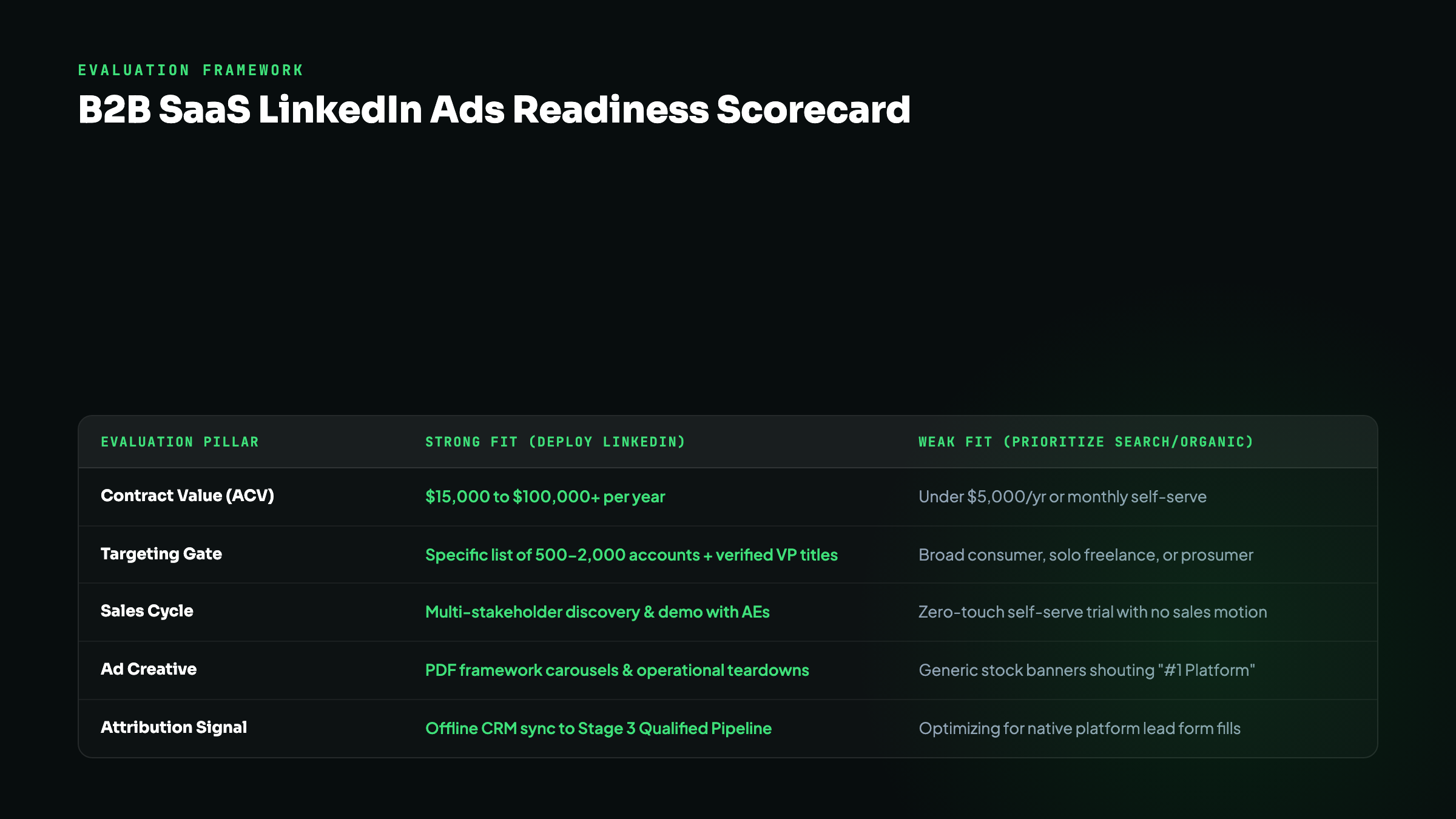
| Evaluation Pillar | Strong Fit for LinkedIn Ads | Weak Fit (Explore Other Channels First) |
|---|---|---|
| Annual Contract Value | $15,000 to $100,000+ ACV | Under $5,000 ACV or monthly self-serve pricing |
| Target Audience Definition | Verified target account list or strict firmographic gates (industry, headcount, seniority) | Broad consumer audience, prosumers, or early solopreneurs |
| Sales Process | Sales-assisted demo and discovery motion with dedicated AE follow-up | Pure zero-touch self-serve trial with no outbound sales team |
| Ad Creative Format | PDF framework carousels, customer breakdown teardowns, and diagnostic benchmarks | Promotional stock imagery shouting "The #1 Platform for Workflow" |
| Tracking Infrastructure | Offline CRM conversion tracking importing qualified pipeline and closed revenue | Last-click web analytics and platform-only vanity conversion pixels |
Eliminating the Fake Lead Tax
The single most common mistake in B2B SaaS LinkedIn advertising is optimizing campaigns for the lowest cost-per-lead using LinkedIn Native Lead Gen Forms.
Native lead gen forms autofill contact details directly from the user's LinkedIn profile. Because submitting the form takes two taps on a mobile screen, the platform algorithm rapidly finds the cheapest possible users within your audience criteria who are prone to tapping buttons.
In practice, those users are often entry-level coordinators, job seekers, and consultants who do not have signing authority. Marketing reports a stellar $65 cost-per-lead, but the sales team reports that 80% of the leads ghost the discovery call or say they only wanted the free PDF download.
To eliminate this Fake Lead Tax:
- Gate on Work Email: Never allow personal email addresses (`@gmail.com`, `@yahoo.com`) on your forms. Require a corporate business domain.
- Deploy Multi-Stage Enrichment: Use tools like Clearbit, 6sense, or Apollo to verify that the submitting domain matches your minimum employee count threshold before pushing the record to an Account Executive.
- Feed Closed-Won CRM Data Back to LinkedIn: Set up Conversions API (CAPI) or offline conversion imports from Salesforce or HubSpot. Train the LinkedIn algorithm on the accounts that reach Stage 3: Opportunity Created rather than raw form submissions.
We discuss how this integrates with whole-pipeline search and paid acquisition in our B2B SaaS growth systems and our PPC management services.
Paid LinkedIn acquisition vs. organic founder content
Many SaaS founders ask whether they should run paid LinkedIn campaigns or invest in organic executive thought leadership.
The answer is that they perform two distinct commercial jobs:
- Organic Founder Content: Builds category authority, establishes the company's operating philosophy, and attracts warm inbound attention from peers and network followers. However, organic reach is subject to algorithmic volatility and cannot guarantee impression frequency within a specific list of 300 target enterprise accounts.
- Paid LinkedIn Distribution: Takes your highest-performing points of view, diagnostic carousels, and client proof assets and forcefully delivers them to the exact decision-makers at your tier-one target accounts on repeat.
Paid social turns an organic post that resonated with your network into an ongoing sales enablement tool that surrounds your prospect's entire executive team.
If your software company has validated product-market fit and needs an acquisition engine that targets real software buyers instead of vanity clicks, review our B2B SaaS growth solutions or request a growth teardown.
Frequently asked questions
What minimum ACV justifies running LinkedIn Ads for SaaS?
As an operator rule of thumb, LinkedIn Ads rarely deliver positive unit economics if your Annual Contract Value (ACV) is below $10,000 to $15,000. Because B2B LinkedIn click costs average between $8 and $15 with lead form costs running $90 to $220, self-serve software charging $50 a month will burn cash before closing enough accounts to break even.
How does LinkedIn Ads targeting differ from Google Search for SaaS?
Google Search captures active in-market demand from software buyers who know their problem and are querying solutions today. LinkedIn Ads is an account-based demand generation engine that targets specific companies, job titles, and buying committee members before they enter an active search cycle. Google captures existing demand; LinkedIn creates and shapes it within designated accounts.
Why do so many B2B SaaS companies see high LinkedIn lead volume but zero revenue?
This is known as the Fake Lead Tax. When SaaS ad accounts optimize for the cheapest native lead form fills, LinkedIn algorithms hunt down junior employees, job seekers, and students who have matching keywords on their profile but hold zero purchasing authority or budget. Optimizing campaigns against offline CRM closed-won pipeline rather than platform lead forms solves this issue.
What ad formats perform best for enterprise SaaS on LinkedIn?
Document ads (PDF slide carousels delivering diagnostic frameworks), single-image thought leadership assets breaking down customer business constraints, and video founder perspectives consistently outperform promotional product banners. Enterprise software buyers engage with frameworks that teach them how to solve an operational problem, not vendor slogans.