
Lawyer clicks often run $50 to $150. In a busy market they go higher. That's not a bug. That's what happens when a single signed case can be worth more than a month of ads.
So "too expensive" is usually the wrong diagnosis. The right one is: you're paying case prices for clicks that were never going to become cases.
If the budget is high and intake isn't, don't ask Google for cheaper clicks. Ask the account which searches you're buying.
The auction is expensive. Waste is optional.
You can't talk a personal injury auction down to $8. You can stop buying:
- "how much can I sue for"
- "[your firm] phone number"
- job-seeker and student queries
- case types you refer out
- cities you don't serve
Those queries look related. They aren't buyers. When they sit in the same campaign as "motorcycle accident lawyer [city]," Google averages them. Your CPA becomes a blended fiction, and every bid change makes the fiction more confident.
That's the same intent-mixing leak we see in every underperforming account. Legal just charges more per mistake.
Cost per click isn't the number
A $120 click that signs is cheap. A $35 click that becomes a voicemail is expensive.
The number that matters is cost per signed case, by practice area. Most legal accounts never see it. They optimize to calls, form fills, or "qualified leads" that nobody defined.
A call isn't a case. A form isn't a client. If Smart Bidding is aimed at the cheap contact, it will find you more cheap contacts. That's the Fake Lead Tax, and it loves legal because the auction is already rich.
Track the click to the matter, the consult, and the retainer. Feed that back. Then the expensive auction starts working for you instead of against you.
Intent first, then bids
Classify search terms the way intake classifies calls.
Case. The person names the matter and wants a lawyer. Spend here. Research. They want a number, a timeline, or a statute. Content can handle this. Ads usually should not. Branded. They already know you. Protect the name if competitors bid on it. Don't let it swallow the budget. Junk. Jobs, students, other states, other practice areas. Negatives. Weekly.
| Click class | What they typed | Keep buying? |
|---|---|---|
| Case | Matter + lawyer + city | Yes. Manage cost per signed case |
| Research | "how much can I sue" | Usually no. Content can handle it |
| Branded | Your firm name | Protect if competitors bid. Don't let it eat the budget |
| Junk | Jobs, students, other states | Negatives. Every week |
Put each class in its own campaign, or at least its own ad group with its own page. Then look at CPA again. The "too expensive" number often falls without a single bid cut, because you stopped subsidizing researchers.
The page has to be worth $100
You paid case money for the click. The page can't be a homepage hero reel and a "contact us."
Match the matter. A DUI search gets a DUI page. A wrongful-death search doesn't get a general practice form. Say what happens after they call. Show that this firm has taken this kind of case. Put the phone where a thumb can hit it.
If organic has the same problem, you already know the pattern: traffic without signed cases. Paid just invoices you for it daily.
Local Services Ads aren't a substitute. They're a second door.
LSAs sit above the rest, carry a Google Screened badge, and bill per lead. For a lot of firms they're the cleanest legal paid channel, because you pay for a contact instead of a curiosity click.
They don't replace search. They miss specific case language. They have their own junk-lead problems. Run them alongside tight search, not instead of it.
If a vendor tells you to "just do LSAs" or "just raise branded bids," they're simplifying their job, not yours.
Paid buys today. SEO stops the rent.
Even a perfect legal account is rent. Pause it and the cases stop.
The firms that get out of the $100-click trap still run ads for speed, and they rank the practice-area terms so they don't rent every case forever. Organic and the map pack keep producing after the spend stops.
We don't have per-channel proof that a named legal account produced a specific Google Ads number. What we can say is the paid discipline transfers: we generated $3.4M in qualified pipeline for Lumini in 60 days at $12.59 a lead, and we increased phone-call leads for United Collection 482% in 60 days. Different categories. Same rule. Optimize to the customer, not the click.
When to pause, and when not to
Pause if you can't see signed cases by query, or if the landing page can't take the matter. You're buying noise.
Don't pause only because CPC looks ugly. Ugly CPC on a case term can still be the cheapest new matter you will buy this year.
Fix tracking, split intent, match the page. Then run the math on cost per signed case. If it still fails, the constraint is case value or market, and more budget won't help.
What an audit should show you
Not a bid spreadsheet. The leaks.
Which search terms are cases, which are research, which are junk. Whether conversions match intake. Whether the page matches the query. Whether LSAs and search are covering different jobs or fighting.
Get a free ad account audit. We'll show you where the expensive clicks are going, and which ones are worth keeping.
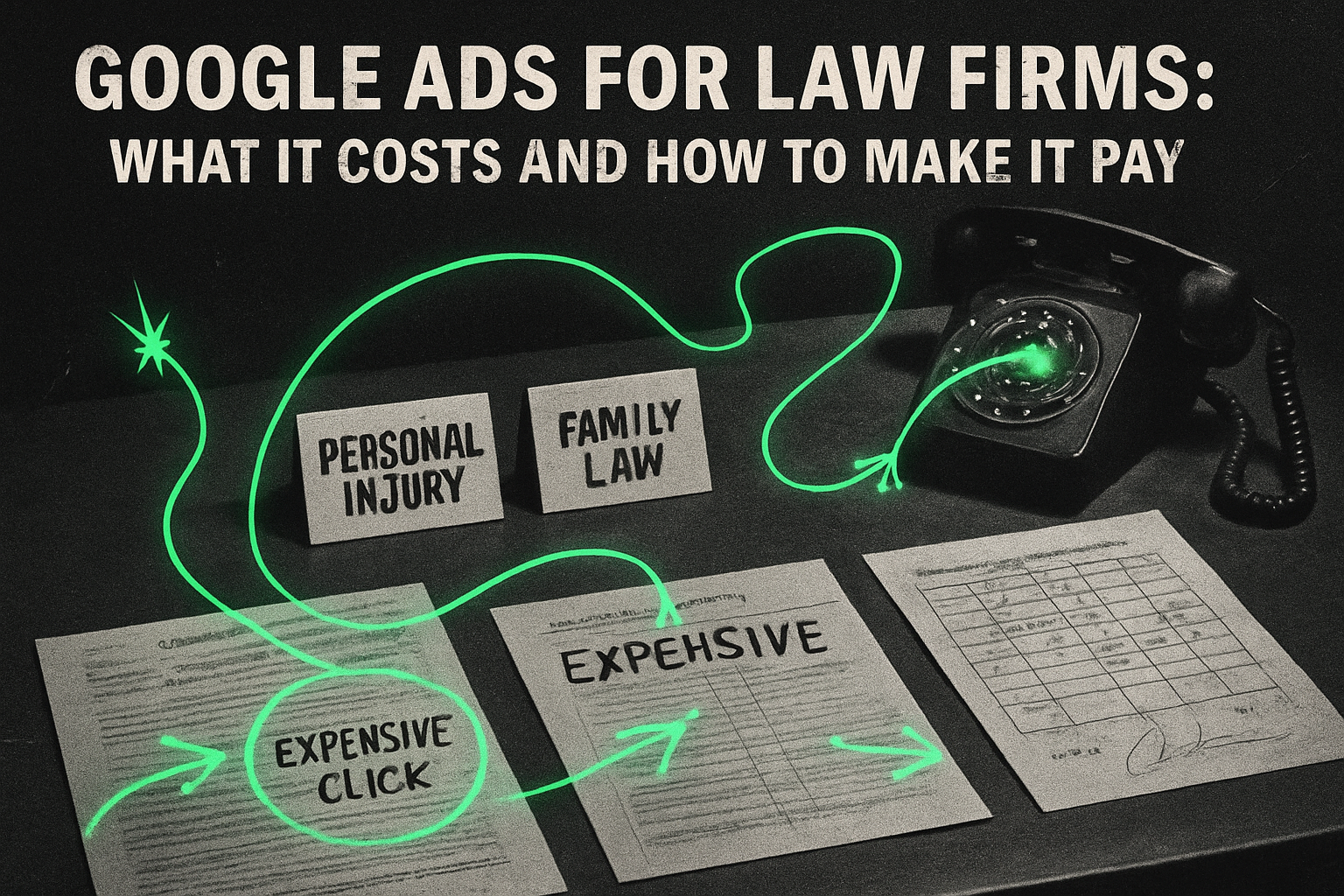
For the category version of this problem, the sibling page is Google Ads for law firms: what it costs and how to make it pay. This page is the pain version: the budget already hurts.
---
FAQ
Why are Google Ads so expensive for lawyers?
A signed case can be worth tens of thousands of dollars, so every firm in the market bids on the same terms. That auction often prices clicks at $50 to $150, more in busy metros. The cost is the price of the case, not a Google glitch.
Are Google Ads worth it if my cost per click is over $100?
They are worth it if cost per signed case still clears your economics. A $120 click that becomes a retainer is cheap. A $40 click that never signs is expensive. Stop managing CPC. Manage cost per signed matter.
How do I lower my law firm Google Ads costs?
You rarely lower CPC in a competitive legal auction. You lower wasted clicks. Separate case-intent searches from research and branded queries, kill junk search terms, match the landing page to the matter, and feed signed-case data back so bidding chases retainers.
Should lawyers use Local Services Ads instead of Google Ads?
Run both when they fit the practice. Local Services Ads bill per lead and sit at the top with a Google Screened badge. Search ads still capture the specific case terms LSAs miss. Treating them as either-or usually leaves a gap.
When should a law firm pause Google Ads?
Pause when you cannot see which queries produce signed cases, or when the landing page cannot take the matter. Do not pause just because CPC is high. Fix tracking and intent first. If the economics still fail after that, the market or the case value is the constraint.