

Healthcare AI search optimization is the work of making your services, expertise, and trust signals easier for search and answer systems to understand. In healthcare, that work has a higher bar because people aren't shopping for trivia. They're making serious decisions.
If you run marketing for a healthcare company, practice, provider group, or service line, you can't treat AI search like a trend deck. You need visibility, but you can't weaken trust to get it.
That's the tension.
AI search changes the format, not the trust problem
AI answers compress information. They summarize. They compare. They may cite sources, or they may describe a category in language that makes every provider sound the same.
Google's documentation on AI features in Search gives site owners a practical frame: make useful content that Google can access and understand. That sounds simple until you apply it to healthcare.
For healthcare, "useful" isn't just keyword coverage.
Useful means:
- the service is clear
- the audience is clear
- the reviewer or expert input is clear
- the limits are clear
- the next step is clear
- the content doesn't pretend to diagnose
If an AI system summarizes your page, you want the summary to preserve trust, not flatten it.
The dangerous version of healthcare AI SEO
The dangerous version is easy to spot.
It publishes a lot. It says the right keywords. It uses confident language. But nobody accountable seems attached to the content.
That may pass a shallow content check. It doesn't pass the healthcare smell test.
Patients, providers, procurement teams, and referral partners all look for trust signals. Search systems do too, even if the mechanisms are more complex than a single checklist. Google's helpful content guidance asks creators to evaluate whether content is reliable, people-first, and genuinely useful.
Healthcare content should meet that bar before it worries about sounding modern.
What healthcare AI search optimization should include
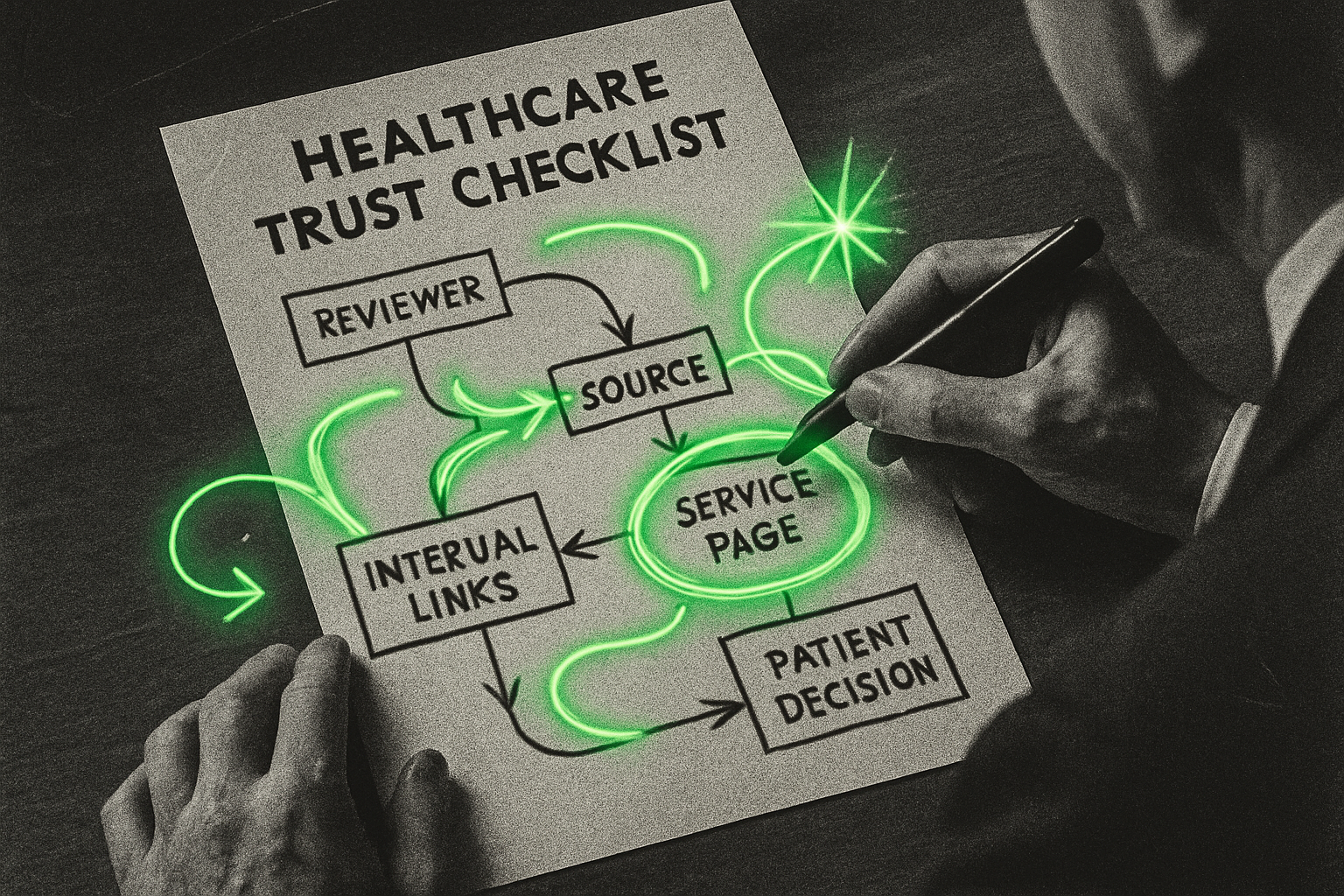
1. Reviewed service pages
Your service pages need to be clear enough for a patient or buyer and careful enough for the category.
Each important page should answer:
- who the service is for
- what problem it addresses
- what happens next
- what you can and can't promise
- who reviewed the content
- when someone should talk to a qualified professional
That doesn't mean every page needs to become a medical journal. It means the page shouldn't sound like anonymous marketing copy in a trust-heavy category.
2. Source-backed claims
Healthcare claims need a ledger.
Not a complicated one. A practical one:
- claim
- source
- approved public wording
- reviewer
- page where it appears
- notes on what not to imply
This protects the brand and the person making the decision. It also gives search and answer systems cleaner material to process.
3. Technical access without accidental risk
AI search still depends on access. If pages are blocked, thin, slow, duplicated, or hard to parse, the trust work may never be seen.
At minimum, check:
- indexable service pages
- clean titles and descriptions
- clear headings
- structured data where appropriate
- canonical URLs
- internal links from related pages
- snippet and robots settings
Google's robots meta tag documentation matters here because page-level controls can affect how content appears in search. In healthcare, those controls should be intentional, not inherited from a template nobody has checked in a year.
4. Content that answers real decision questions
Healthcare buyers and patients don't only ask "what is this?"
They ask:
- Is this right for me?
- What should I expect?
- What does the provider need to know?
- What risks or limits should I understand?
- How do I compare options?
- Who reviewed this?
Those questions make better pages. They also make better AI summaries because the page has actual substance to retrieve.
What we wouldn't claim
We wouldn't claim that healthcare AI search optimization guarantees citations. We wouldn't claim that a page can replace a clinician, specialist, or qualified reviewer. We wouldn't use AI search as an excuse to publish unreviewed medical content faster.
The promise should be narrower and stronger:
Your healthcare pages can be clearer, more trustworthy, easier to crawl, and better aligned with how patients or buyers make decisions.
That's enough work to matter.
How Emerald would approach it
We'd start with the pages that carry trust risk and business value: service pages, condition-adjacent pages, provider or expert pages, comparison pages, and referral or buyer-facing content.
Then we'd tighten the claims, add reviewer context, improve technical access, and build supporting articles around the questions people actually ask before they take the next step.
For the category-specific system, review Emerald's healthcare SEO agency page. For the AI-search layer, review AI search optimization services.
FAQ
What is healthcare AI search optimization?
Healthcare AI search optimization helps healthcare pages become easier for search and answer systems to understand, summarize, and cite while preserving trust, review discipline, and clear next steps.
Is this just healthcare SEO with a new name?
No, but it builds on healthcare SEO. The technical foundation, helpful content, internal links, and trust signals still matter. AI search adds more pressure to make expertise and claims easy to understand.
Should healthcare content be reviewed?
Yes. If a page touches medical, clinical, or care-adjacent decisions, it should be reviewed by someone qualified before publication.
Can AI search optimization guarantee citations?
No. You can improve clarity, crawlability, content quality, and proof. You can't honestly guarantee that every answer system will cite a specific page.
What's the next step?
Audit your highest-value healthcare pages for clarity, reviewer context, source-backed claims, and technical access. Then compare that against Emerald's healthcare SEO approach.