
The front door of commercial research has shifted. Buyers still use Google, but when they want a short list of vendors, law firms, software tools, or agencies, they increasingly open ChatGPT, Perplexity, or read Google's AI Overview at the top of the SERP.
Those engines don't hand the buyer ten blue links and ask them to open eight tabs. They read the top sources for the buyer, weigh which companies appear most credible, and output a direct recommendation naming two or three brands.
If your company is one of the three named inside that answer, the prospect clicks through pre-sold. If you aren't named, you don't even make the consideration set. Generative Engine Optimization (GEO) is the engineering discipline that puts your brand inside that answer.
How ChatGPT, Perplexity, and Google AI Overviews choose who to cite
Most advice on AI search treats "the AI" like a magic black box. If you build search systems for a living, you know it isn't magic. It is an engineering pipeline with two distinct gates: pre-trained model memory and live Retrieval-Augmented Generation (RAG).
When a buyer asks an AI engine a commercial question (for example, *"Who are the best law firm SEO companies?"* or *"Which ecommerce SEO agency handles complex Shopify migrations?"*), the engine doesn't rely only on static training data from a year ago. It fires live search queries, pulls the top candidate URLs into its context window, and synthesizes an answer where multiple sources agree.
Each major AI engine weights its retrieval sources differently:
| AI Search Engine | Primary Retrieval Index | Highest-Weight Citation Sources | What Triggers a Brand Recommendation |
|---|---|---|---|
| Google AI Overviews & AI Mode | Google Core Search Index + Google Knowledge Graph + Google Business Profile | Top-10 ranking commercial pages, authoritative niche guides, structured comparison tables, GBP reviews | Strong page-one organic ranking paired with concise, extractable answer paragraphs and schema |
| ChatGPT Search (OpenAI) | Bing Search Index + OpenAI `OAI-SearchBot` crawl + licensed publisher feeds | Independent "best of" listicles, G2/Clutch/Avvo directories, Reddit discussions, clear pricing pages | Multi-source consensus across third-party roundups plus clean server-rendered HTML on your site |
| Perplexity AI | Independent live web index (`PerplexityBot`) + real-time citation ranking | Primary data studies, named case studies with hard numbers, comparative tables, specialist forums | High information density, specific verifiable metrics, and direct citations from trusted domain peers |
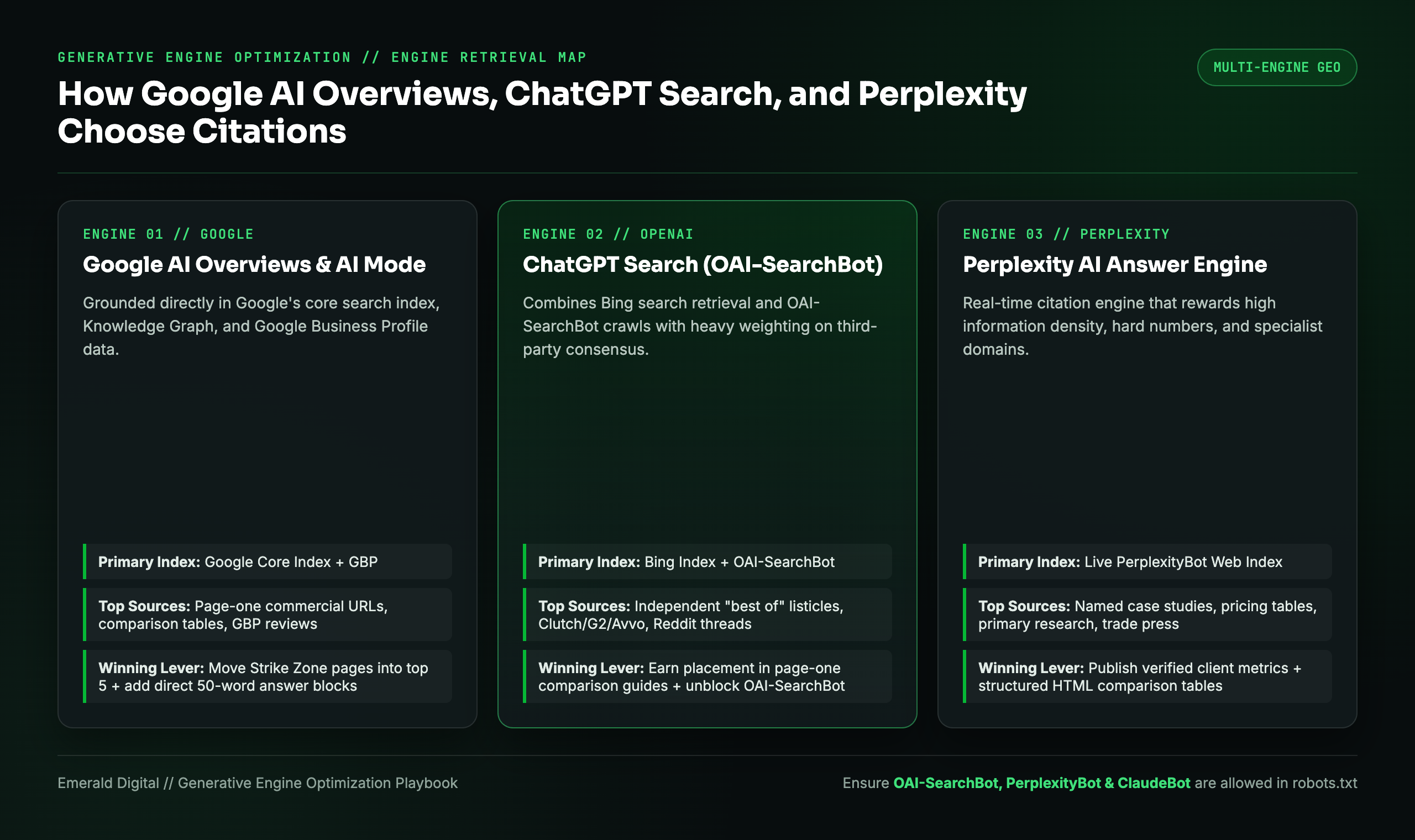
Notice the pattern across all three engines: AI does not trust a claim just because you wrote it on your own homepage. Your site gets you retrieved and supplies the structured facts, while third-party mentions confirm that you belong on the shortlist. For the side-by-side breakdown of how the acronyms fit together, see our guide on AEO vs. SEO and GEO vs. SEO.
The EMBED system: Five moves that get your brand cited
To turn AI visibility from guesswork into a repeatable campaign, we organize our GEO execution around five concrete workstreams we call EMBED:
| Workstream | Core Objective | Concrete Deliverables |
|---|---|---|
| 1. Entity Anchoring | Make your brand an unambiguous entity in the Knowledge Graph | Unified `Organization`, `Service`, and `Person` JSON-LD schema with `sameAs` links to Wikidata, LinkedIn, Crunchbase, and industry registries; standardized 50-word brand boilerplate everywhere |
| 2. Multi-Source Consensus | Build third-party agreement on what you are best at | Earned placement in page-one industry comparison articles, verified review profiles, partner directories, and trade publications |
| 3. Baseline Prompt Tracking | Measure exactly how models perceive and cite you today | Monthly testing across a fixed basket of 30 to 50 commercial buyer prompts on ChatGPT, Perplexity, and Google AI Overviews |
| 4. Ecosystem Coverage | Ensure AI crawlers can read and verify your proof | Server-side rendered HTML, open access for `OAI-SearchBot`, `ClaudeBot`, and `PerplexityBot` in `robots.txt`, and an indexable `/llms.txt` directory |
| 5. Definitive Content | Publish extractable facts and first-hand operator data | Comparison tables, transparent pricing ranges, named client case studies, and clinician or operator interviews that pass the "only you can write this" test |
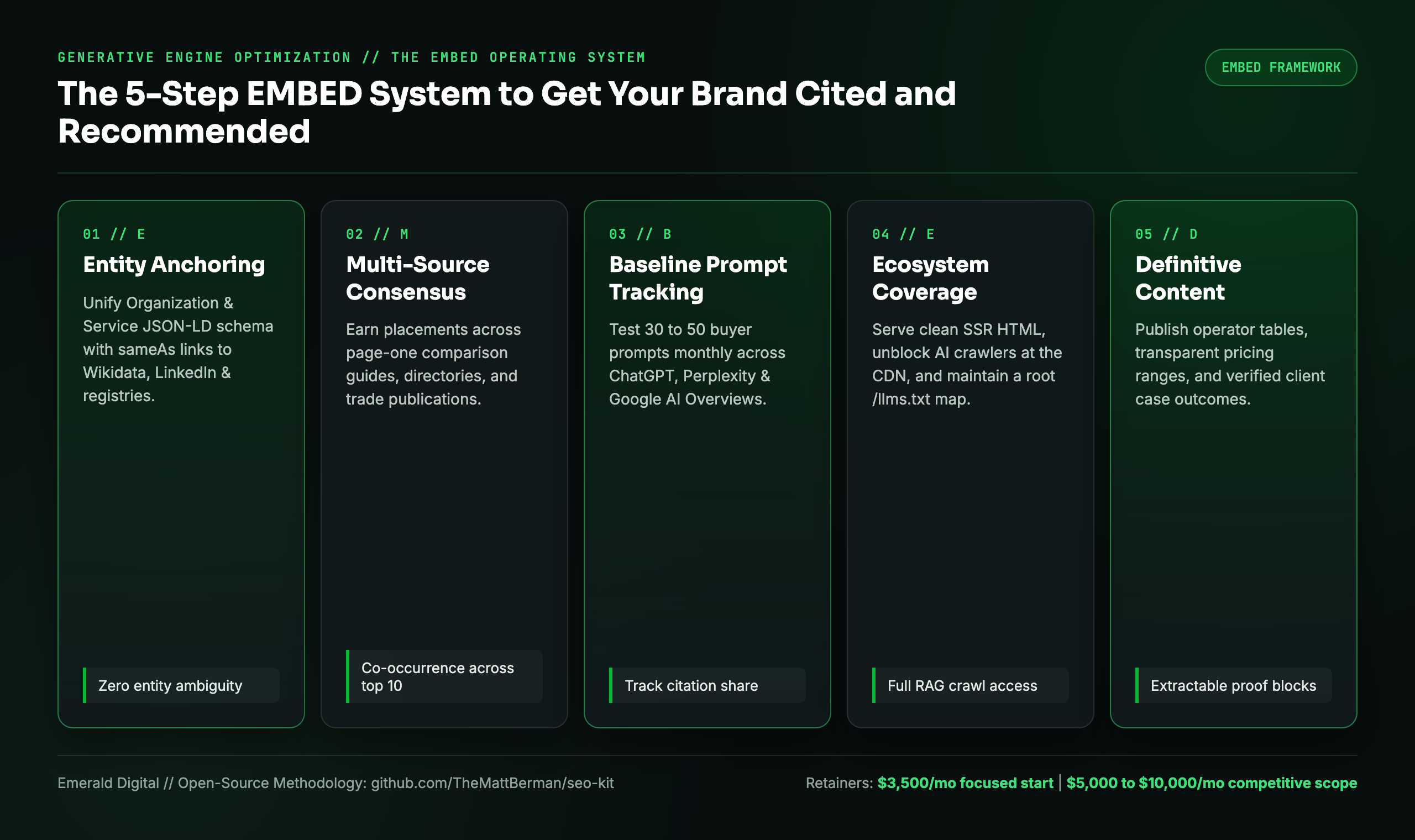
Let's break down how each of the five moves works in practice.
1. Entity anchoring
Before a language model can recommend your company for a specific problem, it has to resolve your brand as a distinct entity with clear attributes. If your homepage calls you a "full-service digital transformation partner," your LinkedIn calls you a "growth studio," and your directory profiles list three different addresses, the model's confidence score drops.
Anchor your entity by stating your exact category, ideal client profile, pricing floor, and flagship proof in plain, consistent language across your site and your schema markup. Link your `Organization` schema directly to your verified external profiles using `sameAs` properties so crawlers connect every mention to the same entity node.
2. Multi-source consensus (Brand mentions are the new backlinks)
For twenty years, SEO revolved around link equity (`PageRank`). Links still matter for organic retrieval, but inside an LLM's synthesis window, co-occurrence and contextual mentions carry enormous weight.
When an AI engine retrieves ten pages for a commercial prompt and sees your company named alongside a specific capability in six of them, it treats that overlap as consensus. If your brand only appears on your own domain, the model often excludes you from the shortlist or mentions you without a citation link. You can see how we diagnose and fix that gap in our guide on mentioned vs. cited in AI search.
3. Baseline prompt tracking
You cannot manage GEO using a traditional rank tracker alone. Start every campaign with two diagnostic prompt sets:
- Entity association prompts: *"What are 10 things you associate with [Brand Name]?"* and *"Who is [Brand Name] best suited for?"* This reveals what the model's weights and live retrieval currently believe about you.
- Category buyer prompts: *"Who are the best [category] agencies for a company spending [$X]?"* or *"Which [practice area] law firm in [city] has strong trial results?"* Track your citation share, link attribution, and sentiment across those prompts every 30 days.
4. Ecosystem coverage and technical AI readiness
We regularly audit companies spending $10,000 a month on content whose infrastructure actively blocks AI engines from reading it. Check three technical gates immediately:
- Unblock search crawlers in `robots.txt`: Make sure your firewall or CDN (especially Cloudflare bot rules) isn't blocking `OAI-SearchBot`, `ChatGPT-User`, `PerplexityBot`, `ClaudeBot`, or `Google-Extended`.
- Render critical proof in initial HTML: Many AI retrieval bots fetch raw HTML without executing heavy client-side JavaScript bundles. Keep your headings, pricing tables, FAQs, and case study metrics in server-rendered HTML.
- Maintain a clean `/llms.txt`: Provide a structured markdown map at your root domain pointing AI agents directly to your canonical service pages, pricing breakdowns, and verified case studies.
5. Definitive content with extractable proof
Generic content gets summarized without attribution. Specific, structured proof gets cited with a link.
Whenever you publish or overhaul a commercial pillar page, include elements that force an answer engine to cite you as the source:
- Verified client receipts: Real named outcomes rather than vague percentages (for example, how we grew DuJour's organic traffic 800% in nine months, or took The Law Center to #2 nationally for "motorcycle accident lawyer" in six months with 5,800+ contacts).
- Structured comparison tables: HTML tables comparing pricing tiers, timelines, or technical trade-offs.
- Direct FAQ blocks: Concise 40-to-60-word answers matching the exact conversational questions buyers type into chat interfaces.
"Ten years ago, when my AC died in the New Orleans heat, I would have Googled 'AC repair reviews' and clicked through five websites. Last summer I snapped a photo of the unit, dropped it into Perplexity, and let it diagnose the capacitor failure and vet the local repair companies. The company it named got the call. The ones it left out never existed to me. That is how your buyers are shopping right now."
Matthew Berman, founder, Emerald Digital
Why moving now compounds so fast
Traditional SEO in a mature vertical means fighting competitors who have been accumulating backlinks since 2012. Generative Engine Optimization is wide open right now because most established market leaders still have terrible entity hygiene, hide their pricing behind sales calls, block AI crawlers by accident, and rely on outdated brochure copy.
When you combine our Strike Zone organic SEO system with the EMBED citation playbook, you capture both halves of modern search: the buyer clicking a high-intent Google result and the buyer asking an AI engine who to trust.
We build our search and AI visibility engine in public. You can inspect our open-source methodology in the seo-kit on GitHub.
See how we get brands cited by AI search, or request a free AI visibility teardown: we will run your category prompts across ChatGPT, Perplexity, and Google AI Overviews, show you who owns the answers today, and give you the exact roadmap to take those citations.