
Contents
If you operate a business in New York City, you have likely experienced the brutal geographic reality of local search in the most competitive commercial market in the world.
You search for your primary service keyword while sitting at your desk in Midtown Manhattan. Your Google Business Profile ranks #1 in the Google Map Pack.
You walk 10 blocks north past Times Square, or 12 blocks east toward Grand Central, pull out your phone, and run the exact same search.
Your business has dropped out of the top three. In its place are three competitor practices that happen to sit a block from your current cross street.
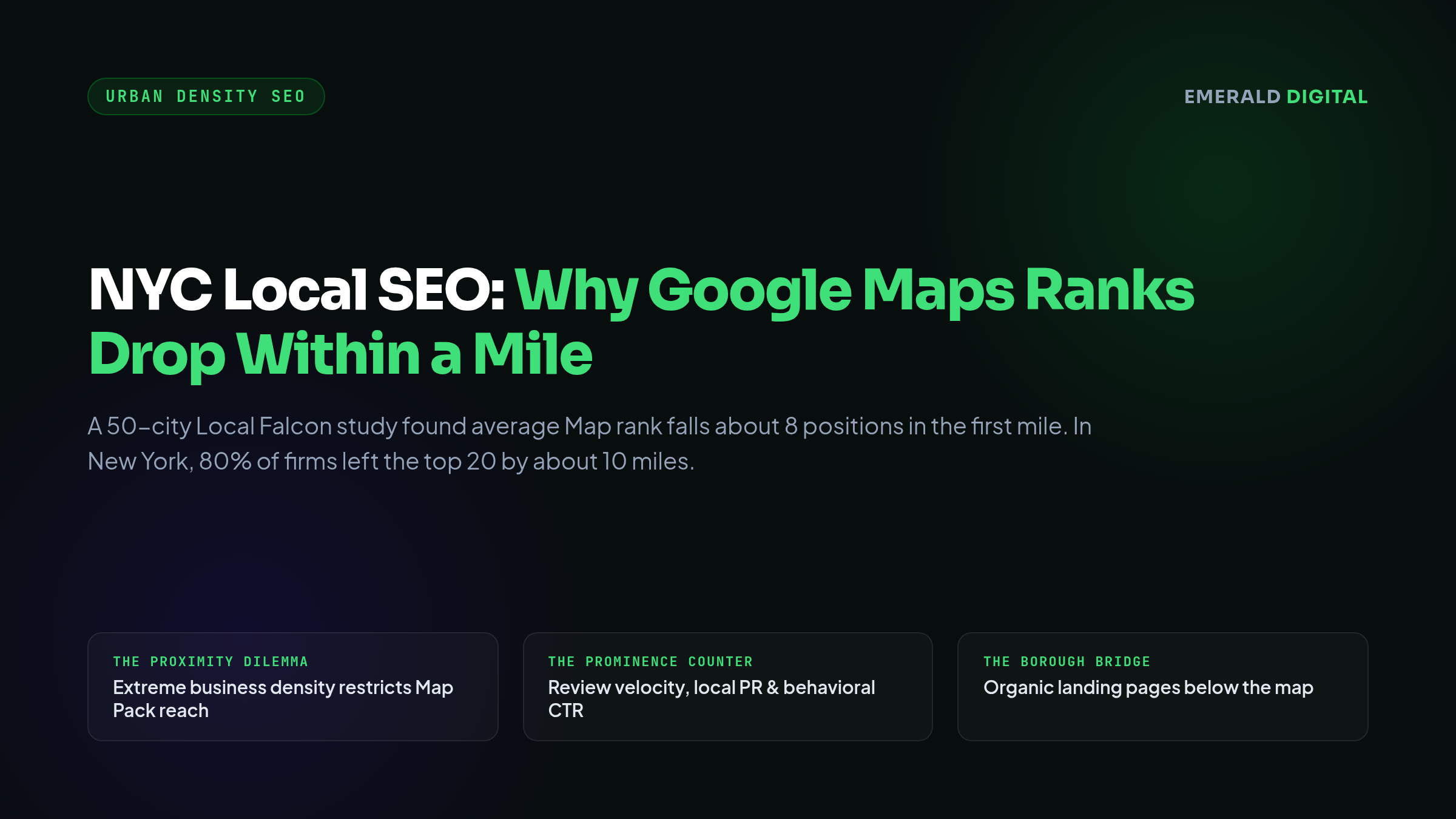
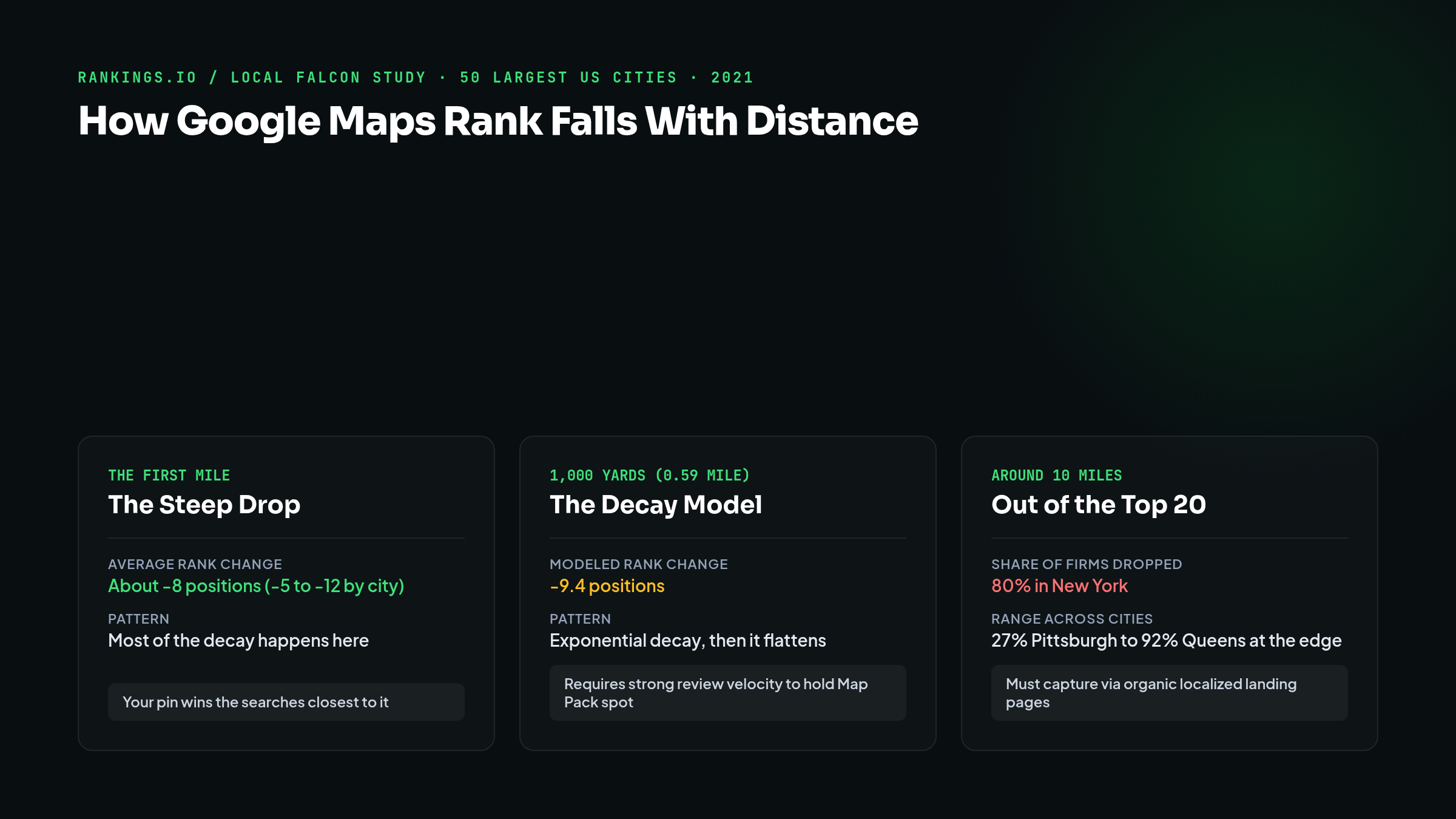
This is measurable. A Rankings.io proximity study ran Local Falcon geo-grids on about 1,100 personal injury firms in the 50 largest US cities. Average Map rank dropped about 8 positions in the first mile (5 to 12 depending on the city). In New York, 80% of firms fell out of the top 20 by around 10 miles, and Queens hit 92%, the highest of any city in the study.
Why does Google Maps proximity decay so aggressively in New York City, and what can ambitious businesses do to break through the local density barrier?
The Manhattan proximity decay curve
Google's local algorithm is governed by three fundamental ranking factors: Relevance, Distance (Proximity), and Prominence.
In low-density suburban areas, there may only be three commercial litigation firms or five specialty pediatric dentists within a 10-mile radius. Because competitor supply is sparse, Google must expand its search radius to satisfy the user's search intent. Distance becomes a secondary factor.
In New York City, the equation is inverted:
A 15-minute walk from our office at 1216 Broadway in NoMad passes more agencies, law firms, and specialty medical practices than many suburbs hold in a whole county.
Because Google has an overabundance of geographically relevant options on every single avenue, its distance algorithm places intense weight on the searcher's physical GPS coordinates.
The study's numbers (2021 data, keyword "car accident lawyer"):
- The first mile: Average rank drops about 8 positions, and in most cities the biggest jump in firms leaving the top 20 happens here.
- 1,000 yards (0.59 mile): The authors' decay model puts the drop at 9.4 positions. A mile is about 20 north-south Manhattan blocks, so that is roughly 12 blocks up an avenue.
- Around 10 miles: 80% of New York firms had left the top 20. The share at the edge of the grid ranged from 27% in Pittsburgh to 92% in Queens.
The study also found firms that barely dropped at 10 miles. That is the prominence lever at work, and it is the one you control.
The four levers to expand your NYC ranking radius
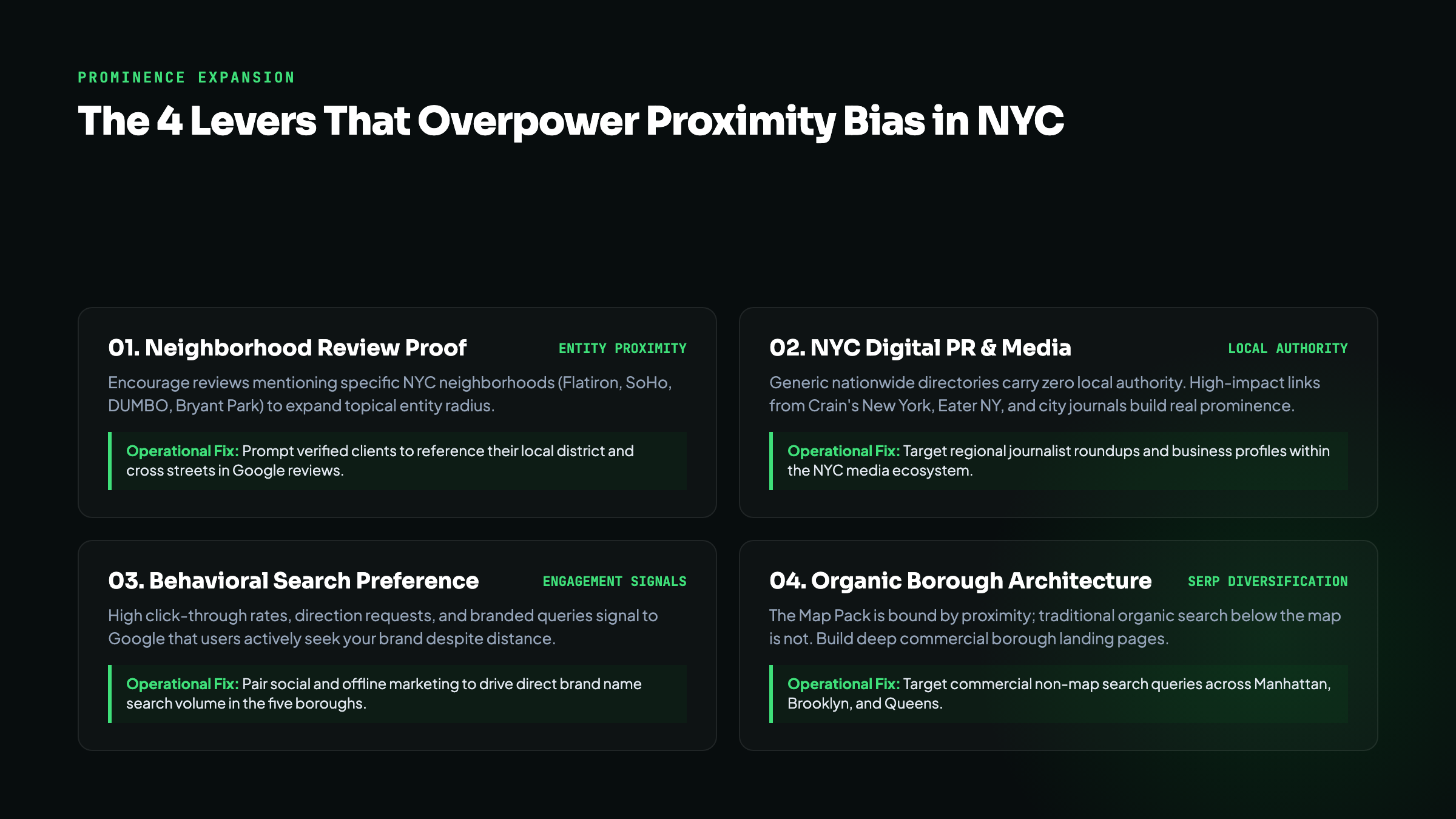
You cannot move your physical building closer to every searcher in New York. Therefore, to widen your ranking radius across Manhattan and Brooklyn, you must aggressively overpower the proximity bias using the Prominence axis:
1. High-Velocity, Neighborhood-Specific Review Proof
Google evaluates review sentiment, volume, and velocity. To expand geographic reach, encourage clients to naturally mention neighborhood context in their reviews: *"Best corporate counsel in Flatiron"*, *"Seamless intake near Bryant Park"*, or *"Great catering for our DUMBO production studio."* These geographic entity markers signal to Google that your operational reputation spans well beyond your single street address.
2. Local New York Digital PR and Media Mentions
Suburban directory citations (Yelp, YellowPages) are table stakes in NYC. To move the prominence needle, your brand needs genuine local media citations: coverage in *Crain's New York Business*, *The City*, *Eater NY*, or prominent local business journals. A single contextual link from a respected New York publication carries more localized entity weight than a stack of generic directory submissions.
3. Click-Through Rate and Behavioral Engagement
When searchers repeatedly click your profile, request driving directions, or tap your phone number even when you appear in position #4 or #5, Google interprets this behavioral signal as strong consumer preference. Over time, high behavioral engagement forces the algorithm to loosen its strict proximity filter and display your listing across a wider geographic radius.
4. Paired Organic Borough Architecture
Do not rely exclusively on the Map Pack. While Google Maps is proximity-bound, localized organic search results below the map are not. By building deep, high-converting organic landing pages tailored to specific commercial markets (such as Manhattan enterprise services, Brooklyn food CPG distribution, or Queens manufacturing), you capture searchers across all five boroughs regardless of where they stand.
Local proof in action: Jerk House NYC
The power of combining hyper-local cultural resonance with aggressive digital distribution was demonstrated in our work with Jerk House NYC.
Starting from a near-zero local digital footprint, our social and local discovery programs generated +2,000% website traffic in 30 days, establishing regional dining prominence across the five boroughs and proving that cultural authority can overcome street-level density.
Whether you are scaling a professional services firm, building an enterprise technology company, or launching a consumer product across New York retail doors, winning local search requires understanding the true mechanics of urban density.
If your team is ready to expand its search footprint across New York City and beyond, explore our New York digital marketing agency services or request a free marketing teardown.
Frequently asked questions
Why do Google Maps rankings drop off so sharply in New York City?
Google's local search algorithm balances three core signals: relevance, distance (proximity), and prominence. In dense urban markets like Manhattan and Brooklyn, competitor supply is overwhelming, so Google's distance filter heavily weights the searcher's exact location. A Local Falcon study of about 1,100 personal injury firms across the 50 largest US cities found average Map rank dropped about 8 positions in the first mile, and 80% of New York firms fell out of the top 20 by around 10 miles.
How can an NYC business expand its ranking radius beyond its immediate block?
You cannot change physical distance, so you must aggressively outrank competitors on the Prominence axis. This requires maintaining continuous positive review velocity with localized neighborhood mentions, securing high-authority NYC digital PR citations, earning organic website backlinks from New York publications, and driving consistent brand search volume.
Does a Midtown Manhattan office address help a business rank in Brooklyn or Queens?
Almost never in the Google Map Pack. For queries with local intent, Google will overwhelmingly favor a business physically located in Williamsburg, DUMBO, or Astoria over a Midtown firm, unless the Midtown firm has extraordinary brand prominence. However, your organic website landing pages can rank across all five boroughs with proper structural architecture.
What is the biggest mistake New York businesses make with local SEO?
Relying entirely on Google Maps while neglecting organic localized landing pages. In NYC, local search traffic is split between the Map Pack (which is hyper-proximity dependent) and traditional localized organic search results below the map. Dominating both requires a paired strategy of GBP optimization and deep content authority.