
Contents
*By Matthew Berman · Reviewed by Matthew Berman · Updated November 2026*
For businesses operating in South Louisiana, local search engine optimization presents a geographic challenge found nowhere else in the United States.
Whether you run a commercial roofing company, a multi-office legal practice, or a high-end HVAC contractor based in downtown New Orleans, your real customer base rarely stops at the Orleans Parish line.
Your crews service accounts across Metairie and Kenner in Jefferson Parish, cross the Causeway into Mandeville and Covington on the Northshore in St. Tammany Parish, and frequently bid on commercial contracts in Baton Rouge.
However, when you look at Google Maps rankings from an office on Poydras Street or St. Charles Avenue, your business dominates the local 3-pack within a 3-mile radius.
Ten miles away in Jefferson Parish, your listing disappears completely from the Map Pack, replaced by competitors who maintain a registered address a few blocks down Veterans Memorial Boulevard.
How do you capture high-intent commercial search traffic across multiple Louisiana parishes without violating Google guidelines or burning budget on black-hat virtual offices?
Physical storefronts vs. Service Area Businesses (SABs)
The first step in multi-parish search architecture is understanding how Google categorizes your operational model.
Too many regional businesses try to game Google Maps by renting unstaffed mail drops in Metairie, Slidell, or Lafayette. In 2026, Google's algorithmic video re-verification checks flag and suspend these listings within weeks.
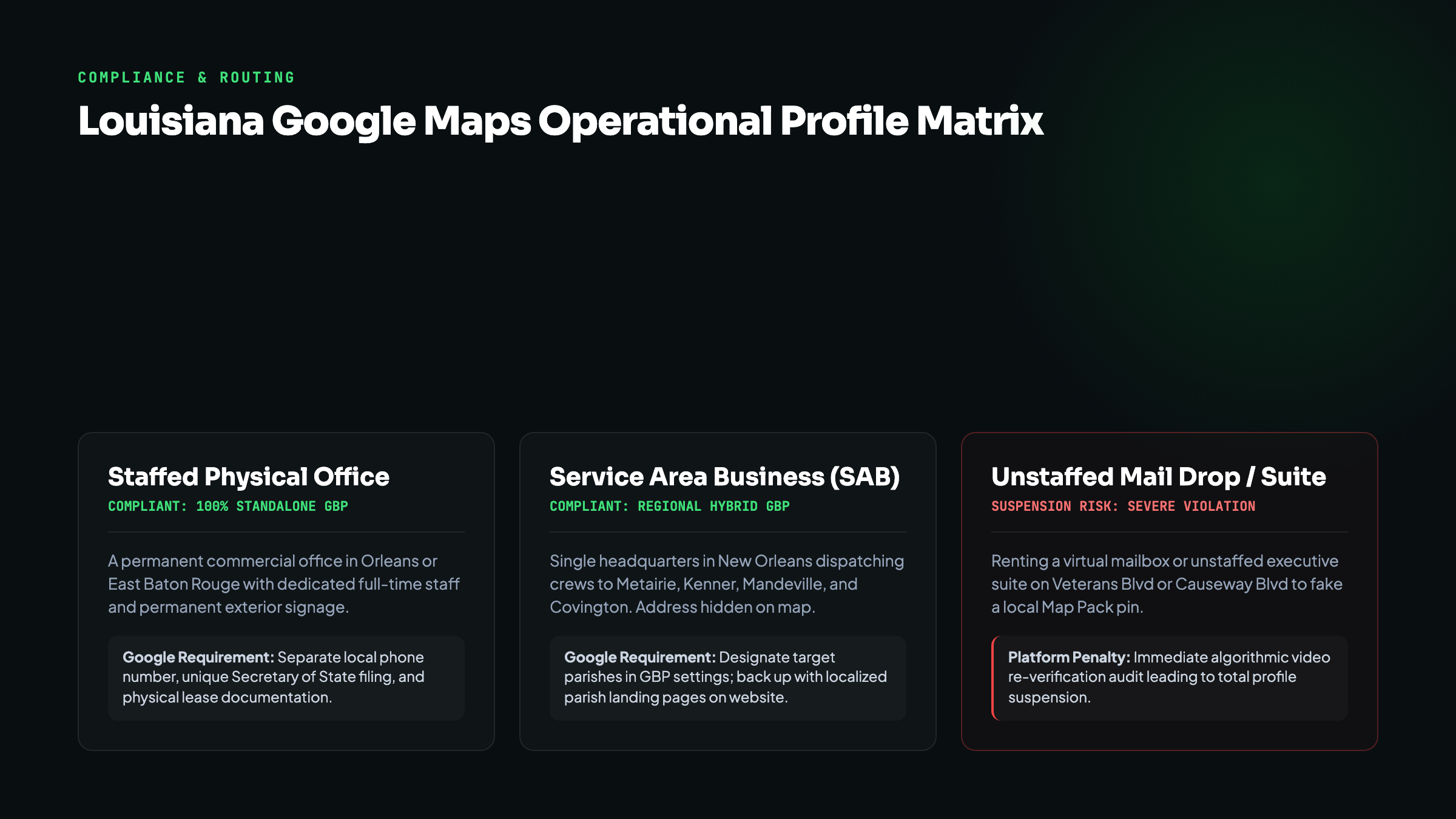
Evaluate your operational footprint against this platform matrix:
1. The Staffed Physical Storefront
If your firm operates a permanent commercial office with dedicated employees and permanent exterior signage in multiple parishes (for example, a primary office in New Orleans and a satellite branch in Baton Rouge), you are entitled to distinct, standalone Google Business Profiles. Each location must have its own local phone number (504 vs. 225), distinct landing page URL, and matching Secretary of State filings.
2. The Hybrid Service Area Business (SAB)
If you operate from a single headquarters in Orleans Parish but dispatch service crews across the Greater New Orleans metro and Gulf South, you must configure your profile as a hybrid or pure Service Area Business. You can explicitly designate target delivery parishes (Orleans, Jefferson, St. Tammany, St. Bernard) within Google Business Profile settings. While an SAB listing does not rank as strongly as a physical doorstep address in neighboring parishes, it keeps your listing 100% compliant and avoids catastrophic map suspensions.
3. The Unstaffed Virtual Office (Immediate Penalty)
Using a co-working mailbox on Causeway Boulevard or a shared virtual suite in Baton Rouge with zero full-time staff present during stated hours violates Google's deceptive representations policy. One competitor reporting an address discrepancy will trigger a video re-verification audit that wipes out your primary listing.
The Louisiana parish geographic routing scorecard
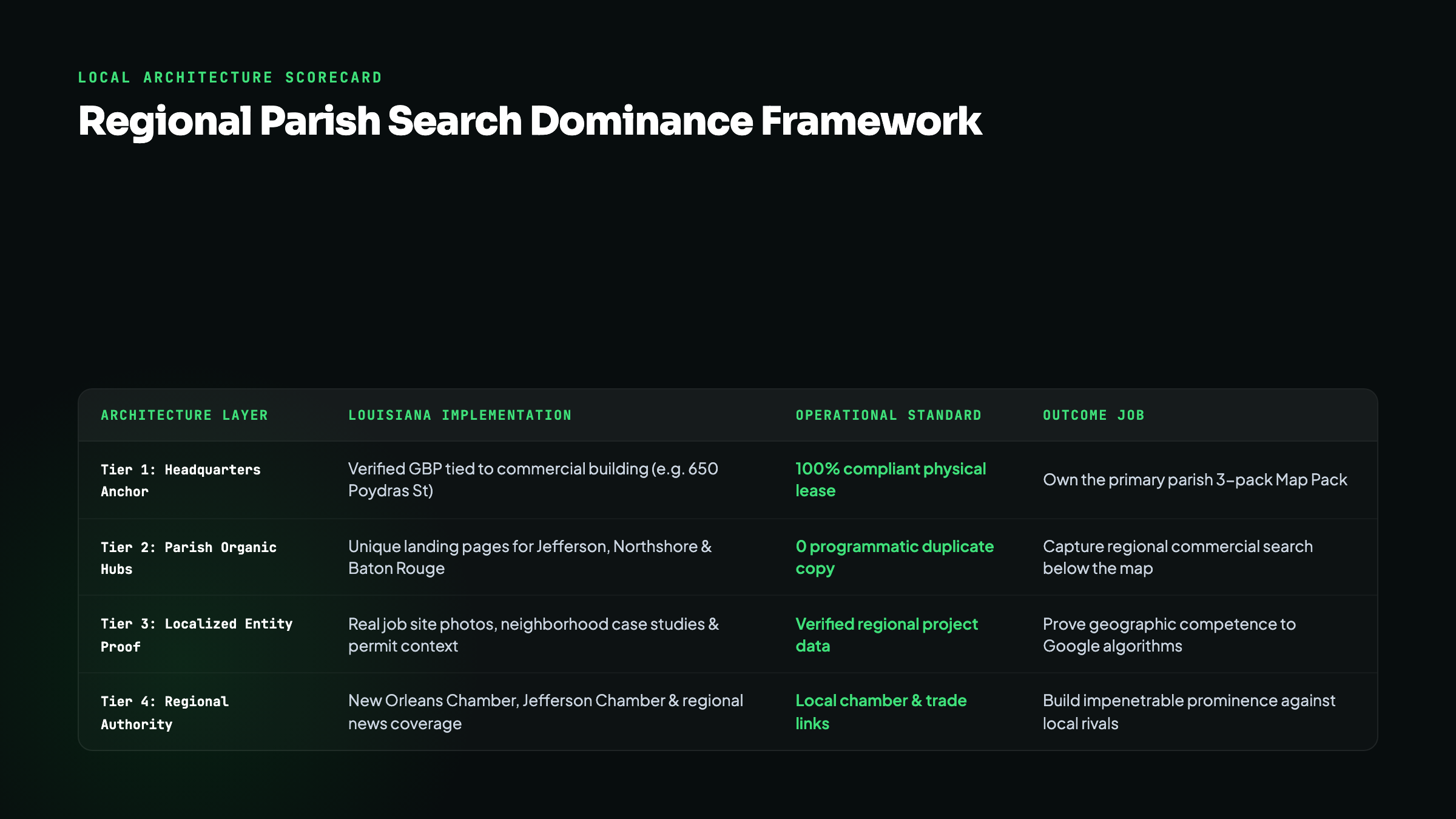
To capture search demand in parishes where you do not maintain a physical commercial office, your organic website architecture must carry the workload that Google Maps cannot:
| Architecture Tier | Strategic Objective | Louisiana Operational Implementation |
|---|---|---|
| Tier 1: Canonical Hub | Anchor authority to your primary headquarters | Link primary GBP to your verified location page (New Orleans office at 650 Poydras St). |
| Tier 2: Parish Landing Pages | Capture organic regional non-map searches | Build dedicated service pages for Jefferson, Northshore, and Capital regions with zero template duplication. |
| Tier 3: Localized Entity Proof | Prove genuine regional business activity | Embed real customer project case studies, parish job permit references, and local neighborhood photos. |
| Tier 4: Regional Citation Footprint | Establish external local entity validation | Secure listings with the Jefferson Chamber, New Orleans Chamber, St. Tammany West Chamber, and regional Louisiana trade groups. |
Why thin parish city pages get penalized
The most widespread mistake regional marketing agencies make in Louisiana is building 30 programmatic landing pages that copy the exact same copy and find-and-replace the parish name:
- *"Best commercial HVAC contractor in Orleans Parish"*
- *"Best commercial HVAC contractor in Jefferson Parish"*
- *"Best commercial HVAC contractor in St. Tammany Parish"*
Google's Helpful Content and spam algorithms easily identify this pattern as doorway page manipulation. These pages are either de-indexed or suppressed from search results.
To earn organic search rankings that generate high-value inquiries, each regional page must prove real operational context:
- Parish-Specific Regulatory Context: Address regional nuances. If you are a roofing contractor, discuss hurricane strapping requirements and wind mitigation codes specific to coastal parish jurisdictions.
- Real Local Project Case Studies: Feature real completed projects: *"Commercial refrigeration retrofit for an Elmwood distribution warehouse"* or *"Historic French Quarter architectural facade restoration."* Real street names and landmarks build entity trust with search engines.
- Dedicated Local Phone Routing: Use trackable local phone numbers or localized extensions that route directly to estimators familiar with that regional zone.
Connecting local search to commercial revenue
Local search is not about ranking for vanity phrases; it is about owning the searches where business owners and homeowners are ready to execute contracts.
Whether you are scaling a regional contracting firm, growing a healthcare practice, or managing a high-stakes litigation firm, your digital footprint must reflect the geographic reality of how South Louisiana moves.
If your team is looking to expand its Google Maps footprint, resolve multi-location profile issues, or dominate organic search across Louisiana and the Gulf South, explore our New Orleans digital marketing agency services or request a free growth teardown.
Frequently asked questions
Can a Louisiana business create multiple Google Business Profiles for neighbouring parishes?
Only if you operate legitimate, fully staffed physical commercial offices in each parish with unique exterior permanent signage and local utility bills. Setting up virtual offices, shared co-working dropboxes, or P.O. boxes in Metairie, Mandeville, or Baton Rouge to game the Map Pack triggers immediate Google suspensions under their deceptive representation guidelines.
How does a New Orleans service company rank in Jefferson or St. Tammany Parish without a physical location?
Configure your primary Google Business Profile as a Service Area Business (SAB) designating specific service regions, then build hyper-localized parish service pages on your website. Pair those pages with localized case studies, project photo metadata, and regional geo-targeted Digital PR and local chamber citations.
What causes Google Map Pack suspensions for Louisiana regional companies?
The three most common triggers are using virtual office addresses (such as mail drop locations on Causeway Blvd or Florida Blvd), changing your primary business category frequently, and listing a shared residential home address while falsely claiming commercial storefront hours.
How should website landing pages be structured for multi-parish service areas?
Never duplicate the same template and swap the town name. Each parish page must feature unique local proof: specific regional client work, neighborhood transit landmarks, parish-specific permitting or licensing context, and unique team bios operating in that specific zone.