
Contents
*By Marcela Gonzalez · Reviewed by Matthew Berman · Updated November 2026*
It is one of the most frustrating experiences in modern brand marketing.
Your latest short-form video batch takes off. The view count crosses 500,000 on TikTok and Instagram Reels. Notifications flood your phone with thousands of likes, shares, and amused comments. The creative team celebrates a viral breakout.
Then the week ends, and the leadership team reviews the commercial numbers.
Shopify revenue did not move. Grocery reorders and retail velocity at Target and Whole Foods did not budge. Inbound demo requests and table reservations stayed dead flat.
You paid for production, spent hours approving cuts, and earned massive reach, yet your business made zero progress.
When social media engagement spikes while sales remain flat, founders often jump to the wrong conclusion: they assume social media marketing does not work for their category, or they assume their product is flawed.
In reality, you are dealing with a broken conversion bridge. Attention and commercial intent are entirely different psychological states. If your content is not engineered to guide a viewer across the gap between entertainment and transaction, massive views will always produce zero revenue.
The five-step social evidence ladder
To understand why high engagement fails to produce revenue, you must examine how attention travels from a platform scroll to your bank account.
Most underperforming social accounts attempt to jump directly from a broad entertainment hook to an aggressive checkout demand. When viewers scroll past, the brand is left with empty views.
Use this operational evidence ladder to pinpoint exactly where your funnel is disconnecting:
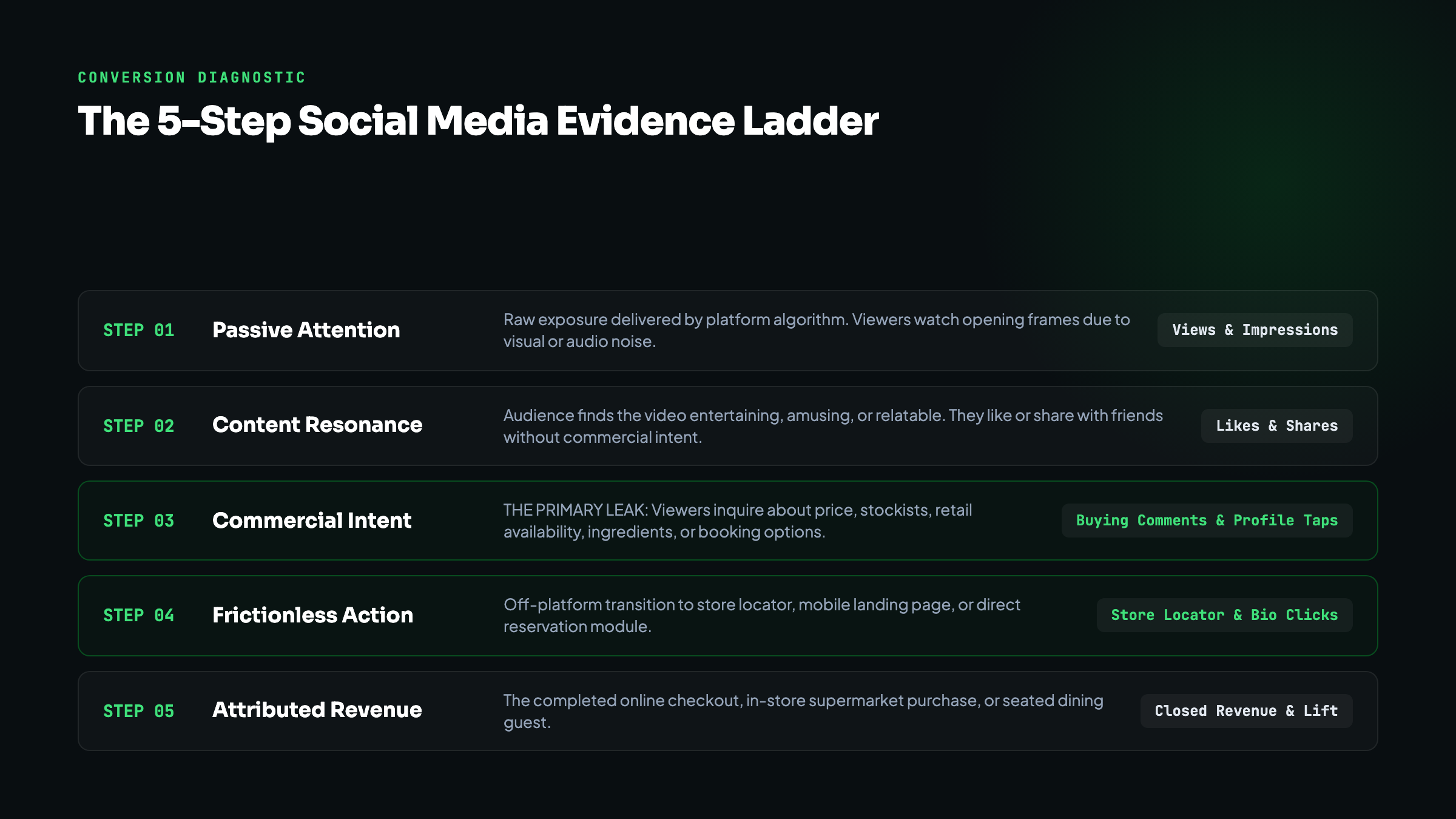
Step 1: Passive Attention (Views and Impressions)
The platform algorithm serves your video. Viewers watch the first three seconds because the visual was loud or unusual. This represents raw exposure, not interest.
Step 2: Content Resonance (Likes and Shares)
Viewers find the content relatable, entertaining, or aesthetically pleasing. They like or share it with a friend. At this stage, they are engaging with the media, not your product.
Step 3: Commercial Intent (Comment Inquiries and Profile Clicks)
The critical turning point. Viewers transition from entertained observers into prospective buyers. They ask questions in the comments: *"Where can I buy this?"*, *"Is this gluten-free?"*, or *"Does this integrate with Salesforce?"* They tap through to your brand profile to inspect your bio.
Step 4: Frictionless Action (Store Locator or Landing Page Visit)
The buyer takes an off-platform action. In DTC or B2B, they land on a focused, mobile-optimized landing page. In grocery retail, they search your store locator to find a local supermarket. In hospitality, they open your reservation module.
Step 5: Attributed Revenue (The Transaction)
The customer completes the purchase, signs the contract, or books the table.
When sales are flat despite viral views, 90% of brands are stalling out between Step 2 and Step 3, or leaking all their traffic between Step 3 and Step 4.
The four structural conversion breakpoints
If your views are climbing while your top-line revenue is stagnant, audit your current content engine against these four common breakpoints:
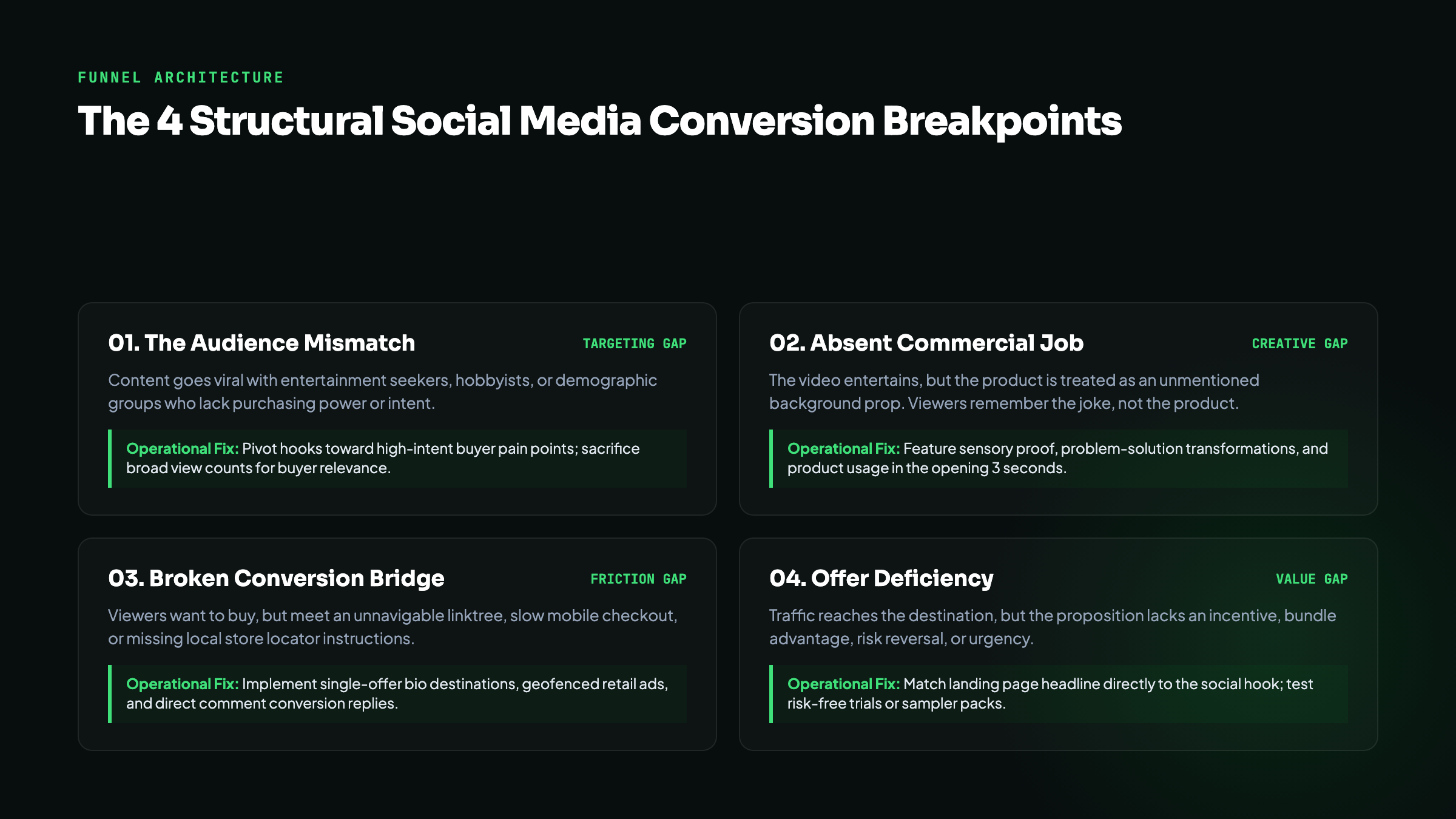
1. The Audience Mismatch
Your content is entertaining the wrong demographic. If a luxury skincare brand goes viral with teen comedy trends, it will accumulate millions of views from high schoolers who cannot afford a $95 serum. The algorithm optimizes for watch time, not purchasing power. If your content appeals to everyone, it sells to no one.
2. The Absent Commercial Job
Your video entertains, but never demonstrates what the product does or why the viewer needs it. If an organic beverage brand posts a comedy sketch where the bottle is merely an unmentioned prop in the background, viewers remember the joke and forget the brand. Every piece of content needs a commercial job: proving sensory appeal, demonstrating a before-and-after transformation, or confronting an acute buyer objection.
3. The Broken Retail or Digital Bridge
Viewers want to buy, but you have made it impossible for them to complete the purchase. In DTC, the link in your bio leads to an unnavigable tree of 15 dead links. In retail food and CPG, you went viral nationally, but your product is only stocked in 40 grocery stores in Southern California. If you do not provide localized store locator instructions, interest evaporates in seconds.
4. The Weak Offer
The viewer lands on your website, but finds an uninspiring generic proposition. There is no trial incentive, no bundle advantage, no risk reversal, and no urgency. Traffic alone cannot save a weak commercial offer.
Diagnosing by business model: DTC, Retail CPG, and Hospitality
Different business models experience the conversion break in distinct ways:
DTC Ecommerce
- The Symptom: High video views, strong link-in-bio clicks, but severe cart abandonment.
- The Diagnosis: Your social video set an expectation that the mobile landing page failed to deliver. If the video promised a simple $25 solution, but the landing page forces the user into a complex subscription selector or charges $12 shipping at checkout, the buyer bounces.
- The Fix: Direct paid and organic traffic to focused landing pages that mirror the exact hook and product featured in the social asset.
Retail Food, Beverage, and Grocery CPG
- The Symptom: Massive national TikTok views, enthusiastic comments asking where to buy, but stagnant wholesale reorders from distributor warehouses.
- The Diagnosis: The global algorithm fallacy. A video viewed 2 million times across the country does not move inventory if 95% of viewers live outside your distribution footprint.
- The Fix: As we detailed in our guide on why food brands go viral on TikTok with zero grocery velocity, brands must shift creative away from generic recipes toward retail walk-in reels and geofenced paid whitelisting within 3 to 5 miles of key grocery stockists.
Hospitality and Dining
- The Symptom: Viral food photography and high local save counts on Instagram, but empty tables on Tuesday nights.
- The Diagnosis: Passive visual appetite without an occasion hook or easy reservation path.
- The Fix: Pair mouth-watering sensory footage with specific occasion prompts (such as date-night menus or private party bookings) and direct links to OpenTable or Resy.
What real social proof looks like
When evaluating agency case studies or diagnosing your own performance, be brutally honest about what your metrics actually prove:
- Brand Awareness & Engagement: For historic kosher provisions brand Abeles & Heymann, our social programs generated 1M+ organic engagements in 150 days. That is verified proof of cultural resonance and retail audience engagement, not a fabricated claim of direct online sausage sales.
- Demand Generation & Waitlist Velocity: For college social app Connyct, our creator seeding engine drove 34M organic views and 10,000+ waitlist signups. That proves conversion from algorithmic attention to verified user intent.
- Local Foot Traffic & Discovery: For Jerk House NYC, focused social creative and local discovery drove +2,000% website traffic in 30 days, proving that hyper-local cultural content can dramatically expand a restaurant's digital footprint.
Every channel has an operational role. Stop expecting broad entertainment videos to magically close sales without a structured commercial bridge.
If your brand is generating views without revenue, explore our social media marketing services or request a free social teardown to diagnose where your funnel is leaking.
Frequently asked questions
Why does viral social media engagement rarely translate into immediate sales?
Viral reach on platforms like TikTok and Instagram Reels is driven by broad entertainment algorithms, not commercial purchase intent. A video can earn 2 million views because viewers find a joke funny or an audio track catchy, without ever registering your brand name, understanding what product is being sold, or knowing where to purchase it.
How should a brand track commercial intent in social media comments?
Separate vanity engagement from commercial signal. Emojis, generic reactions, and joke replies represent passive attention. Commercial signal consists of high-intent inquiries: asking about price, ingredient sourcing, retail availability at specific supermarket chains, sizing, or reservation availability. Tracking comment intent velocity indicates whether creative is sparking purchase desire.
How does the conversion bridge differ between DTC, retail CPG, and hospitality?
In DTC ecommerce, the bridge is seamless link-in-bio routing and mobile landing page checkout speed. In retail grocery CPG, the bridge is visual shelf recognition and geofenced store-locator calls to action within 3 to 5 miles of stockists. In hospitality and dining, the bridge is local geographic intent paired with zero-friction direct reservation links.
What is the Fake Conversion Trap in social media reporting?
The Fake Conversion Trap occurs when marketing reports celebrate top-of-funnel vanity metrics such as reach, video views, and follower growth while revenue, wholesale reorders, and qualified customer acquisition remain flat. True commercial reporting evaluates hold rate, profile-to-site click-through rate, store-locator searches, and customer acquisition cost.