
Contents
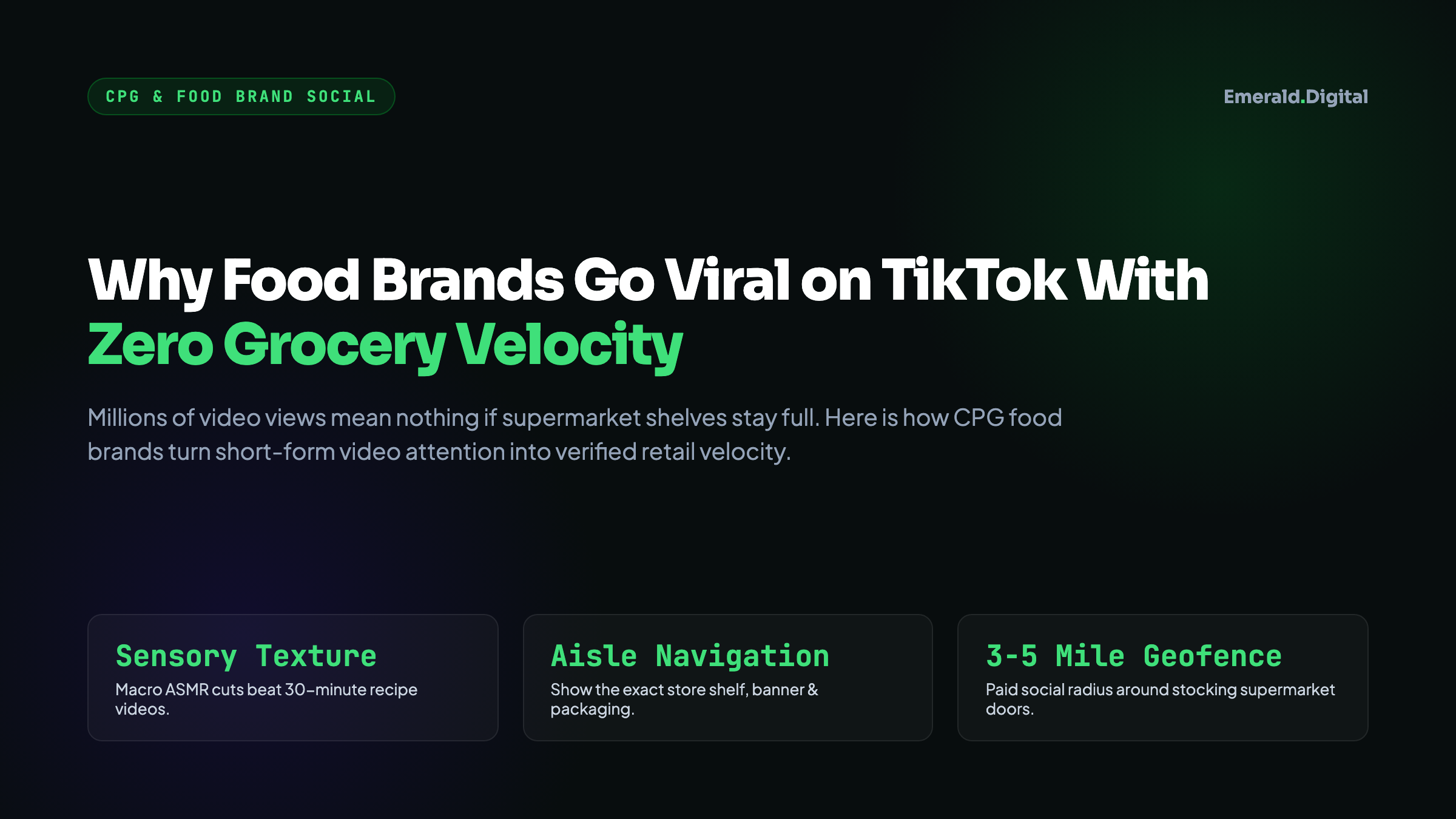
Every food brand founder knows the exhilarating feeling of checking TikTok or Instagram Reels on a Tuesday morning and seeing a video explode.
500,000 views. 40,000 likes. 1,200 comments saying *"omg this looks incredible"* or *"I need this right now."*
Then Friday comes. The sales team pulls the weekly SPINS, Nielsen, or distributor velocity reports across your target accounts at Whole Foods, Sprouts, or Kroger.
The needle barely moved. Units per store per week (UPSPW) remained flat.
Meanwhile, your brand is paying thousands of dollars for creator gifting, video editors, and paid boosting to keep the viral momentum alive.
This is the great short-form video trap for consumer packaged goods (CPG) and food brands. Getting views on TikTok is an entertainment challenge. Moving physical product off a supermarket shelf into a shopper's cart is a behavioral distribution challenge.
If your creative fails to bridge the gap between digital appetite and retail store navigation, your social presence is just an expensive hobby.
The disconnect between viral views and supermarket shelf pull
To understand why entertaining food videos fail to sell product, look at what happens when a consumer scrolls social media:
1. The Global Algorithm Fallacy
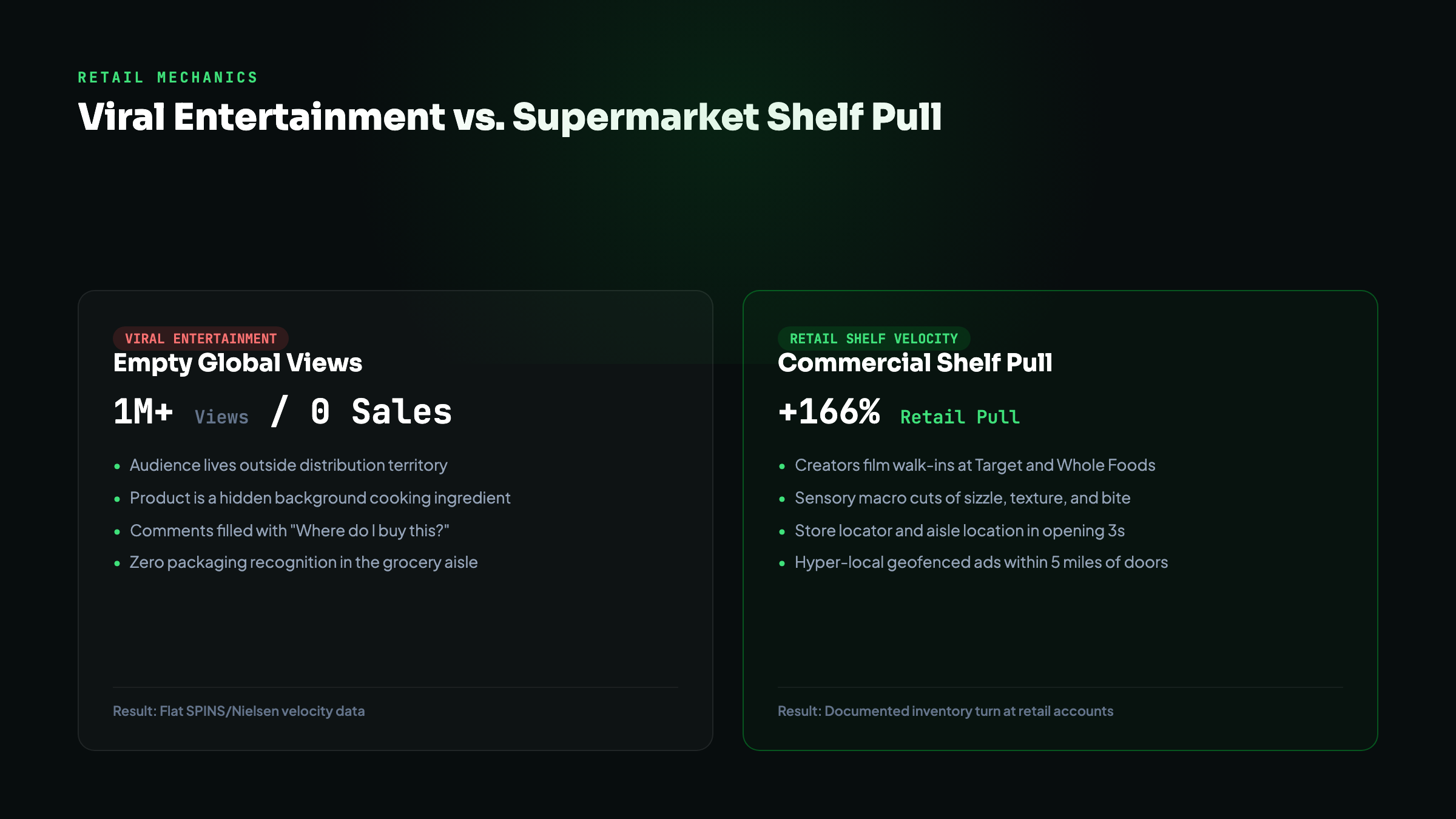
TikTok and Instagram optimize for retention and watch time, not your grocery distributor's territory map. A recipe video featuring your hot sauce or specialty snack might get 800,000 views, but 40% of those viewers live outside your country, and another 45% live in regions where your product has zero retail distribution. Views from consumers who cannot buy your product at their local store create vanity engagement, not commercial velocity.
2. Disguised Product Placement
Most influencer recipe videos treat the food product as a passive background ingredient. The creator uses two teaspoons of your seasoning or drops your butter into a pan, but the viewer's entire focus is on the finished dish (the steak, the pasta, the dessert). The viewer saves the video to make the recipe, but they buy the generic store-brand ingredient when they go to the supermarket.
3. The Comment Section Graveyard
Open the comments on any viral food reel. You will inevitably see dozens of people asking: *"Where do I buy this?"* or *"Is this in Canada?"* or *"What store is this at?"*
When comments ask where to buy the product, your video has failed the primary commercial test. A shopper should never have to ask where to find you; the availability and packaging should be unmistakable in the first three seconds.
The 4-part food brand short-form rotation
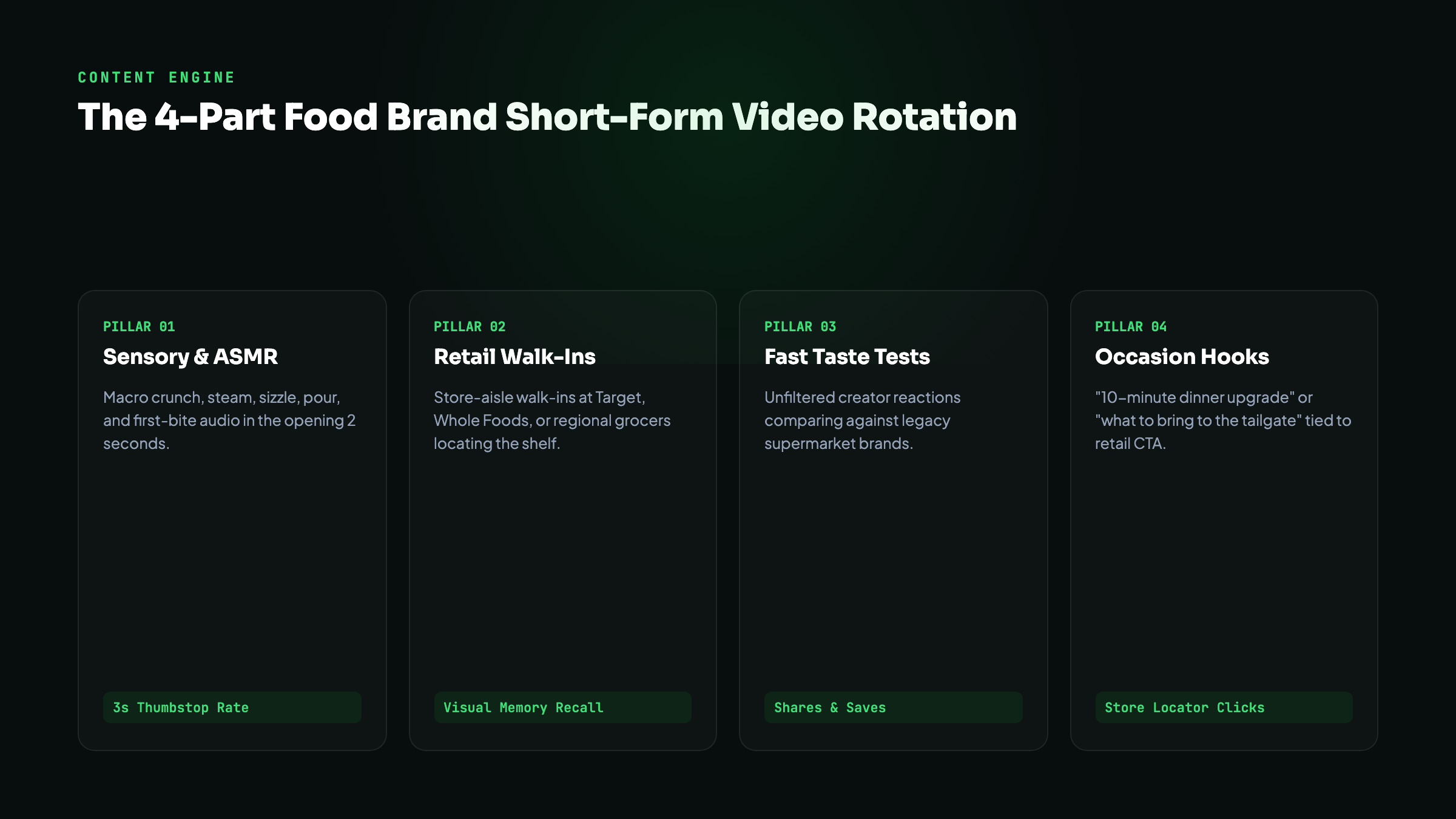
To transform social attention into shelf velocity, we deploy a four-pillar content engine designed to guide consumers from sensory appetite to in-store purchase:
Pillar 1: Sensory Texture & ASMR Cuts
People do not buy packaged food because of nutritional paragraphs; they buy because their brain craves the sensory experience. We prioritize extreme close-up macro shots, the sound of the crunch, the steam rising, the sauce drizzle, and the first-bite reaction.
In our campaign for heritage brand Abeles & Heymann, moving away from static promotional posts and leaning into sensory sizzle and plating generated over 1,000,000 organic social engagements in 150 days.
Pillar 2: Retail Walk-Ins & Shelf Navigation
Train the shopper's brain before they enter the grocery store. Film creators physically walking through the sliding doors of Target, turning down the snack aisle, scanning the shelf, and grabbing your distinctive package.
When a shopper encounters hundreds of competing items in a crowded supermarket aisle, visual memory does the heavy lifting. Showing them exactly which aisle and shelf height your product occupies reduces in-store decision friction.
Pillar 3: Fast Taste Tests & Unfiltered Reactions
Consumers are naturally skeptical of branded advertising claims. Unfiltered, authentic taste-test reactions from relatable creators (especially comparing your product against the legacy market leader) overcome the initial trial hesitation.
Focus on clear, honest feedback: *"I thought this was going to taste like cardboard like other keto snacks, but the texture is actually insane."*
Pillar 4: Objection Busting & Occasion Hooks
Directly address the primary reasons consumers hesitate to buy: price point, ingredient sourcing, macros, or preparation complexity. Pair this with occasion-driven hooks:
- *"The 10-minute weeknight dinner upgrade when you have no energy to cook."*
- *"What to bring to Sunday football when you want everyone to ask who brought the snacks."*
The local grocery velocity ad formula
Organic social builds brand affinity, but hyper-targeted paid media drives retail sell-through. When launching in a new grocery region or supporting a key retail banner:
- Set 3-to-5-Mile Store Geofences: Run paid Instagram Reels and TikTok ads targeted strictly within a five-mile radius of the exact store locations carrying your SKU.
- Feature Store-Specific Creative: Customise the ad hook to the retail environment: *"Dallas: Find our organic protein bars in the refrigerated section at your local Central Market."*
- Pin the Stockist Locator in Bio & Comments: Make your store locator tool effortlessly accessible. Never send paid grocery traffic to a generic homepage; send them to a ZIP code lookup tool that pinpoints the nearest aisle.
To inspect how we build high-converting creative for food, beverage, and CPG brands, explore our food brand social media services or our full social media marketing programs.
Frequently asked questions
Why do viral food videos fail to drive retail grocery sales?
Most food brands optimize for entertaining recipe content or visual food porn that attracts global audiences who do not live near the brand's retail stockists. If a video gets two million views but fails to show the physical packaging, the grocery aisle location, and the specific store banner where it is sold, shoppers cannot convert that appetite into an in-store purchase.
What short-form video style converts best for packaged food brands?
Sensory macro cuts and ASMR (audio of the crunch, sizzle, snap, or pour) combined with clear packaging recognition consistently outperform elaborate 30-minute recipe videos. In our work with heritage food brands like Abeles & Heymann, focusing on sensory product texture generated over one million organic social engagements in 150 days.
How should food brands use retail walk-in content?
Retail walk-ins feature creators or founders physically walking into Target, Whole Foods, or regional grocers, locating the specific shelf section (refrigerated, snack aisle, international foods), and pulling the product. This trains the viewer's visual memory so they instantly recognize the product when shopping in real life.
How do food brands connect digital ad spend to local grocery velocity?
Deploy hyper-local paid social radius campaigns (within 3 to 5 miles of target store locations) featuring store-specific calls to action like 'Now available at your Austin Whole Foods.' Combining this with digitized coupon apps (like Ibotta or aisle rebate offers) creates direct digital-to-register tracking.