
Contents
*By Matthew Berman · Reviewed by Matthew Berman · Updated November 2026*
Most social media audits delivered by digital marketing agencies are 40-page slide decks of decorative vanity metrics.
They catalog follower counts, calculate blended engagement rates across mismatched post types, praise the visual color palette of your Instagram grid, and conclude with the same generic recommendations: post more consistently, hop on audio trends faster, and run a giveaway.
None of that answers the only question a founder or marketing director actually cares about: Why is our social media presence consuming executive time and creative budget without moving our commercial pipeline?
A commercial social media audit is not an aesthetic inspection. It is an operational diagnostic. Its purpose is to identify exactly where attention is leaking between the scroll, the hook, the message, and the commercial checkout.
If your team is preparing to audit its social footprint or evaluate agency performance, use this practical framework to evaluate your channels, creative assets, and conversion plumbing.
The channel role and intent matrix
The single most common mistake in corporate social media is treating every platform like a syndicated broadcast tower. A marketing coordinator produces a single 16:9 graphic or horizontal video, slaps it onto TikTok, Instagram, LinkedIn, and Facebook, and wonders why engagement is dead on arrival.
Every platform distributes content according to distinct algorithmic incentives and user psychology. An audit must first clarify whether each channel has an assigned commercial job:
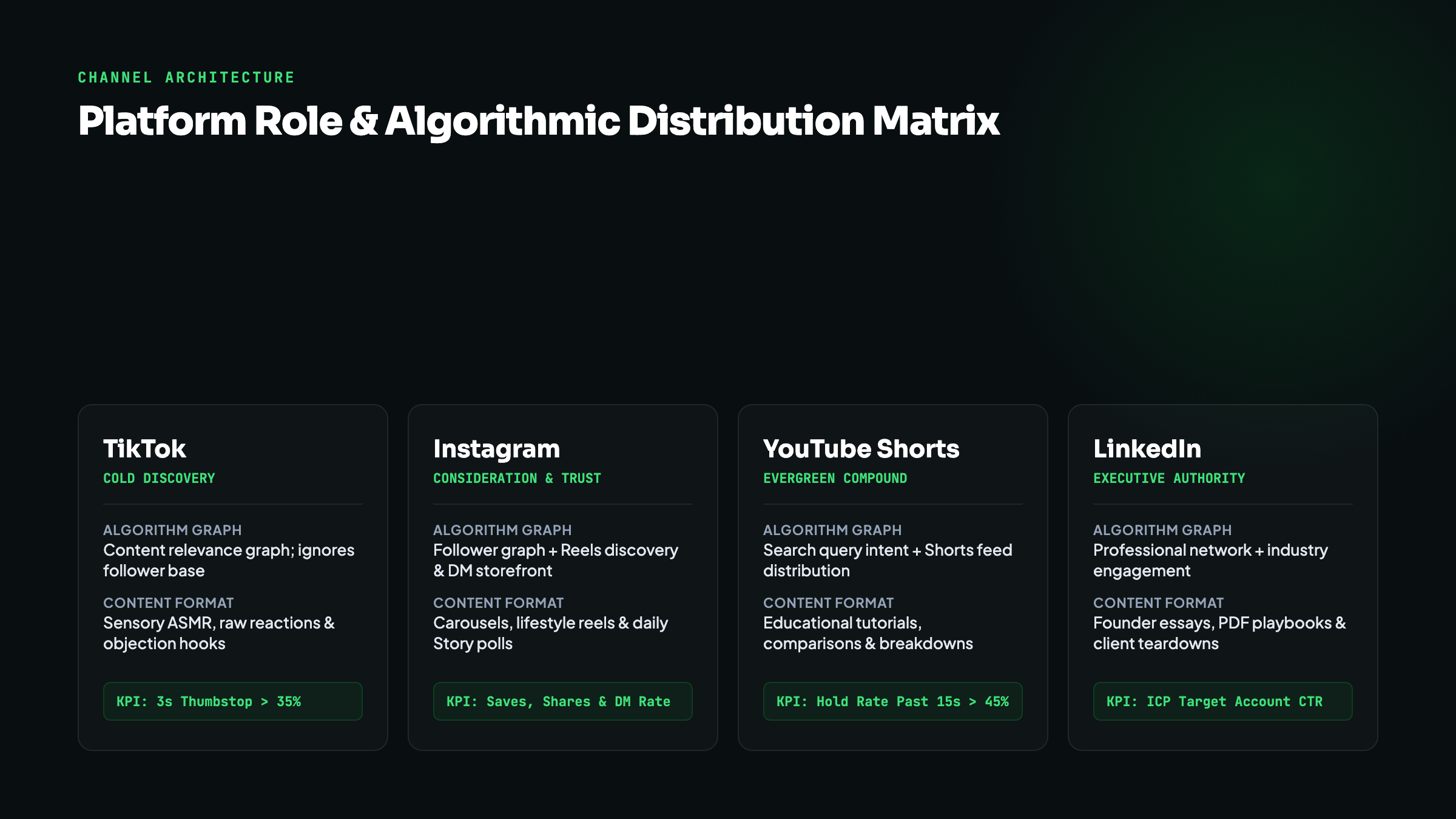
1. Discovery and Algorithmic Reach (TikTok and YouTube Shorts)
These platforms distribute content based on content graph relevance, not follower graphs. Your existing audience count is largely irrelevant. If a video holds attention in the first two seconds and maintains retention through 15 seconds, the algorithm pushes it to hundreds of thousands of non-followers. The job of these channels is cold customer acquisition, brand awareness, and demand creation.
2. Consideration and Community Nurturing (Instagram)
Instagram has transitioned into a relationship-maintenance and consideration engine. Feed posts and carousels nurture existing followers; Reels drive moderate non-follower discovery; Stories maintain daily top-of-mind relevance with warm buyers; and the Direct Message (DM) inbox serves as an active commercial storefront.
3. Executive Authority and Account-Based Trust (LinkedIn)
For B2B software, professional services, and high-ticket offers, LinkedIn is an account-level trust accelerator. The commercial job is not entertainment; it is educating economic buyers on category constraints, demonstrating operator competence, and de-risking high-value purchase decisions.
The practical social audit worksheet
To execute an audit that results in clear operational decisions, evaluate each active channel against the five diagnostic tiers below. Fill in evidence, assign a performance status, and determine the single next corrective action:
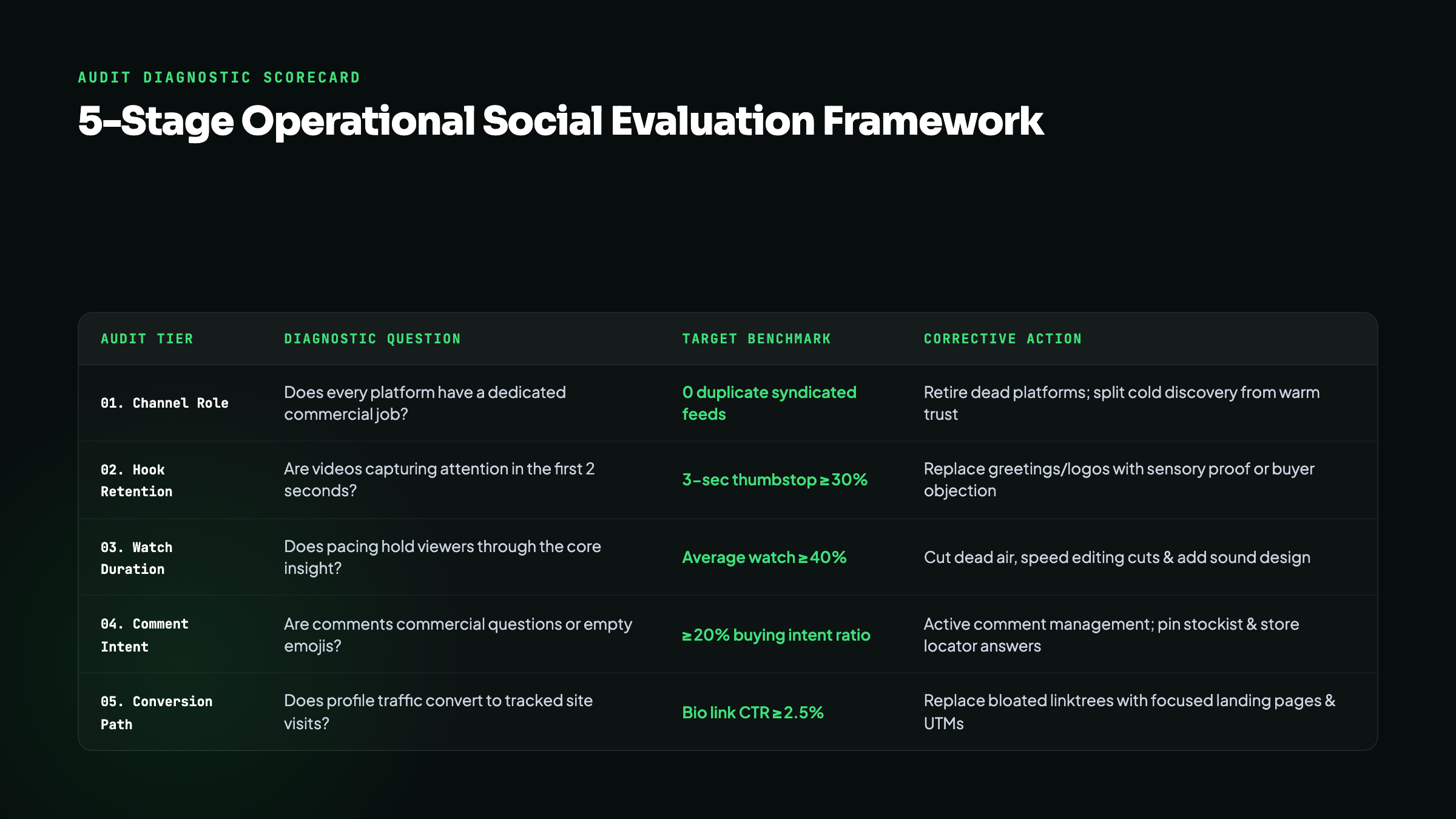
| Diagnostic Tier | Evaluation Question | Evidence to Review | Status (Pass / At Risk / Fail) | Corrective Action |
|---|---|---|---|---|
| Tier 1: Channel Role | Does every platform have a distinct commercial role rather than syndicated duplicate posts? | Native channel post history and native format adoption rates | *Audit Score* | Retire dead channels; assign cold discovery to TikTok/Shorts and warm trust to Instagram/LinkedIn. |
| Tier 2: Hook Mechanics | Are videos capturing qualified attention in the opening 2 seconds? | 3-second thumbstop rate (benchmark: 30%+ on short-form video) | *Audit Score* | Rewrite the opening visual and verbal hook to lead with the buyer's acute objection or sensory proof. |
| Tier 3: Watch Retention | Does the narrative hold viewers through the commercial payoff? | Average watch percentage (benchmark: 40%+ on 30s reels) | *Audit Score* | Cut the introductory fluff, speed up pacing, add sound design, and eliminate visual dead space. |
| Tier 4: Comment Intent | Are commenters asking commercial questions or posting bot emojis? | Ratio of buyer intent questions ("Where to buy?", "Pricing?") to generic emojis | *Audit Score* | Implement active community management; pin store locator links and answers to high-friction buying doubts. |
| Tier 5: Conversion Path | Does profile traffic convert into tracked website visits, signups, or sales? | GA4 UTM campaign parameters, link-in-bio CTR, and store locator queries | *Audit Score* | Replace bloated linktrees with a singular high-intent conversion destination or dedicated offer teardown. |
The four layers of social creative failure
When an audit uncovers underperforming channels, the root cause almost always lives inside one of four distinct creative bottlenecks:
1. The Opening Hook Deficit
If your 3-second thumbstop rate is below 25%, viewers are scrolling before your brand or offer is ever introduced. You do not have a product problem or an offer problem; you have a hook problem. Common culprits include:
- Showing a static company logo in the first frame.
- Starting with a greeting ("Hey guys, welcome back to my channel").
- Delaying the sensory payoff or core insight until the middle of the video.
2. The Pacing and Retention Collapse
If your thumbstop rate is high (35%+) but your average watch time drops off a cliff at second 5, your hook made a promise that your content failed to deliver. The pacing is too slow, the speaker is lecturing rather than demonstrating, or the visual framing never changes.
3. The Follower Audience Mismatch
If your engagement is high but incoming inquiries are disqualified, your content is attracting peers or casual hobbyists rather than economic buyers. In B2B, posting memes about startup life generates applause from founders who have zero budget, while enterprise buyers scroll silently past.
4. The Broken Conversion Bridge
If thousands of viewers watch your video to completion, but your link-in-bio clicks and site conversions are flat, the video lacked a commercial job. You entertained the audience without ever clarifying what problem your product solves, where to find it on grocery shelves, or what step to take next.
Turning audit findings into an execution roadmap
An audit without an execution plan is just expensive documentation. Once your channels and creative assets have been diagnosed, consolidate your findings into three prioritized work streams:
- The Kill List: Immediately terminate platforms and posting cadences that consume resources without reaching your target audience. If your B2B enterprise software team is spending 10 hours a week designing Pinterest graphics, stop today.
- The Creative Sprint: Take your top three worst-performing formats and replace them with high-retention frameworks: sensory close-ups for physical goods, founder-led frameworks for B2B, or direct retail walk-ins for supermarket CPG brands.
- The Funnel Reconnection: Clean up your profile destinations. Ensure every bio features a single, clear commercial CTA, active UTM tracking on every link, and an active comment management protocol that answers buyer inquiries within two hours.
If your internal team needs an outside operator eye to diagnose channel leaks, inspect your creative hooks, or build a repeatable social production engine, explore our social media marketing services or request a free social teardown.
Frequently asked questions
What is the primary objective of a commercial social media audit?
A commercial social media audit is designed to answer one question: which channels and creative formats produce pipeline, sales, or foot traffic, and which produce empty vanity reach. It evaluates channel role alignment, audience relevance, 3-second thumbstop rates, comment intent, and the path from profile click to purchase.
How often should a marketing team conduct a social media audit?
A comprehensive structural audit belongs on a quarterly or semi-annual cadence to re-evaluate channel mix, platform algorithm shifts, and commercial unit economics. Meanwhile, creative-level mechanics (hold rates, hook testing, and comment sentiment) should be reviewed on a weekly or bi-weekly basis to steer ongoing video production.
What is the difference between an aesthetic review and a channel diagnostic?
An aesthetic review looks at visual cohesion, brand colors, and grid layout. A channel diagnostic investigates operational data: 3-second hook retention, average watch percentage, comment conversion velocity, profile bio link click-through rate, and post-click customer acquisition cost. Beautiful posts that do not hold attention or drive site action fail the diagnostic.
What tools are needed to execute a thorough social media audit?
You do not need bloated enterprise suites to run an actionable audit. Native platform analytics (TikTok Studio, Instagram Professional Dashboard, YouTube Studio, LinkedIn Analytics) combined with Google Analytics 4 (GA4) traffic attribution and your CRM (HubSpot, Shopify, or reservation backend) provide 100% of the data needed to spot funnel breaks.