There are two loud camps in search marketing right now. One camp claims traditional SEO is dead and tries to sell you a brand-new retainer called AEO or GEO. The other camp insists nothing has changed and tells you to keep publishing the same keyword-stuffed blog posts from 2019.
Both camps are wrong, and listening to either one will cost you pipeline.
When a buyer asks ChatGPT, Perplexity, or Google AI Overviews who to hire in your category, the engine doesn't hand them ten blue links and wish them luck. It synthesizes a short list of two or three recommended companies and explains why to call them. If your brand isn't named in that synthesis, you lose the deal before the buyer ever visits a website.
Here is the straight operator breakdown of SEO vs. AEO vs. GEO, how the underlying retrieval and citation mechanics actually work, and how to run all three as one compounding system.
SEO vs. AEO vs. GEO: The operator comparison
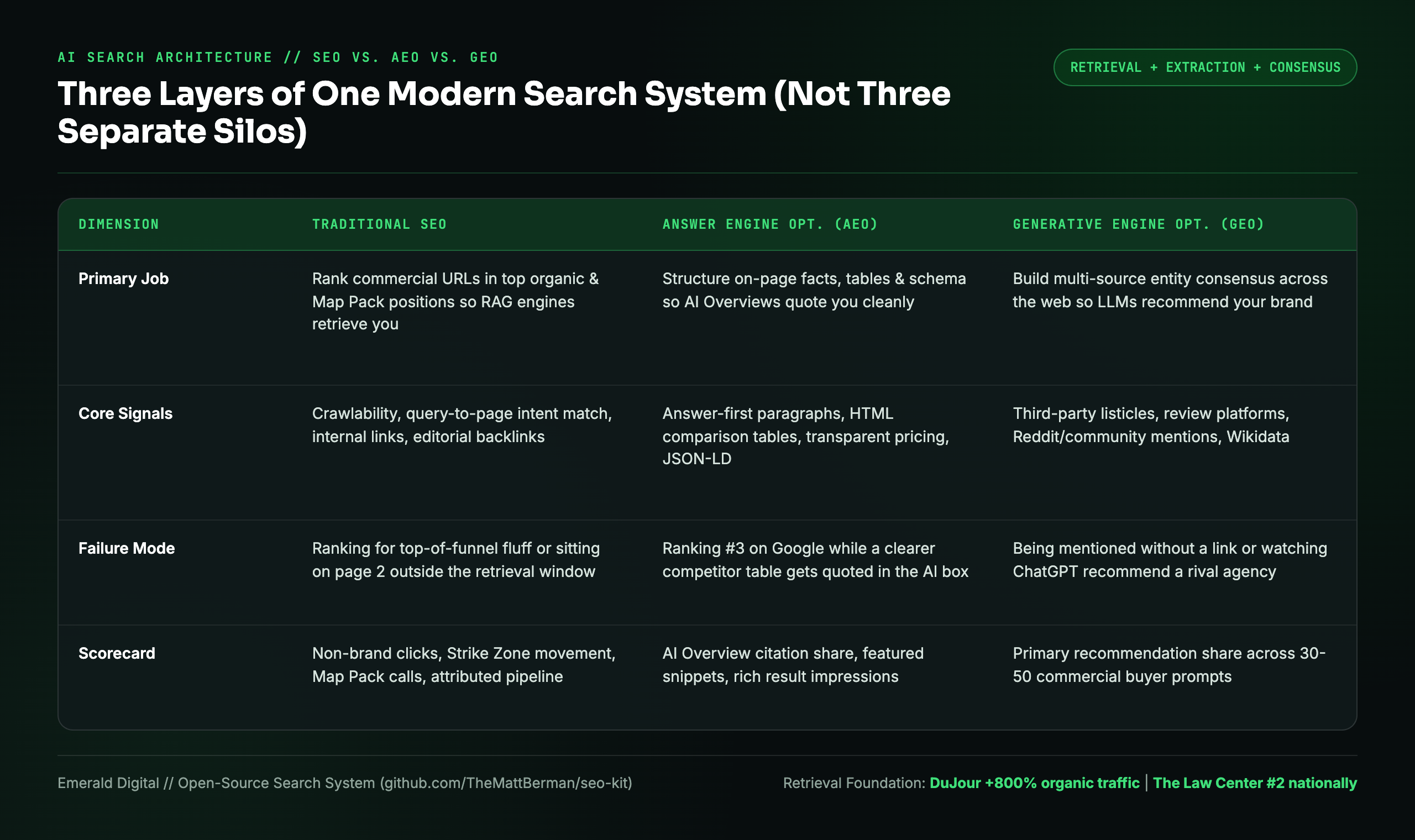
Marketers love inventing acronyms to make incremental shifts sound like a new religion. Strip away the buzzwords and you are looking at three specific jobs inside one search architecture:
- SEO (Search Engine Optimization): Earning organic rankings in Google and Bing so buyers clicking blue links find your commercial pages, and so AI search engines pull your URLs into their live retrieval set.
- AEO (Answer Engine Optimization): Structuring the information on your pages (direct definitions, comparison tables, verified pricing, and schema markup) so answer engines can extract and quote your page cleanly without hallucinating.
- GEO (Generative Engine Optimization): Engineering your brand's off-site footprint across the third-party sources large language models trust (independent roundups, review sites, Reddit communities, industry press, and knowledge graphs) so the AI recommends your company by name.
| Dimension | Traditional SEO | Answer Engine Optimization (AEO) | Generative Engine Optimization (GEO) |
|---|---|---|---|
| Primary Goal | Rank commercial URLs in top 3 organic & Map Pack positions | Get quoted as the direct factual source inside AI Overviews & answer boxes | Get named and recommended when buyers ask LLMs who to hire or buy from |
| Core Mechanism | Crawlability, query-to-page intent match, internal links, backlinks | Extractable answer blocks, comparison tables, `FAQPage` / `Service` schema | Multi-source entity consensus, third-party listicles, reviews, community mentions |
| Where the Work Happens | Your website architecture + authoritative backlink profile | On-page formatting, structured data, and clinician/operator proof blocks | Across the external web ecosystem that RAG engines and LLMs synthesize |
| Primary Failure Mode | Ranking for informational fluff that never converts into leads | Ranking on page one while a clearer competitor page gets quoted in the AI box | Being mentioned in passing without a link or losing the recommendation to a rival |
| Key Scorecard Metric | Non-brand organic clicks, Map Pack calls, attributed pipeline | AI Overview citation rate and featured snippet ownership | Share of voice and primary recommendation rate across buyer prompt sets |
If you want the deep dive on the five-step system we use to build off-site model consensus, read our complete guide to generative engine optimization.
Retrieval vs. citation: The two-stage architecture
To understand why you cannot abandon SEO for AEO, or ignore AEO while doing SEO, look at what happens under the hood when someone types a commercial question into ChatGPT Search, Perplexity, or Google.
Modern AI search runs on Retrieval-Augmented Generation (RAG). It executes in two distinct stages:
- Stage 1: Retrieval (Classic SEO). The AI engine translates the user's prompt into search queries, hits a live web index (Google's index for AI Overviews, Bing and proprietary crawlers for ChatGPT and Perplexity), and pulls back the top-ranking documents. If your site has broken indexation, thin service pages, or sits on page four, you never enter the retrieval window.
- Stage 2: Synthesis & Citation (AEO + GEO). Once the model retrieves 10 to 30 candidate pages, it reads all of them simultaneously. It looks for structured facts it can extract (AEO) and cross-source agreement on which brands are credible (GEO).
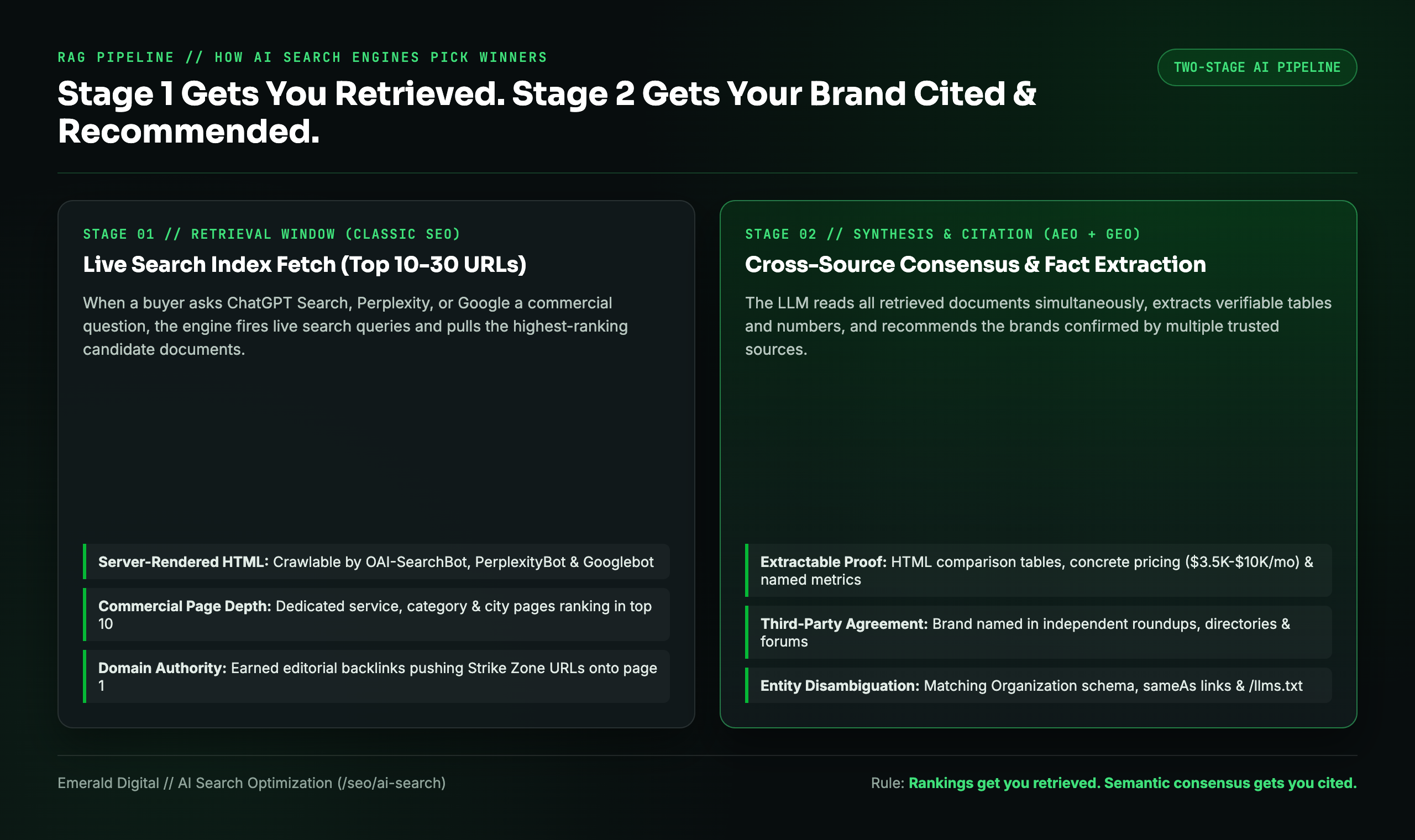
Rankings get you retrieved. Semantic clarity and multi-source consensus get you cited.
That two-stage reality explains the frustration we diagnose every week: a company ranks #3 on Google for its core service term, yet when a prospect asks ChatGPT who the best provider in that city is, the AI recommends a competitor ranked #7. Why? Because the competitor at #7 had clear pricing tables on their page and was named across four independent industry comparison guides in the retrieval set. We break down that exact failure mode in why AI recommends your competitor instead of you and the difference between being mentioned vs. cited in AI search.
"The 'is SEO dead' debate is a distraction for people who don't build search systems. Retrieval is still SEO. Citation is AEO and GEO. If you skip the first half, the model never finds you. If you skip the second half, the model reads your page, ignores your brand, and recommends your competitor."
Matthew Berman, founder, Emerald Digital
What still matters from classic SEO (do not cut this)
The fastest way to tank your AI visibility is listening to an "AEO guru" who tells you traditional rankings no longer matter. Every live AI search engine relies on classic search signals to decide which pages are worth reading in the first place:
- Commercial page depth: Dedicated, conversion-ready pages for every core service, practice area, product category, and city you serve.
- Technical crawlability: Clean canonical tags, server-side rendered HTML (many LLM crawlers do not execute heavy client-side JavaScript), fast response times, and an accurate XML sitemap.
- Authoritative editorial links: Real digital PR and earned links from relevant industry publications that push your commercial pages into the top 10 retrieval window.
- Google Business Profile & local authority: For local queries (`best personal injury lawyer in Houston`, `emergency dentist in Austin`), AI engines pull heavily from local map pack signals, review counts, and directory consistency.
When we grew DuJour's organic traffic by 800% in nine months, took The Law Center to #2 nationally for "motorcycle accident lawyer" in six months (5,800+ contacts), and drove a 482% increase in phone leads in 60 days for United Collection Bureau, that foundational retrieval power was the engine.
What is genuinely new (and missing from 90% of SEO retainers)
If your current agency is only tracking blue-link rankings and publishing 800-word generic blog posts, you are exposed on the citation side. Here are the four upgrades required to turn organic rankings into AI citations and recommendations:
1. Answer-first page structure and comparison tables
LLMs hate burying the lede. When a buyer asks about cost, timelines, or how two options compare, the model extracts the page that states the answer in the first two sentences after the heading and backs it up with a clean markdown/HTML table. Put real numbers, clear scope ranges, and direct comparisons on your commercial pages instead of hiding behind "contact us for a custom quote."
2. First-hand operator proof ("only you can write this")
AI Overviews can summarize generic textbook definitions for free, which means generic informational blog traffic is collapsing across every industry. What an LLM cannot synthesize on its own is proprietary data, real case outcomes, and first-hand clinical or operator experience. Every page you publish should contain specific workflow details, verified client metrics, or named real-world examples that force the model to cite you as the primary source.
3. Entity disambiguation and schema consistency
Your brand name, founding team, service categories, pricing floor, and verified case results should match word-for-word across your website footer, `Organization` and `Service` JSON-LD schema, LinkedIn, Wikidata/Crunchbase, and industry directories. When an LLM sees conflicting facts across domains, it drops confidence in your entity.
4. Third-party citation and listicle engineering
When someone asks an AI engine for the "best [service] companies," the model retrieves third-party comparison articles, Clutch/G2 profiles, state bar or trade directories, and Reddit threads far more heavily than individual company homepages. Earning placement inside the exact third-party comparison pages that already rank on page one for your category is the highest-leverage GEO move available.
How to run SEO, AEO, and GEO as one operating system
You don't need three budgets or three agencies. You need one search program that executes both stages of the pipeline in sequence:
- Audit your prompt set alongside your keyword rankings: Test 30 high-intent buyer questions across Google AI Overviews, ChatGPT Search, and Perplexity to see who gets retrieved and who gets recommended today.
- Push your Strike Zone commercial pages into the top 5: Focus link building and content upgrades on the commercial pages sitting between positions 5 and 20 so your domain enters the live retrieval window.
- Retrofit commercial pages for AEO extraction: Add direct summary answers, pricing/comparison tables, and validated JSON-LD schema to your top money pages.
- Close the off-site consensus gap: Secure placements, reviews, and mentions on the third-party comparison domains and industry publications the AI engines are already citing in your vertical.
We build our search and AI visibility tooling in the open. You can inspect our agentic workflows directly in the seo-kit on GitHub.
See how we get brands cited across AI search, or request a free AI search teardown: we will run your exact buyer prompts across ChatGPT, Perplexity, and Google AI Overviews, show you why competitors are getting named, and map the exact retrieval and citation fixes to take those spots.