
Usually, no. A dental practice needs a separate city page when it can help patients in that community make a distinct decision about visiting. If neighboring cities share the same office, services and reasons to visit, one useful service-area page may be enough.
Here's the sentence that gets to the heart of it:
“There is no satellite office in Lone Oak.”
It's on Smile Station's page for Lone Oak, Kentucky. Treatment happens at the practice's Paducah office. The page makes that clear and gives patients directions.
I like that sentence because it answers something a patient actually needs to know. You haven't found a dentist down the street. You've found a dentist in another community. Now you need to decide whether to go there.
That's the job I'd give a dental city page: explain why the trip makes sense, then make it easy to take.
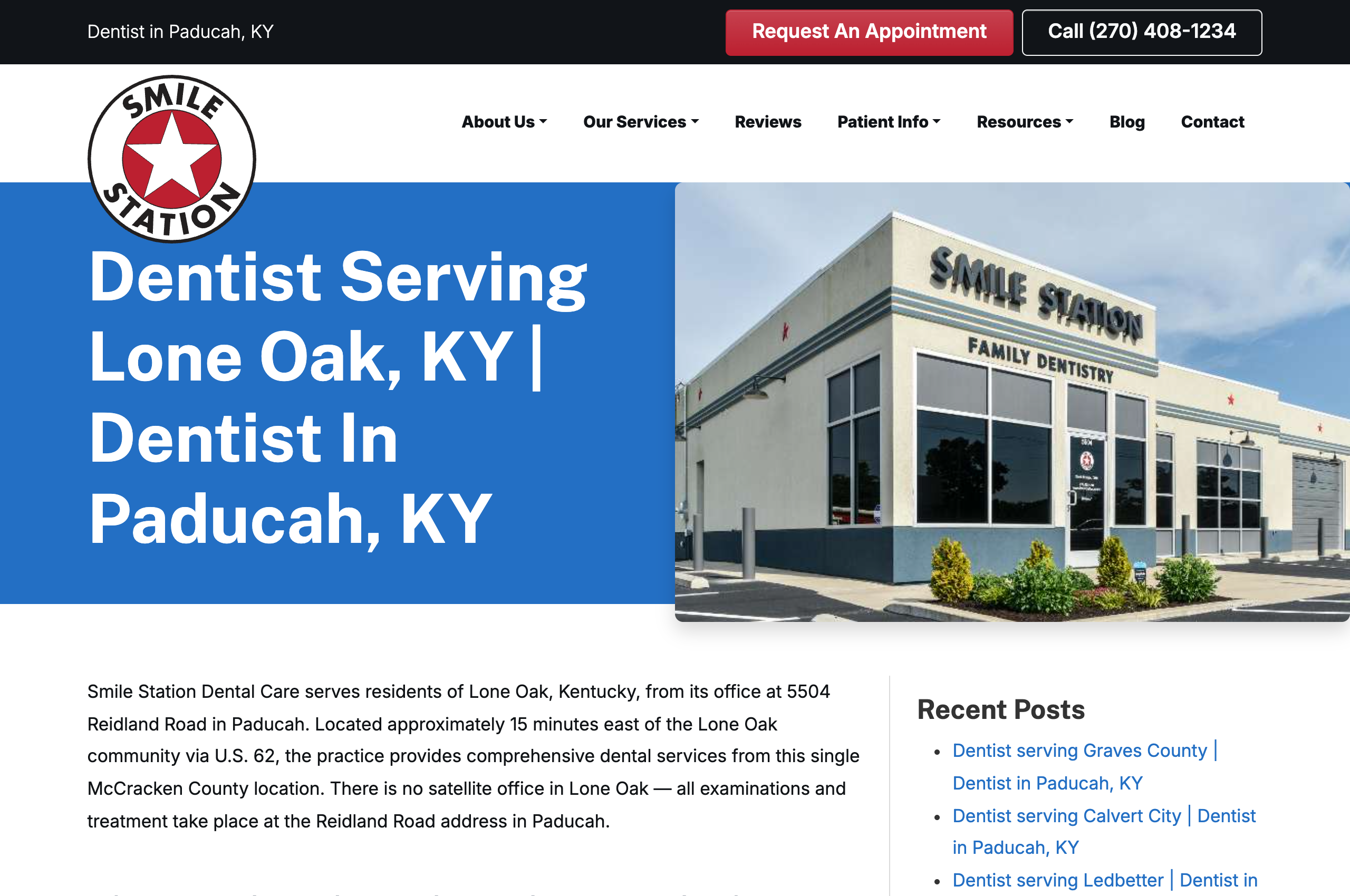
Source screenshot: Smile Station's Lone Oak page, September 4, 2026. The page makes the actual treatment location explicit.
What should a dental city page tell patients?
Start with where treatment happens. If your practice doesn't have an office in the city named in the headline, say so. Show the actual address and give people a clear route to that office's appointment options.
Then answer the harder question: why would someone choose it?
A parent trying to fit a cleaning around school pickup needs different information from someone comparing implant consultations. A person with tooth pain needs to know how to reach the office and confirm availability. A paragraph about the town's history doesn't help with either decision.
The Lone Oak page has useful location details, but it also spends space on schools, parks and community history. I'd put that space toward the questions someone might otherwise have to call and ask: Where do I park? Is this the office that offers the treatment I need? How do I check whether you accept my insurance?
Those answers still need to be true. Don't add evening appointments, language services or financing because they'd make good copy. Confirm what the office can offer, then explain it plainly.
The detail I'd fix before buying another page
Trusted Dental Care's Royse City page shows how more detail can introduce another problem.
It identifies the real office in Wylie and includes hours and directions. But one passage describes a 10-minute drive from downtown Royse City. Farther down, the directions give a 29-minute trip.
Different routes or starting points may explain the estimates. This isn't evidence that the practice provides poor care or that the page loses patients. It is something I'd clarify before publishing another version for another town.
Picture yourself checking that page between meetings. You've got time for the shorter drive. The longer one means rearranging your afternoon. Which estimate should you plan around?
The website has handed you a question instead of answering it.
This is where I'd bring the front desk into the review. Ask which starting point the directions use and whether the travel estimate needs a traffic caveat. Then agree on who updates the information when something changes. Giving a writer the right facts once doesn't keep every page accurate forever.
When is one service-area page enough?
Second Line Family Dentistry takes a simpler approach. Its regional page identifies the Metairie office and welcomes patients from communities including Elmwood, Kenner and New Orleans. It also provides the address and office hours.
There's no need to make a reader infer where they'll receive care.
If your surrounding communities share the same destination and appointment process, I'd start there. Explain who you serve and how to visit. Add a separate page when you have something useful to say that doesn't belong just as comfortably on that regional page.
A different route can be worth explaining. A difficult transit connection might need its own arrival guidance. But a route paragraph alone doesn't automatically justify a new URL. It may fit perfectly well on your existing page.
I'm not arguing that fewer pages rank better. These examples don't establish search performance. I'm asking whether the extra page saves a patient work.
Why “nearby” isn't a complete answer
A US study published in JAMA Network Open examined geographic access to dental clinics. Its limitations matter here: driving-time estimates assume access to a car, and the analysis didn't account for dental insurance coverage or health literacy.
The study doesn't test dental websites. It does give us a reason to be careful about treating distance as the whole access question.
For your page, I'd translate that into practical information. Explain transit or parking where relevant. Tell people how to confirm insurance participation. If you mention appointment availability, make clear whether they can book a slot or are sending a request that someone still needs to confirm.
“We're close” leaves a lot unsaid. Help the reader work out whether an appointment will actually fit their life.
How to decide whether another city page is worth building
Before you approve the next page, finish this sentence:
A patient in ___ would travel to our office in ___ for ___ because ___.
I'd spend most of the review on that last blank. “We're friendly and provide quality dentistry” doesn't explain why someone would pass other offices to reach yours.
Use this short worksheet with the person who knows the office's day-to-day arrangements:
| Question | What you need before approving the page |
|---|---|
| Where will this patient receive treatment? | The actual office address, with no suggestion of a location that doesn't exist. |
| What does this community need to know? | A relevant arrival issue, access detail or reason to visit that you can verify. |
| Can the patient take the next step? | A working call or booking path that explains what happens next. |
| Does this information need a separate page? | A reason it wouldn't be clearer on your office, service or regional page. |
| Who keeps it accurate? | A named person responsible for changes to hours, directions and appointment language. |
If you can't identify a meaningful difference, put the useful information on an existing page. You can revisit the decision when you have more to say.
Are dental city pages against Google's rules?
Not automatically. Google's doorway-abuse policy addresses pages created for similar search queries that act as less-useful intermediate steps. Its examples include city-targeted pages that funnel visitors toward one destination.
That isn't a verdict on the practices discussed here. It is a reason to question a plan built around swapping city names into otherwise similar pages.
If you already have city pages, don't delete them based on that description alone. Review their search traffic, inquiries and incoming links before deciding what to keep or combine. Plan appropriate redirects for any pages you remove.
I'd begin with one page, not a site-wide rewrite. Open it on your phone and try to arrange a visit using only what's there. Note every question you still need answered.
That takes us back to Lone Oak. “There is no satellite office” isn't an impressive marketing line. It's an honest answer that lets the patient move on to the next decision.
Give the rest of your page the same job.
If you're deciding which pages your practice needs, see Emerald Digital's approach to dental SEO.
Research note: This article draws on selected public dental pages checked September 4, 2026, plus the linked research and Google guidance. The examples aren't a representative sample or evidence of rankings, conversions or patient outcomes. Published travel times weren't independently tested. No practices were called and no appointments were requested.