
Almost every new dental patient follows the exact same three-minute sequence before booking an appointment. They type a treatment or `dentist near me` into Google on their phone, scan the top three clinics in the Map Pack, check review counts and recent photos, and click through to confirm insurance, parking, and appointment availability.
The practice that owns that three-minute window fills its hygiene chairs and surgical schedule without begging for referrals. The practice that sits at position #6 on the map or buries patients in generic blog fluff ends up paying Google Ads per click forever just to keep the schedule full.
Our local and commercial SEO system is built for markets where the Map Pack and high-ticket service pages decide everything. Using this exact system, we drove a 482% increase in phone-call leads in 60 days for a local-service company (United Collection Bureau) and took The Law Center to #2 nationally in six months (5,800+ contacts) in one of the hardest YMYL categories on the web. Here is how to run that playbook for a dental practice.
Map every patient search to the page that books the chair
Most dental marketing agencies sell you "SEO" and spend six months ranking your homepage for your own practice name while publishing generic 500-word blog posts about flossing.
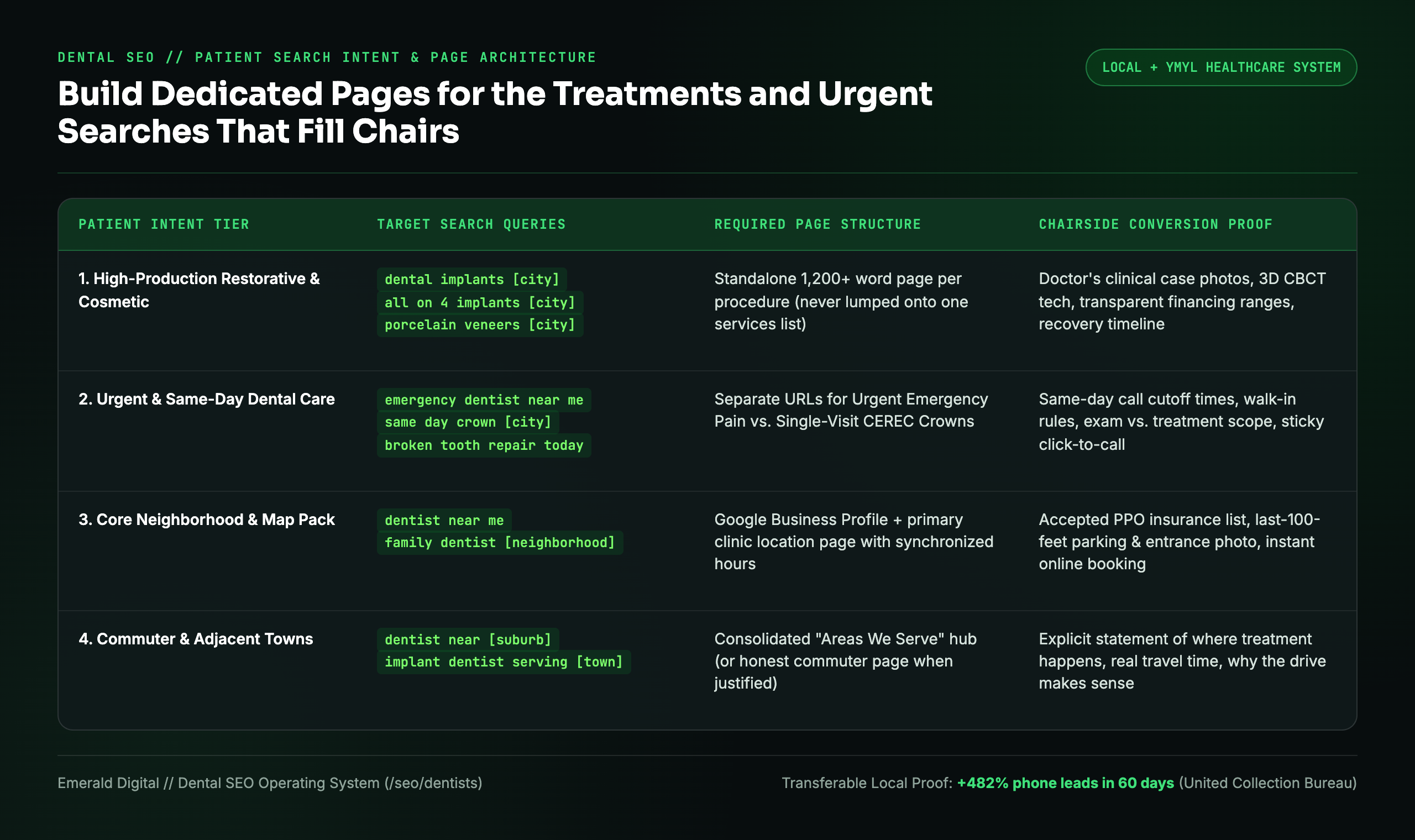
Patients typing your practice name into Google already have your referral card or drive past your sign every morning. They are existing demand. Net-new patients search by symptom, urgency, treatment, or neighborhood. If your site lumps all of your procedures onto a single bulleted "Services" page, you will never rank for the treatments that actually drive practice production.
| Patient Search Category | Example High-Intent Queries | Target Page Architecture | What Converts the Patient on the Page |
|---|---|---|---|
| High-Production Restorative & Cosmetic | `dental implants [city]`, `all on 4 implants [city]`, `porcelain veneers [city]`, `invisalign dentist [neighborhood]` | Dedicated 1,200+ word commercial page per procedure (never combined onto one general page) | Doctor's clinical case photos, CBCT/3D scanner tech, transparent cost/financing ranges, consult expectations |
| Urgent & Same-Day Care | `emergency dentist near me`, `same day crown [city]`, `broken tooth repair today` | Dedicated emergency & same-day page with sticky mobile click-to-call | Honest explanation of same-day exam vs. treatment availability, walk-in rules, after-hours triage instructions |
| Core Family & Preventive Local Pack | `dentist near me`, `family dentist [neighborhood]`, `pediatric dentist [city]` | Google Business Profile + primary location hub page | Accepted PPO insurance list, exact parking and entrance directions, online booking confirmation clarity |
| Regional & Neighboring Commuter Towns | `dentist near [adjacent town]`, `implant dentist serving [suburb]` | Consolidated regional service-area page (or distinct city page only when warranted) | Explicit statement of which office provides treatment, real driving/transit directions, why the trip makes sense |
Next step
Find the SEO opportunities you should own.
See how we win local search and the Map Pack for dentistsWin the Google Map Pack first (`local seo for dentists`)
For `dentist near me`, `emergency dentist [city]`, and neighborhood queries, the Google Map Pack sits above the organic blue links and captures the majority of mobile calls. Ranking in the top three of the Map Pack is not luck; it is an engineering checklist across four signals:
- Category precision on your Google Business Profile (GBP): Set `Dentist` as your primary category (or `Cosmetic dentist` / `Dental clinic` depending on your core focus), and add every accurate secondary category your doctors actually perform: `Dental implants periodontist`, `Emergency dental service`, `Teeth whitening service`, `Pediatric dentist`, and `Orthodontist`.
- Complete treatment and insurance attributes: Fill out the native Services menu inside GBP for every procedure, upload real interior, exterior, and clinician photos (never stock imagery), and keep your holiday and Friday hours synchronized across your GBP, website body, and footer.
- Consistent review velocity: A practice that earns 8 to 12 new five-star patient reviews every month will outrank a clinic sitting on 150 stagnant reviews from two years ago. Automate a post-visit text request through your practice management system right after checkout so happy patients mention the specific hygienist, doctor, and treatment.
- Practitioner listing hygiene: In multi-doctor practices, unmanaged individual dentist GBP listings often cannibalize the main practice profile or display outdated phone numbers. Consolidate or properly nest practitioner profiles so the main clinic owns the Map Pack impression.
Stop building doorway city pages (and fix the access details patients actually need)
One of the worst habits in dental SEO is paying an agency to spin up 15 identical "Dentist in [Nearby Suburb]" pages where the only difference is the town name swapped into the H1 and a paragraph about local parks. Google explicitly classifies those as doorway abuse, and prospective patients hate clicking a page for their town only to realize halfway down that you don't have an office there.
Instead of mass-producing doorway pages, win local commuters by answering the four operational questions that actually determine whether a patient books and shows up:
- Be upfront about where treatment happens: Read our breakdown on whether dentists actually need a page for every nearby city. If a patient in a neighboring town will be treated at your main office, state that clearly in the opening paragraph and explain why the 15-minute drive is worth making.
- Give real arrival, parking, and transit instructions: A map pin doesn't tell an anxious first-time patient which lot to use, which door leads to the suite, or which bus route stops out front. See how top practices handle this in our guide to dental website directions and patient access.
- Keep hours and booking links synchronized everywhere: Nothing kills trust faster than a city page listing Friday closing at noon while the website footer says 1 p.m. Establish a single source of truth using our dental website maintenance workflow.
- Define what "Same-Day" and "Book Now" actually mean: Make sure your urgent-care pages clearly distinguish between a same-day exam, CEREC one-visit crowns, and an unconfirmed appointment request. We cover the exact copy checklist in what same-day dentistry should mean on your website.
Clear Google's YMYL healthcare bar with clinician-led copy
Dentistry sits squarely inside Google's YMYL (Your Money or Your Life) healthcare classification. Google holds dental pages to its highest standard for clinical experience, expertise, and trust, and AI Overviews already summarize generic textbook symptoms for free.
If your agency is publishing AI-written blog posts titled *"5 Benefits of Dental Implants"* or *"Why Do My Gums Bleed?"*, you are wasting money. Ten thousand dental websites already published that exact article.
Here is the editorial workflow we use to clear the healthcare bar and rank treatment pages fast:
- Interview the practicing dentist for 20 minutes. We ask the questions only a clinician can answer: *What makes a patient a candidate for immediate-load implants vs. staged bone grafting in your operatory? What imaging technology do you use during the consult? What surprises patients most about day-three recovery? How do you structure phased treatment plans or third-party financing?*
- Put the doctor's byline, credentials, and clinical workflow directly on the treatment page. We pair the procedure steps with `Dentist`, `MedicalProcedure`, and `FAQPage` schema markup.
- Enforce the "only you can write this" rule. Every treatment page must include specifics from your actual clinic, equipment, and scheduling desk that an AI Overview or a content mill could never fabricate.
"Every dental website in your city has the same stock photo of a smiling retiree and the same three paragraphs about implants. The one asset no competitor can copy is your doctor's actual chairside process and how your front desk handles anxious patients. Put that on the page and both Google and the patient trust you immediately."
Matthew Berman, founder, Emerald Digital
How the Dental Strike Zone compounds new patient flow
You don't need to wait a year to see new patients from organic search. The fastest chair-filling wins sit in your Strike Zone: the commercial treatment and neighborhood queries where your site already ranks between positions 5 and 20 in Google Search Console.
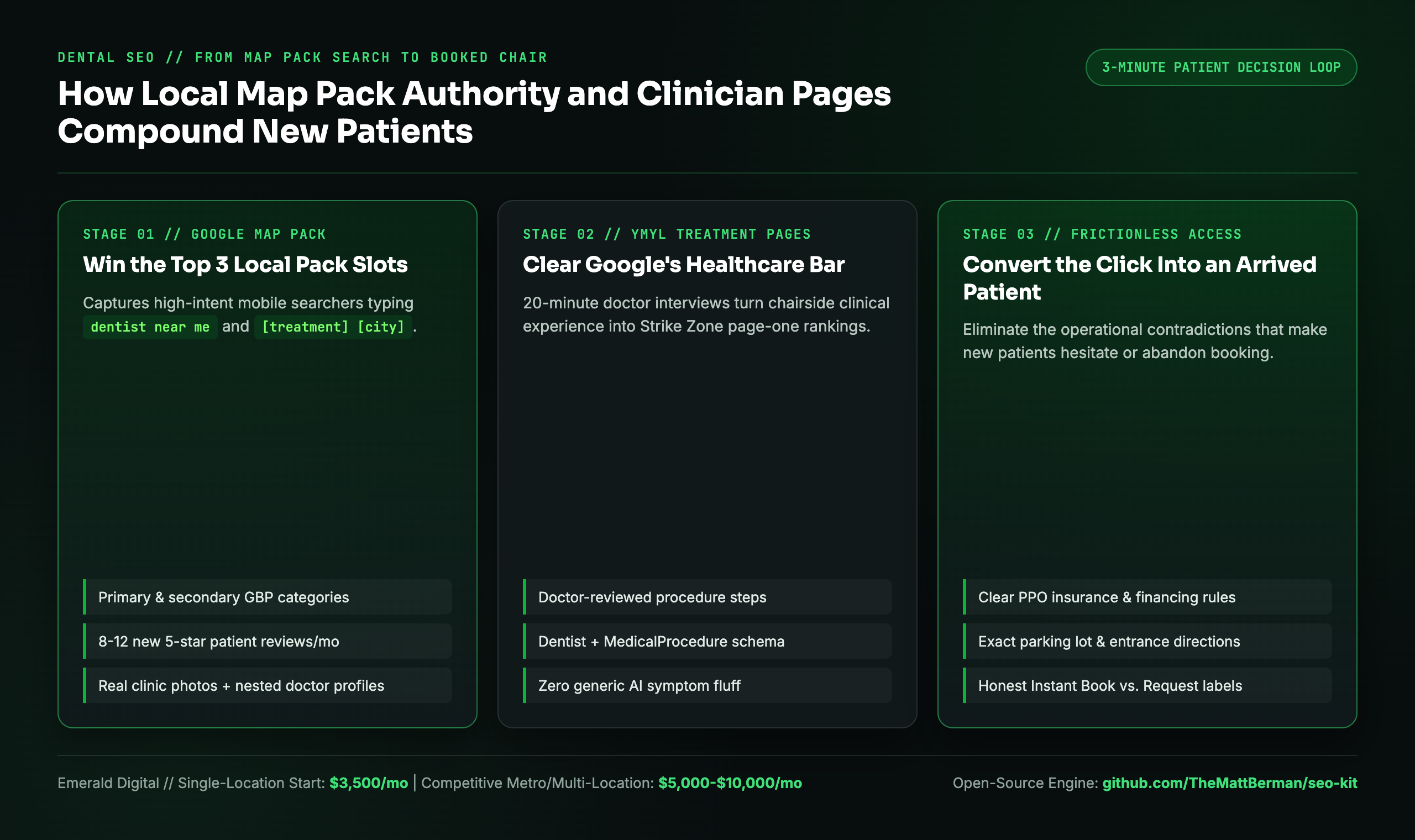
When your `dental implants [city]` or `emergency dentist [neighborhood]` page sits at position 11, it is on page two earning almost zero calls. Upgrading that single page with clinician-reviewed depth, clear financing and insurance answers, internal links, and local authority moves it into the top 5, where click volume jumps 4x to 6x.
Our retainers start at $3,500/month for focused single-location practices and $5,000 to $10,000/month for competitive metro implant/cosmetic practices and multi-location groups, built on our open-source agentic search engine (the seo-kit on GitHub).
See how we win local search for dentists, explore our broader SEO system, or request a free dental SEO teardown: we will show you who owns the Map Pack and high-value treatment keywords in your zip code today, where your Strike Zone pages sit, and the exact plan to fill your schedule.