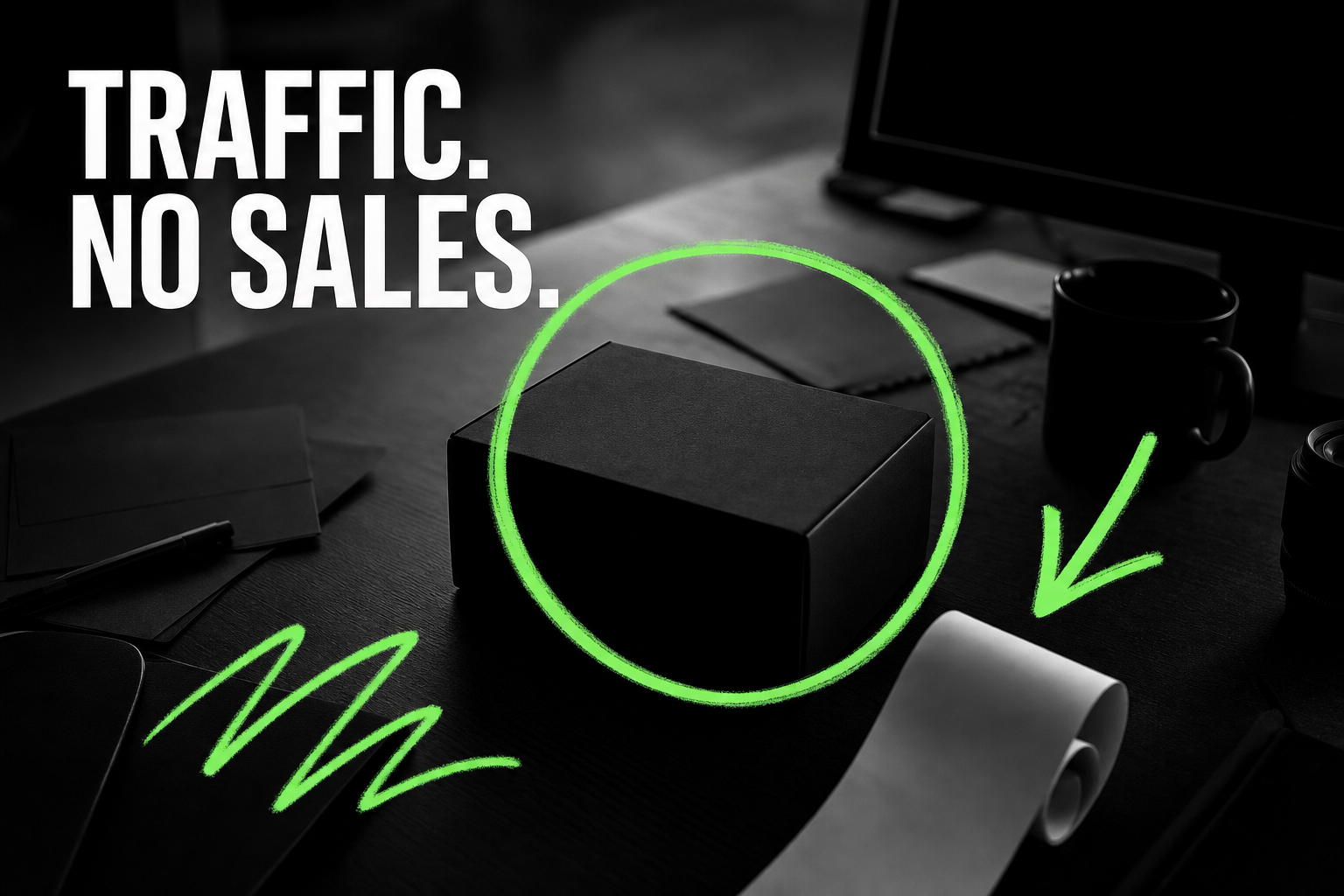
Analytics says organic is growing. Shopify says the money isn't.
Those two facts can both be true. Sessions are a count of visits. Revenue is a count of people who found a product they would buy and were allowed to finish.
If you treat sessions as the win, you will keep publishing and keep wondering.
Separate demand from decoration
Open the landing pages for the last 90 days. Tag each one.
Brand. Your name, your trademark, "login," "order status." Recapture. Not new demand.
Journal / blog. Guides, trends, "how to style." Fine as support. Fatal as the core of Shopify SEO.
Collection browse. Broad category traffic. Can sell if merchandising is tight. Often just window shopping.
Product. A specific SKU or close variant. This is where new revenue usually lives.
Junk. Other countries you don't ship to, out-of-stock URLs, parameter copies.
| Landing type | Demand or decoration? | What to do |
|---|---|---|
| Brand | Recapture | Keep it. Don't call it growth |
| Journal / blog | Decoration unless it sells a SKU | Point hard at one product or demote |
| Collection browse | Maybe | Fix merchandising before more keywords |
| Product | Demand | Rewrite Strike Zone URLs first |
| Junk / facets | Decoration | De-index |
If the growth is in brand plus journal, you didn't build a store in search. You built a magazine that happens to have a cart.
We grew DuJour's web traffic 800% in nine months. That's a real search result. It's also a media brand. For a Shopify store, the graph that matters is organic revenue and new customers, not a media-style session spike.
The product page is the money page
A shopper who typed the product, the use, or the comparison should land on a page that can sell it.
Title and first screen match the query. Price and availability are honest. Photos answer the doubt. Reviews are about this product. Shipping and returns aren't a scavenger hunt. The variant picker works on a phone.
If any of that's broken, SEO can "work" and the store still misses. You paid for the click in time and links, then lost it in the last fifteen seconds.
This is the commerce version of website traffic with no leads. Same leak. Different cart.
Collections rank. They don't automatically sell.
Collection pages are easy to rank and easy to waste.
The query is broad. The page is a grid. No point of view. Filters are slow. Best sellers are buried. Out-of-stock tiles still show. The copy is a keyword paragraph nobody reads.
A collection should help a human choose, then pass them to a product. If it can't do that, ranking it only increases refund-rate-adjacent browsing: lots of sessions, thin intent.
Merchandising is SEO here. Not another 600 words of "welcome to our shop."
Theme, speed, and indexation quietly steal the graph
Shopify makes it easy to index nothing useful and everything junk.
Facet URLs, vendor pages, tagged copies, stale discounts. Google crawls the mess. Your good product pages share crawl with garbage.
A slow theme on mobile will rank and still not sell. The back button is free.
If thousands of pages should rank and aren't in the index, you have a coverage problem, not a blogging problem. Fix robots, canonicals, and the sitemap before you write another guide.
Paid won't save a leaky product page
If you're buying Shopping or search ads onto the same URLs, you will see the leak as CPA. Clicks with no conversions is the paid name for this article.
Clean the page and the feed first. Then the same click is worth more. We generated $3.4M in qualified pipeline for Lumini in 60 days at $12.59 a lead. That was paid discipline on a product launch, not a blog strategy. The transferable rule: match the query, track the outcome, don't celebrate the session.
What to do in one working session
Export landing pages, queries, and revenue (not just sessions).
Find the product URLs that already get impressions and sit in positions 5 to 20. Those Strike Zone pages are the first rewrite.
Find journal URLs with traffic and no assisted revenue. Demote them in internal links. Point them at one product, hard.
Find collections with traffic and high bounce. Fix merchandising before you chase more keywords.
Check indexation on the SKUs you actually sell. If they're excluded, stop writing.
What not to do
Don't start a "content engine" to paper over a catalog Google can't find.
Don't chase 'best [category] 2026' until the product pages convert.
Don't celebrate branded organic as if it were new customers.
Don't invent conversion rates to make a report look like a win. If you don't have a store-level receipt, say what you know: traffic moved, revenue didn't, here is the page-level leak.
The teardown
We'll show you which queries create buyers, which pages are decoration, and what to fix first. See how we rank the ecommerce pages that sell, or get a free SEO teardown.
For the category playbook, the sibling drafts are the Shopify and ecommerce SEO guides. This page is the pain: the sessions already arrived.
---
FAQ
Why is my Shopify store getting traffic but no sales?
Usually the traffic is branded, blog, or the wrong collection, or the product page cannot finish the sale. Rankings on 'what is' content and category browsing inflate sessions. Revenue comes from product and commercial-intent pages that match what the shopper typed.
How do I know if Shopify SEO is working?
Track revenue and new-customer orders back to landing page and query, not just sessions. If organic growth is mostly your brand name and journal posts, SEO is recapturing demand, not creating it.
Should I blog to grow Shopify traffic?
Blog when the article creates demand for a product you sell, and links to that product like a store, not a magazine. A journal that ranks and never sends a buyer is a traffic hobby. We would rather rank the product and collection pages that sell.
Why do my collection pages get traffic but not convert?
The collection ranked for a broad browse query, and the merchandising does not help the shopper choose. Too many SKUs, weak titles, no proof, slow filters. The click was a browse. The page treated it like a dump.
Is it better to rank product pages or the homepage?
Product and collection pages. The homepage is for people who already know you. New revenue comes from the URL that matches the product or the job the shopper searched.