
Contents
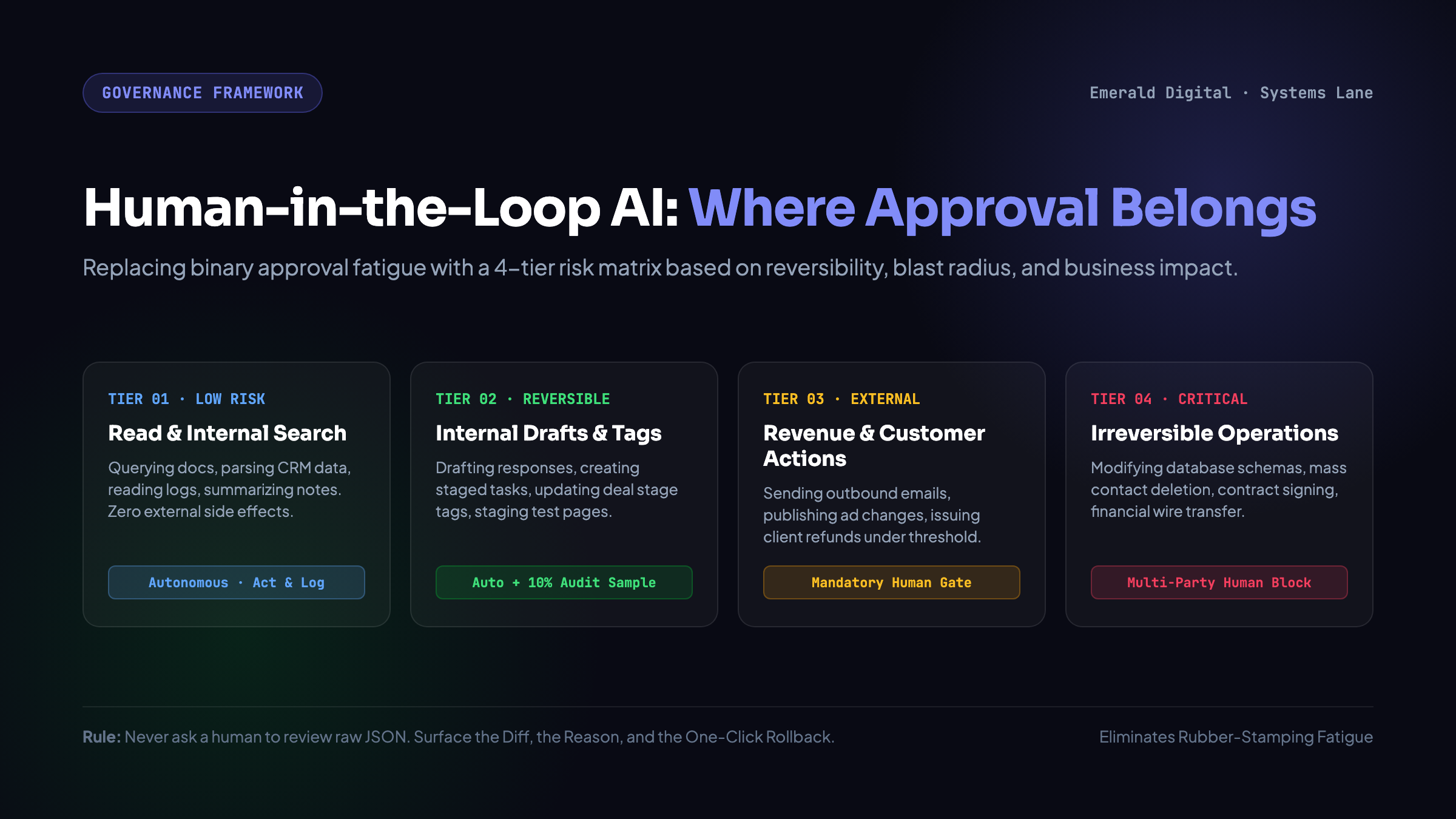
When leadership teams begin deploying AI agents into operational workflows, they almost always swing between two destructive extremes.
The first extreme is the Autonomous Cliff.
An enthusiastic engineering team builds an autonomous agent, grants it write access to production APIs, connects it to customer communication channels, and lets it run unattended. Within weeks, the system encounters an ambiguous edge case that was never covered in prompt instructions. The agent promises an unapproved discount to an enterprise buyer, overwrites critical CRM pipeline stages, or deploys thousands of dollars in ad spend against misconfigured keywords. Trust collapses, and leadership bans AI across the organization.
The second extreme is the Rubber-Stamp Bottleneck.
Chastened by safety concerns, management mandates that a human operator must review and approve every single action the model takes. The result is instant operational gridlock. A marketing manager receives 180 Slack notifications a day asking for permission to read a web page, summarize a transcript, or generate a draft tag.
Faced with overwhelming notification volume, the human stops evaluating the work. They begin clicking "Approve" reflexively just to clear their screen. The organization now suffers from the worst of both worlds: zero automation velocity, and zero genuine safety.
Human-in-the-loop (HITL) engineering is not about checking every step. It is the disciplined science of determining where approval belongs based on two objective engineering criteria: reversibility and blast radius.
The governing principle: Reversibility versus blast radius
To build an automation system that scales safely, you cannot evaluate tools or actions using vague concepts like "importance." You must evaluate every tool an AI agent can execute against two technical axes.
1. Reversibility
Can this action be cleanly, completely, and cheaply undone if the model makes an error?
Updating a draft document in a staging environment has 100 percent reversibility. If the AI hallucinates, you revert the file or delete the scratchpad. No customer ever saw it, no partner was offended, and no financial balance changed.
Sending an unvetted email directly to a prospective client has near-zero reversibility. Once the bytes leave your mail server, the communication is permanent. An awkward or inaccurate sentence permanently alters the prospect perception of your brand.
2. Blast Radius
What is the maximum potential downside if the action fails catastrophically?
A miscalculated internal task tag carries a blast radius of zero. A miscalculated automated refund script or an unconstrained ad-budget reallocator carries a financial blast radius directly proportional to your credit line or bank balance.
When you plot every operational task along these two axes, an objective governance model emerges.
The 4-tier operational risk matrix
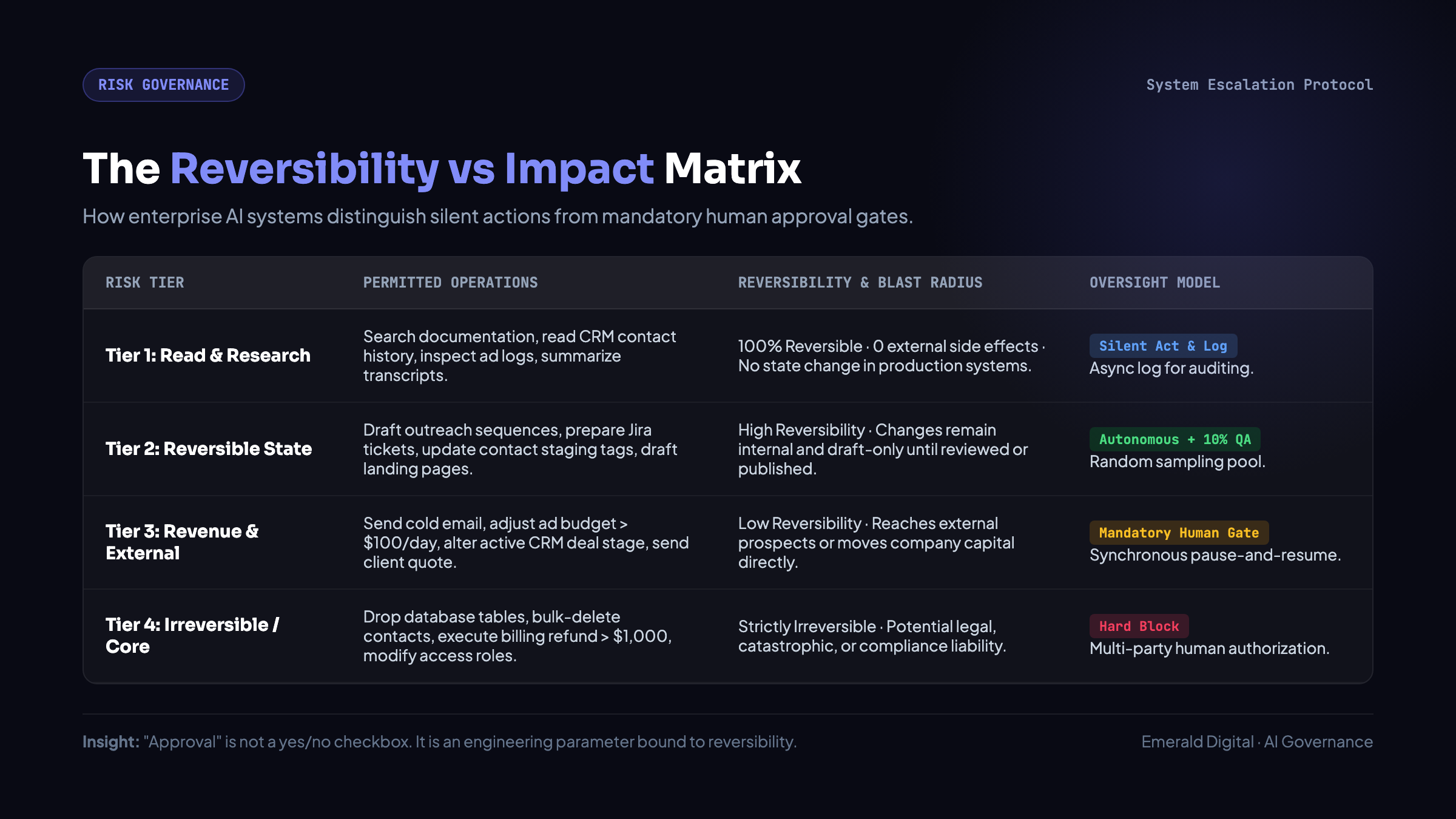
Rather than debating approval policies on a case-by-case basis, robust enterprise workflows categorize every action into one of four standardized risk tiers.
| Risk Tier | Operational Scope and Capabilities | Reversibility and Blast Radius | Default Oversight Model |
|---|---|---|---|
| Tier 1: Read and Research | Search documentation, inspect CRM history, read ad account logs, summarize meeting notes | 100% Reversible; zero external side effects; no state changes in live systems | Autonomous (Act and Log): Executes silently and records execution metadata to an audit log |
| Tier 2: Reversible Internal Changes | Generate draft email replies, create staging tickets, update deal tags, build scratchpad landing pages | High Reversibility; changes remain internal and draft-only until published | Autonomous with Sample QA: Executes automatically; 5 to 10 percent of outputs routed to asynchronous review |
| Tier 3: Revenue and External Actions | Send external emails, alter active deal stages, adjust ad campaign budgets, send client proposals | Low Reversibility; touches external buyers, active pipeline, or operational capital | Mandatory Human Approval Gate: Synchronous pause-and-resume; execution freezes until sign-off |
| Tier 4: Critical and System Operations | Drop database tables, bulk-delete contacts, issue large billing refunds, modify user permissions | Strictly Irreversible; potential severe legal, financial, or compliance liability | Multi-Party Authorization: System-level hard block; requires dual human credentials to proceed |
Tier 1: Read and Research (Silent Execution)
Tier 1 represents pure data retrieval and qualitative synthesis.
The agent queries your knowledge base, parses an inbound lead corporate website, inspects yesterday's Google Ads conversion metrics, or summarizes a 45-minute sales call. Because the agent is only reading information and structuring insights into memory, there is zero risk of damaging external operations.
These actions should execute autonomously with zero human intervention. The system writes the tool call, parameters, and response into a structured log for post-hoc telemetry, but never interrupts an operator.
Tier 2: Reversible Internal State (Sample Auditing)
Tier 2 represents actions that modify internal systems, but in ways that are contained, draft-only, and easily rolled back.
Examples include:
- Creating a suggested response in a customer support ticket without sending it.
- Drafting an initial research brief for an Account Executive before an upcoming call.
- Tagging an inbound company in HubSpot as "High Fit / Enterprise" based on firmographic enrichment.
- Building a draft variant of a landing page inside your CMS staging environment.
Because these changes do not touch external buyers, requiring synchronous sign-off for each item reintroduces the rubber-stamp problem. Instead, Tier 2 actions execute automatically, while a background job routes a random 10 percent sample to an asynchronous quality assurance dashboard.
If the error rate within the sample stays below 2 percent across 500 consecutive executions, the system maintains autonomy. If errors rise, the system automatically dials back permissions and alerts operations.
Tier 3: Revenue and External Actions (The Human Gate)
Tier 3 represents the critical boundary where internal data turns into external action.
Whenever an agent attempts to:
- Transmit a message to a customer or prospect.
- Adjust daily advertising spend above a predefined threshold.
- Move a high-value enterprise deal to a closed-lost or disqualified stage.
- Generate and dispatch a binding commercial contract.
Execution must freeze. The state machine pauses, preserves all working memory, and dispatches a structured review request to the designated human operator.
Tier 4: Critical and Irreversible Operations (Hard Blocks)
Tier 4 consists of operational actions that no autonomous agent should ever be permitted to execute alone under any circumstances.
Mass data deletions, modifying production database schemas, issuing financial payouts above strict thresholds, or changing user authentication credentials must remain strictly locked behind multi-party human controls. The agent may prepare the analytical justification or stage the script, but the execution key remains entirely in human hands.
The anatomy of an effective reviewer interface
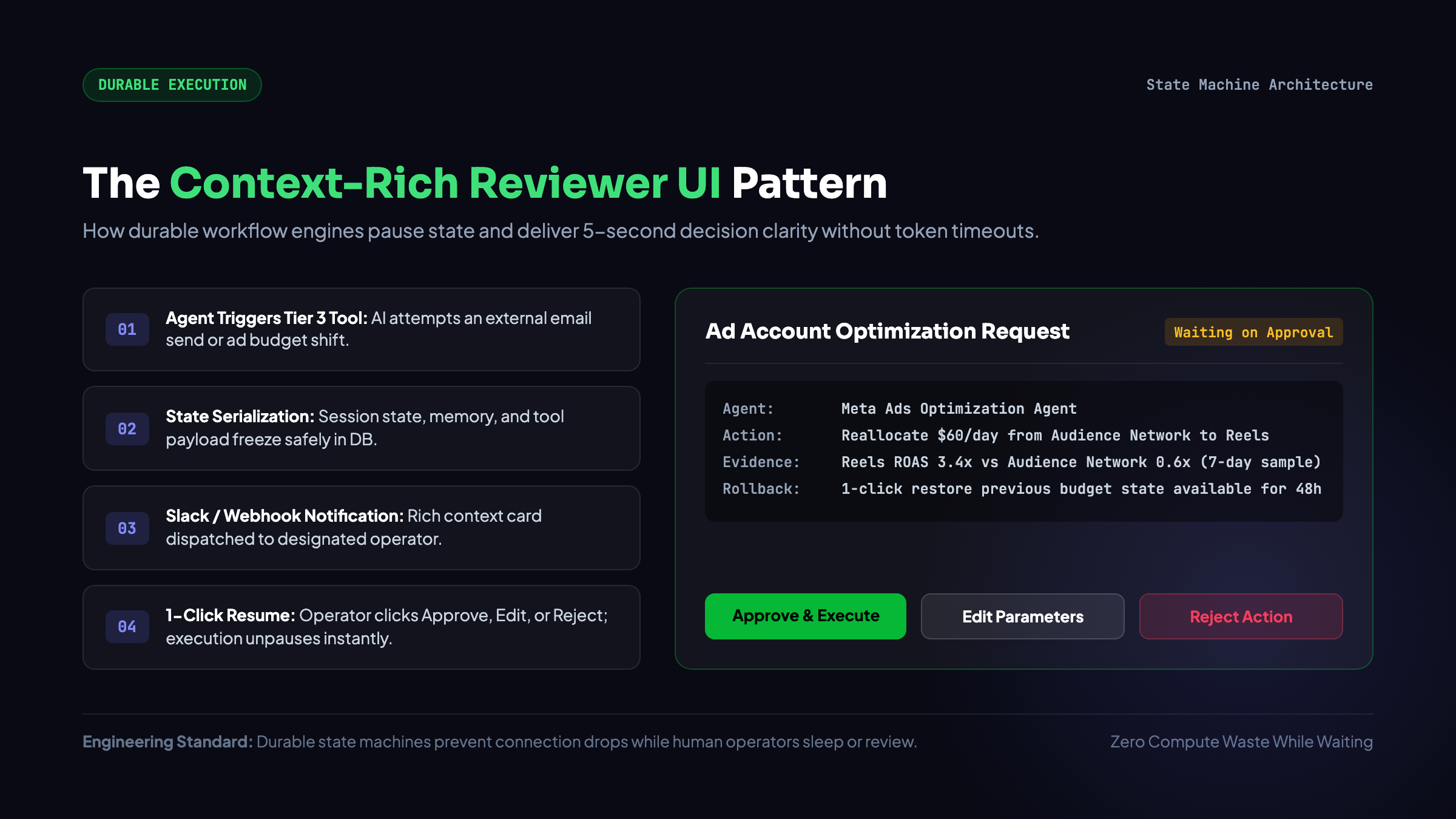
The primary reason human-in-the-loop systems break down is poor reviewer interface design.
If you send a human operator a raw JSON payload in Slack and ask them to click "Approve" or "Reject," you are inviting failure. Human beings cannot effectively parse 60 lines of nested JSON syntax while sitting in an airport terminal or between back-to-back meetings.
An effective approval card presents three specific components:
- The Proposed Action (The Diff): A plain-English, visual diff showing exactly what will happen. (e.g., *"Reallocate $60/day from Meta Audience Network to Instagram Reels"*).
- The Justification and Evidence: The specific data points that led the model to this recommendation. (e.g., *"Reels generated a 3.4x ROAS over the last 7 days across 18 ad sets, while Audience Network generated 0.6x"*).
- The Rollback Horizon: Explicit notice of how long the action can be undone after execution. (e.g., *"State can be restored with one click for the next 48 hours"*).
Crucially, the interface must provide three distinct response buttons, not two:
- Approve and Execute: The state resumes and the action takes effect immediately.
- Edit Parameters: The operator modifies the specific variable (e.g., changing "$60/day" to "$30/day") and approves without restarting the workflow.
- Reject Action: The workflow is cancelled, and the operator is prompted for a one-sentence reason that is logged back into the prompt evaluation dataset.
Durable pause-and-resume architecture
A common technical flaw in basic agent implementations is relying on synchronous HTTP requests while waiting for human input.
If an agent attempts an action and waits on a long-polling API call, network timeouts, server restarts, or worker scaling will kill the process within minutes. If the human operator takes two hours to reply, the entire workflow crashes and burns compute tokens.
Production AI systems decouple execution using durable state machines (such as Temporal or native persistent workflow orchestrators).
When a Tier 3 action is triggered:
- The engine serializes the complete workflow state, environment variables, message history, and tool payload into a persistent database record.
- The active compute worker terminates cleanly. Zero CPU cycles or API tokens are consumed while waiting.
- The system registers a webhook listener tied to the unique workflow execution ID.
- When the operator clicks "Approve" in Slack or an internal dashboard, the webhook fires.
- A fresh worker rehydrates the serialized state from the database and continues execution from the exact line where it paused.
The system can sleep for 30 seconds or three days without losing context or dropping connections.
Earned autonomy: The path to scalable operations
The ultimate objective of a mature AI operations strategy is not to keep humans locked in low-leverage review loops forever. It is to establish a rigorous, data-driven framework for earned autonomy.
Every workflow begins with conservative parameters: strict Tier 3 approval gates across all external touchpoints. As the system runs, your operational telemetry tracks:
- The percentage of suggestions approved without modification.
- The specific fields operators frequently edit.
- The qualitative reasons behind operator rejections.
When a specific workflow achieves a 99 percent unedited approval rate across 1,000 live runs, the governance committee can safely graduate that specific task from Tier 3 (mandatory synchronous approval) to Tier 2 (autonomous execution with 10 percent sample auditing).
You systematically expand automation velocity while maintaining absolute control over your commercial downside.
To learn how we design, open-source, and manage senior-led automation systems for growing companies, explore our AI workflow systems or read our breakdown of AI lead qualification architecture.
Frequently asked questions
What is Human-in-the-Loop (HITL) in the context of business AI workflows?
Human-in-the-loop AI is an operational architecture where automated software agents execute routine data processing and drafting, but pause execution before high-consequence, irreversible, or revenue-impacting actions to require explicit sign-off from a qualified human operator.
What is approval fatigue in AI systems and how do you prevent it?
Approval fatigue occurs when a system requires human sign-off on trivial, low-risk actions, such as reading documents or creating draft tags. Overwhelmed human reviewers begin blind-clicking approval buttons without evaluating the output. It is prevented by automating low-risk, easily reversible tasks silently and reserving human gates exclusively for external communications, financial transfers, or irreversible database changes.
How does reversibility determine the oversight level of an AI agent?
Reversibility measures the financial, operational, and reputational cost of undoing an action if the model errs. Creating a draft email or internal note has zero blast radius and can be rolled back instantly, requiring minimal oversight. Sending an unvetted message to 5,000 customers or modifying live ad budgets carries high blast radius and low reversibility, requiring a synchronous human approval gate.
How do durable state machines handle long pauses while waiting for human review?
Durable workflow engines serialize the complete execution state, variables, and tool parameters to a database and safely suspend active execution. When an operator approves or edits the request via Slack or an internal dashboard hours later, the state is rehydrated and execution resumes without connection drops or compute waste.