
Contents
For more than a decade, B2B revenue operations relied on static, points-based lead scoring.
Marketing automation platforms instructed administrators to invent arbitrary numbers: award 5 points for downloading an eBook, 10 points for visiting the pricing page, and 15 points if the company claimed to have more than 100 employees. When a prospect crossed an artificial 50-point threshold, the CRM declared them a Marketing Qualified Lead (MQL) and dropped them into a sales rep queue.
The result was operational cynicism.
Sales reps learned that MQL meant nothing more than a junior analyst reading whitepapers on a corporate laptop. Meanwhile, an executive buyer from a Fortune 500 company who visited your homepage once, filled out a contact form with a specific technical deployment blocker, and asked for pricing was delayed because their profile had not yet accrued enough arbitrary activity points.
Replacing static forms with a basic AI prompt does not fix the problem. Teams that ask a large language model to look at an inbound form and output a binary "Qualified: Yes or No" quickly discover a different failure mode: model hallucinations, unexplainable rejections, and lost pipeline.
Here is the operational architecture required to build an AI lead qualification engine that sales teams trust.
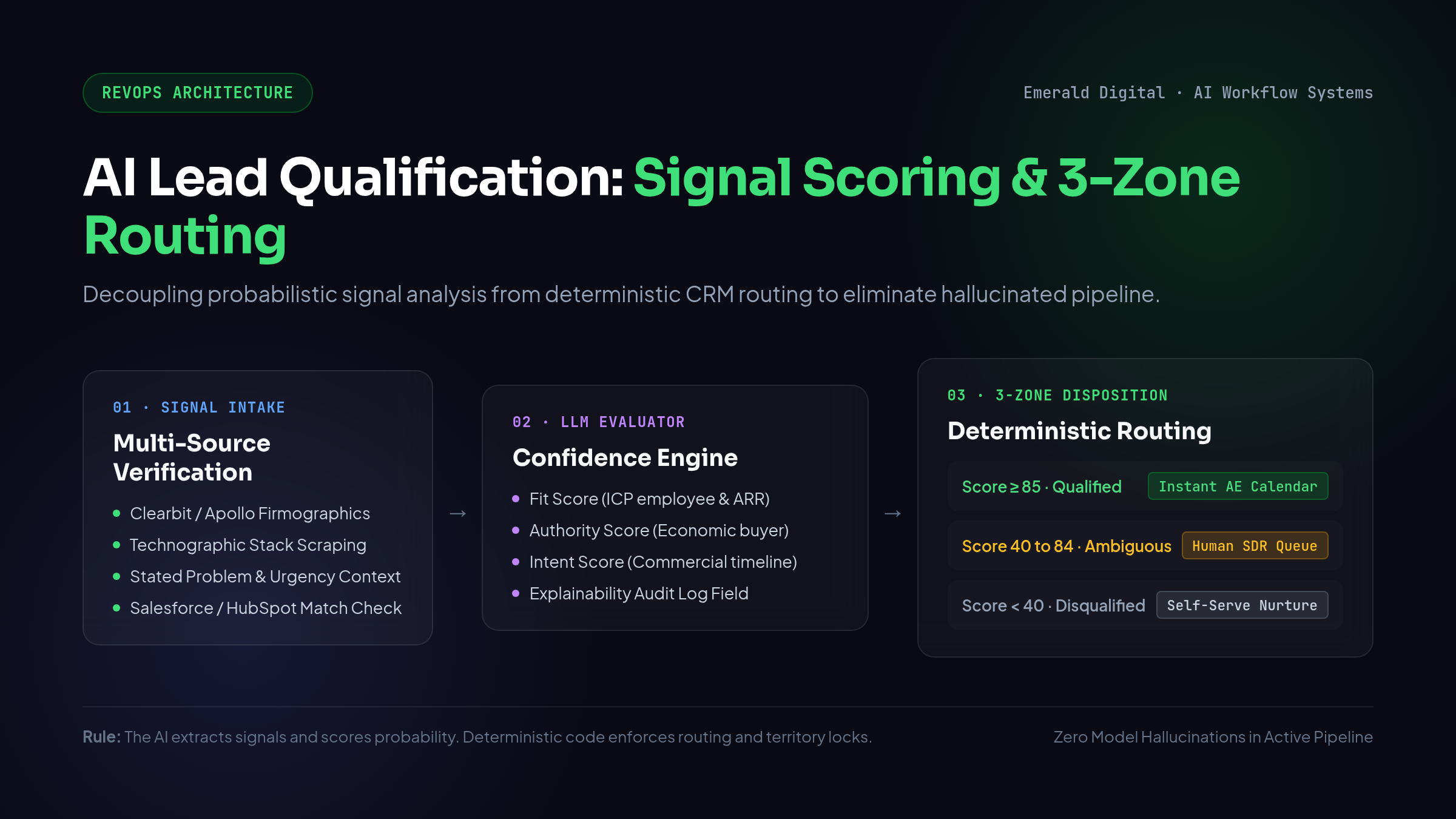
Decouple probabilistic signal extraction from deterministic routing
The foundational mistake in automated lead qualification is letting the AI model make the actual routing decision.
Language models excel at qualitative synthesis: reading messy free-text inputs, normalizing irregular job titles, parsing technographic stack clues, and evaluating commercial urgency. They are probabilistic engines. They deal in likelihoods and confidence intervals.
CRM routing engines must remain strictly deterministic. Territory assignments, enterprise account exclusivity, round-robin equity, and SLA escalations are hard operational rules. If an AI agent attempts to directly assign account ownership based on probabilistic reasoning, you introduce silent routing errors across your sales organization.
The correct workflow separates the process into two distinct stages:
- Signal extraction and confidence scoring (Probabilistic): The model consumes enriched profile data and form context, extracts structured evidence, and assigns three independent dimension scores alongside a qualitative explanation.
- Execution and territory routing (Deterministic): Code-level rules evaluate the model output against hard business thresholds, locking assignments, populating CRM fields, and routing records based on company policy.
The AI evaluates the evidence. Deterministic code enforces the pipeline rules.
The three-signal inbound qualification matrix
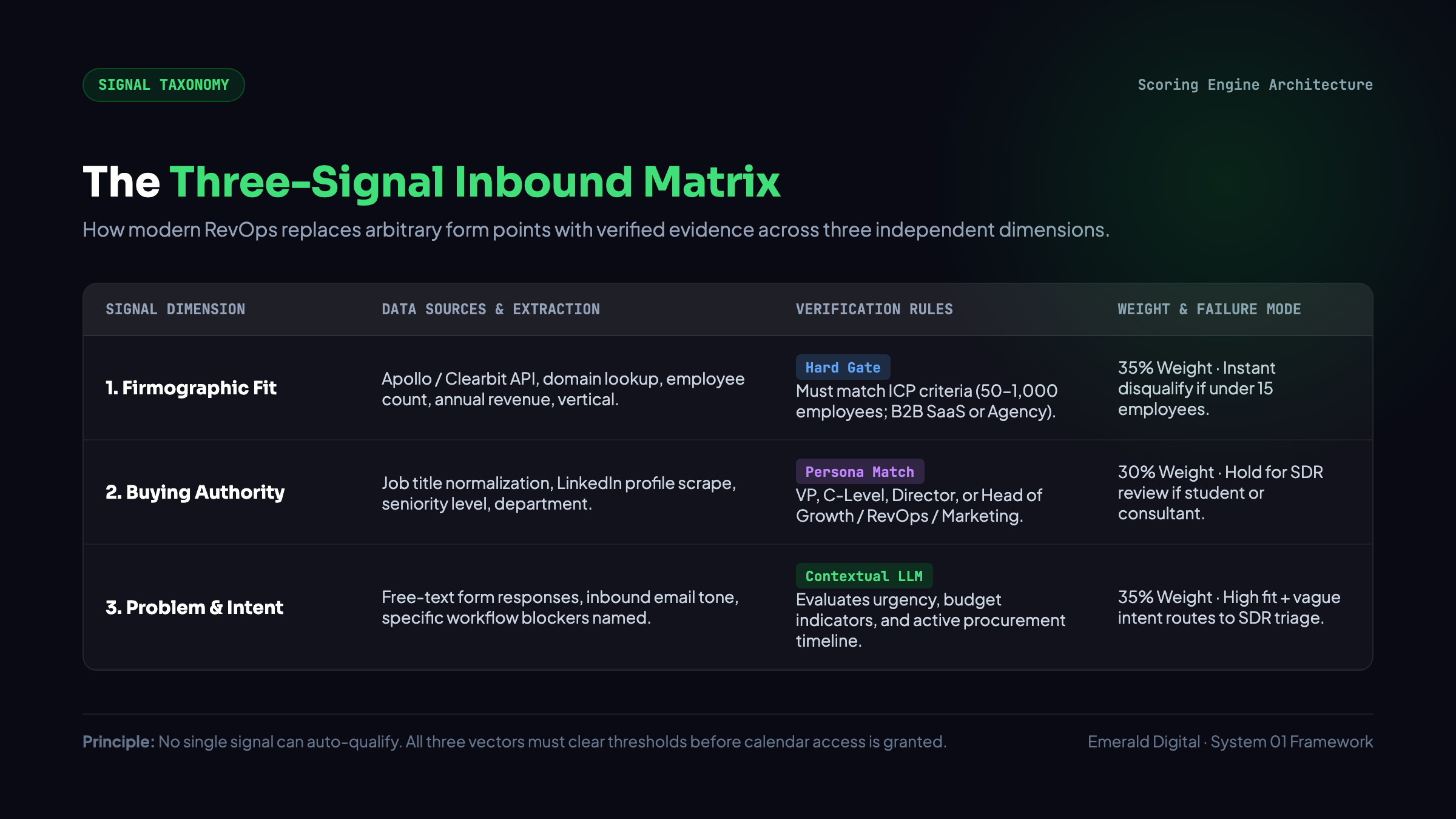
Rather than aggregating dozens of superficial digital actions into a single vanity score, an effective qualification system measures three independent vectors.
Each vector represents a non-negotiable commercial requirement. If any single vector fails completely, the lead cannot proceed to an Account Executive calendar.
| Signal Dimension | Data Sources and Extraction | Verification Standard | Failure and Routing Action |
|---|---|---|---|
| Firmographic Fit | Domain lookup, Clearbit/Apollo API, employee count, annual revenue, industry vertical | Hard match against Ideal Customer Profile (ICP) boundaries (e.g., 50 to 1,000 employees; B2B software or professional services) | Instant disqualification if below minimum size; route to self-serve resources |
| Buying Authority | Job title normalization, department mapping, LinkedIn profile extraction | Identifies decision makers, budget owners, or key operational champions (VP, Director, Head of Growth, RevOps lead) | Ambiguous titles held for human review; individual contributors routed to async nurture |
| Commercial Intent | Free-text form submissions, inbound email context, specific technical pain points stated | Evaluates urgency, project timeline indicators, and specific problem-solution alignment | High fit with vague intent routes to SDR triage queue rather than instant AE calendar |
1. Firmographic Fit
Firmographic fit establishes whether the company has the operational scale and budget capacity to succeed with your service.
The qualification engine takes the prospect work email, extracts the corporate domain, and enriches it via an external data provider. The model checks basic parameters: verified employee headcount, primary operating industry, and geographic footprint.
If your core service requires a minimum team size to generate ROI, firmographic fit acts as a hard filter. An inbound inquiry from a three-person freelance collective might be a genuine inquiry, but routing them to a senior enterprise Account Executive wastes company time and creates a poor experience for the prospect.
2. Buying Authority
Buying authority determines whether the person submitting the form has the organizational standing to commission an evaluation or approve capital expenditure.
Job titles in modern technology companies are notoriously noisy. A "Growth Hacker" might be an entry-level intern at an agency or the sole operational driver of an eight-figure eCommerce brand. An "Operator" could be an executive partner or a mid-level coordinator.
The AI engine normalizes the raw title against standard organizational hierarchies. It looks for functional responsibility: does this individual oversee pipeline, manage ad spend, direct engineering infrastructure, or run revenue operations?
3. Commercial Intent
Commercial intent evaluates the specific words the buyer entered in your form or inquiry field.
Traditional forms reduce user intent to multiple-choice dropdowns ("What is your timeline? Within 1 month / 3 months / 6 months"). Every extra mandatory dropdown is one more reason for a busy buyer to quit the form.
A clean intake flow pairs a minimal form with a single open-ended question: *What is the specific bottleneck your team is trying to solve right now?*
The AI model evaluates the response for commercial maturity. Compare two example submissions:
- *Submission A:* "Need help with marketing and want to see pricing options."
- *Submission B:* "We are spending $45k/mo on Meta and Google Ads across three brands. Our blended CPA climbed 38 percent over the last 90 days, and our attribution in HubSpot is broken. Looking to audit creative performance before Q1 budget lock."
Submission A shows low commercial clarity. Submission B shows extreme operational maturity and high urgency. The model recognizes these markers and weights the intent score accordingly.
The 3-zone uncertainty routing framework
In the real world, leads do not arrive in clean binary packages.
A rigid system that forces every record into either "Book a meeting" or "Trash" will inevitably drop high-value edge cases. For instance, a founder using a personal Gmail address because their new stealth venture domain is not yet indexed, or a Director of Product at a $100M enterprise who simply typed "explore platform" into the notes field.
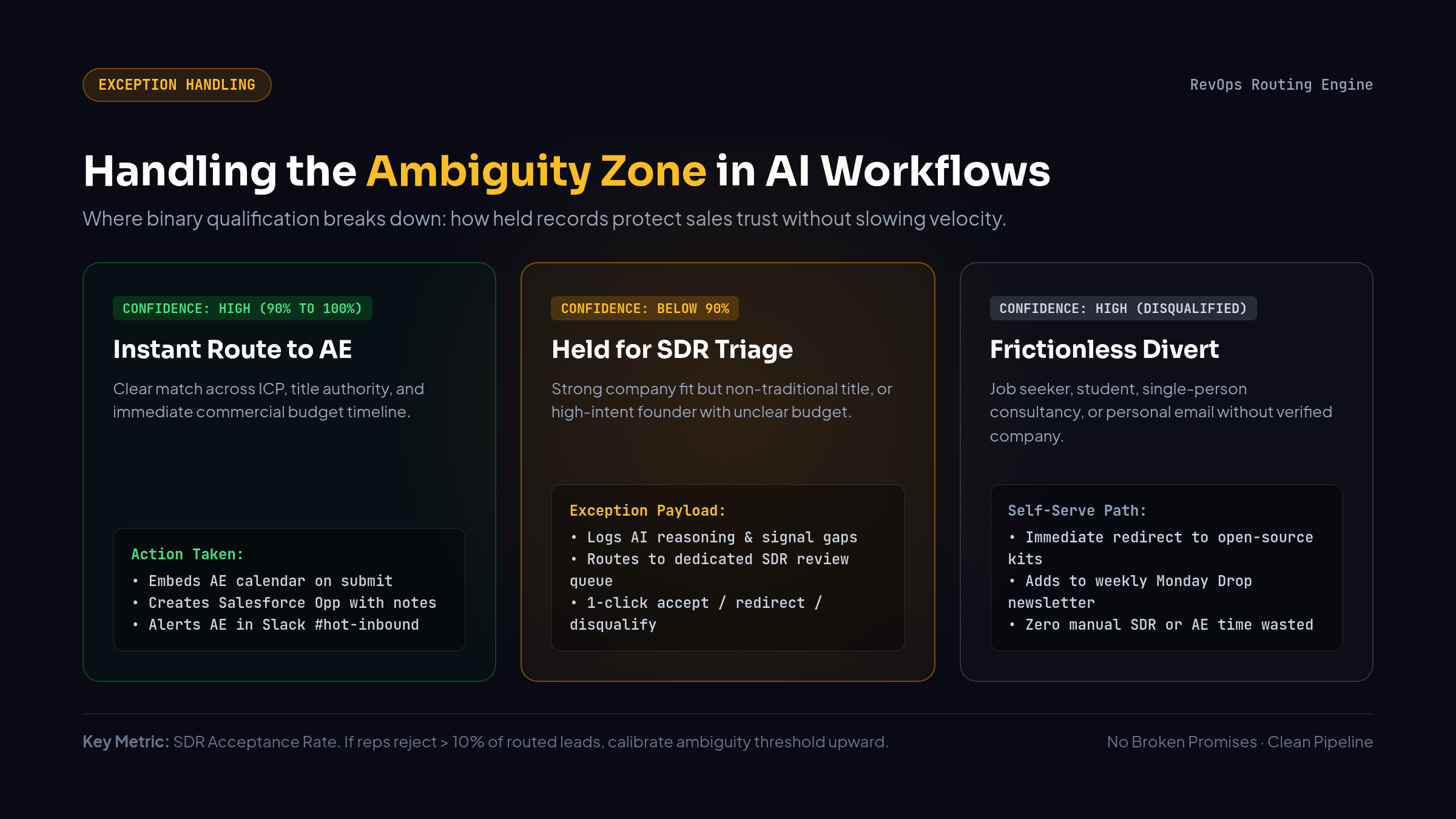
To handle operational reality, your RevOps architecture must implement a three-zone disposition model.
Zone 1: High-Confidence Qualified (Score 85 to 100)
When all three vectors clear your verified thresholds, speed to lead is the only metric that matters.
The workflow acts immediately:
- Injects a native calendar scheduler onto the form confirmation screen, allowing the prospect to book an introductory call within 60 seconds of submission.
- Creates the Account and Contact records in your CRM, populating enriched fields and the AI qualification summary.
- Posts an alert into the assigned Account Executive private Slack channel with a bulleted synthesis of the buyer problem and verified company metrics.
Zone 2: Ambiguous and Held Records (Score 40 to 84)
This is the uncertainty zone. It is where automation stops and human judgment begins.
Instead of rejecting the prospect or burdening an Account Executive with an unqualified discovery call, the engine routes the record into a dedicated SDR triage view. Crucially, the system attaches an Explainability Field generated by the model:
```json { "prospect": "jordan.m@aurora-logistics.com", "company": "Aurora Freight Systems", "fit_score": 92, "authority_score": 65, "intent_score": 58, "disposition": "HELD_FOR_TRIAGE", "explainability_note": "Company has 180 employees ($24M ARR estimate), matching primary ICP. Title 'Special Projects Lead' does not map to standard revenue authority. Inbound note references 'automating dispatch workflows' without naming timeline or budget. Recommend 5-minute LinkedIn profile review before scheduling." } ```
The SDR does not need to start research from scratch. They read the two-sentence diagnostic summary, verify the prospect on LinkedIn, and make a one-click decision: approve calendar invite, route to email follow-up, or disqualify.
Zone 3: High-Confidence Disqualified (Score Below 40)
When a submission clearly fails foundational criteria (job seeker resumes, student research projects, spam submissions, or single-person service providers outside your operating model), the system diverts them frictionlessly.
The prospect is not ghosted. The confirmation screen presents relevant self-serve documentation, open-source code repositories, or educational newsletter content. The CRM logs the contact as unqualified with the specific failure reason, preventing sales pipeline clutter.
Measuring pipeline velocity and rep trust
An automated qualification engine should never be deployed without an active feedback loop.
The health of your qualification system is governed by a single metric: Sales Acceptance Rate.
If your sales team routinely marks auto-routed leads as "Invalid" or reassigns them back into unassigned pools, your qualification threshold is too aggressive. The model is letting noise leak into executive calendars.
Conversely, if your sales reps complain about a lack of inbound volume while your SDR exception queue contains hundreds of unworked, high-fit companies, your ambiguity buffer is too wide.
Run a bi-weekly review comparing accepted discovery calls against rejected submissions. Review the explainability notes on disputed records and calibrate your scoring weights. When sales reps know that every calendar notification represents a verified, context-rich opportunity, their conversion rates from introductory meeting to qualified pipeline climb dramatically.
If your team is looking to automate lead intake, ad account reads, or repetitive operational workflows with human oversight built in, explore how we build custom AI workflow systems for growing operators.
Frequently asked questions
Why does traditional points-based lead scoring fail for modern sales teams?
Traditional scoring assigns arbitrary numbers to disconnected actions, such as adding 10 points for downloading a PDF or 5 points for viewing a pricing page. This measures digital curiosity rather than actual commercial intent. It floods sales reps with junior researchers while high-value executive buyers who read one page and submit a direct inquiry get delayed in manual queues.
What is the core difference between probabilistic scoring and deterministic routing?
Probabilistic scoring uses language models to extract nuanced signals from free-text form inputs, job titles, and enriched company profiles to evaluate match confidence. Deterministic routing uses strict, hard-coded software rules to enforce territory locks, account executive assignments, and threshold actions. The AI never decides who owns the deal; it only scores the evidence.
How should an AI qualification workflow handle ambiguous or borderline leads?
Borderline leads should be directed into an exception queue with an AI explainability note rather than being forced into a binary qualified or disqualified state. The system provides human SDRs with the specific reasons the record was flagged, such as high company fit combined with an unusual title, allowing a 30-second human review instead of automated rejection.
What metric best proves that an AI lead qualification workflow is working?
Sales Acceptance Rate is the primary operating metric. If Account Executives accept and run discovery calls on more than 90 percent of auto-routed leads without reassigning them back to an unworked queue, the threshold is calibrated correctly. If rep rejections exceed 10 percent, the ambiguity buffer must be widened.