
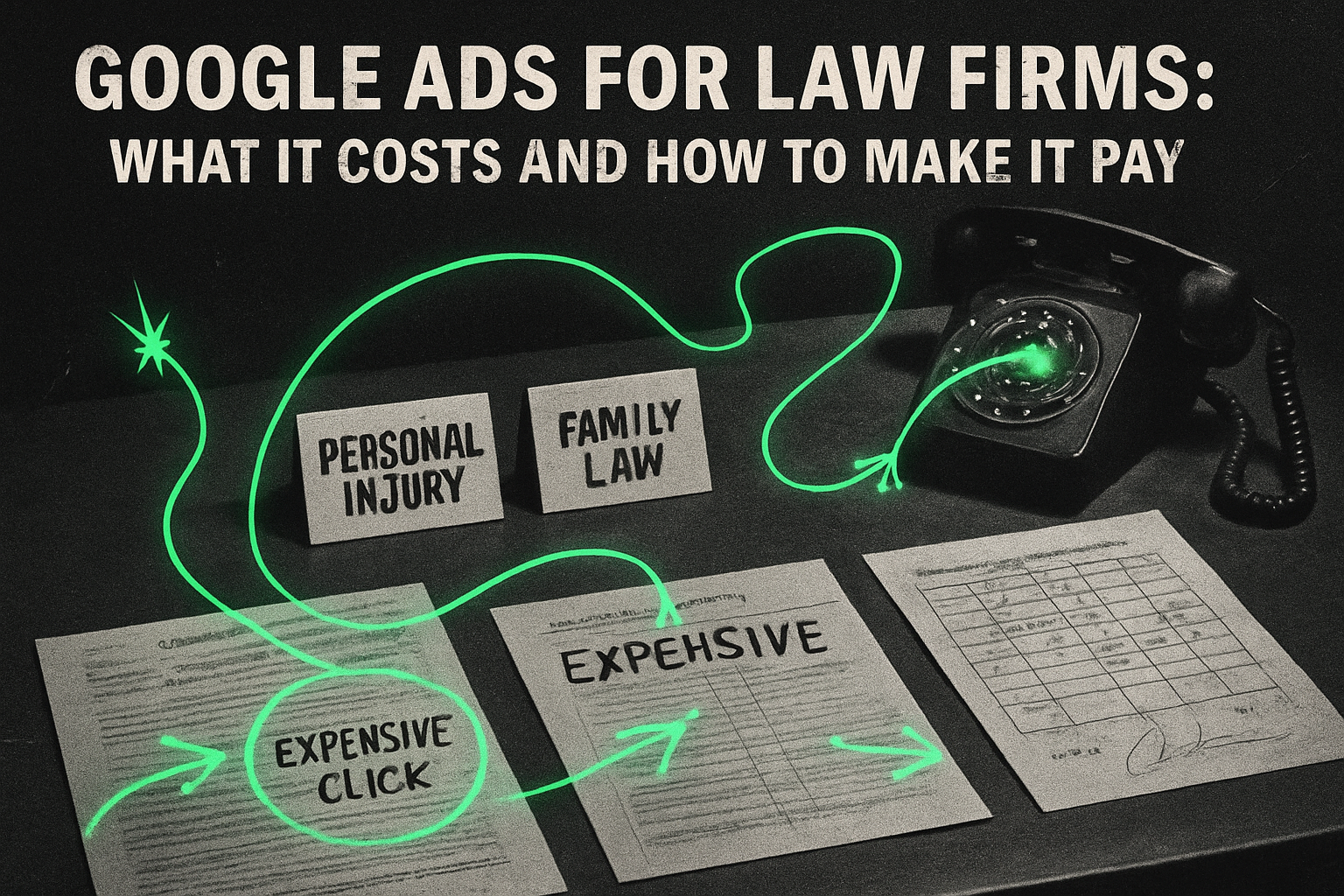
Legal clicks can get painfully expensive fast. Recent legal PPC guides put competitive legal keywords in the $50-$200+ range in busy markets. That does not make Google Ads bad. It means sloppy structure gets punished immediately.
So the question isn't whether Google Ads is expensive for law firms. The question is whether you're turning those expensive clicks into signed cases, or lighting the budget on fire one tire-kicker at a time. Here's how to make it pay.
You win legal PPC on intent, not bigger bids
Most law firm ad accounts make the same mistake: they bid on broad terms like "lawyer" and "attorney" and pull in every researcher, job-seeker, and current client in the state. Then they "optimize" by adjusting bids, which does nothing, because the problem was never the bids.
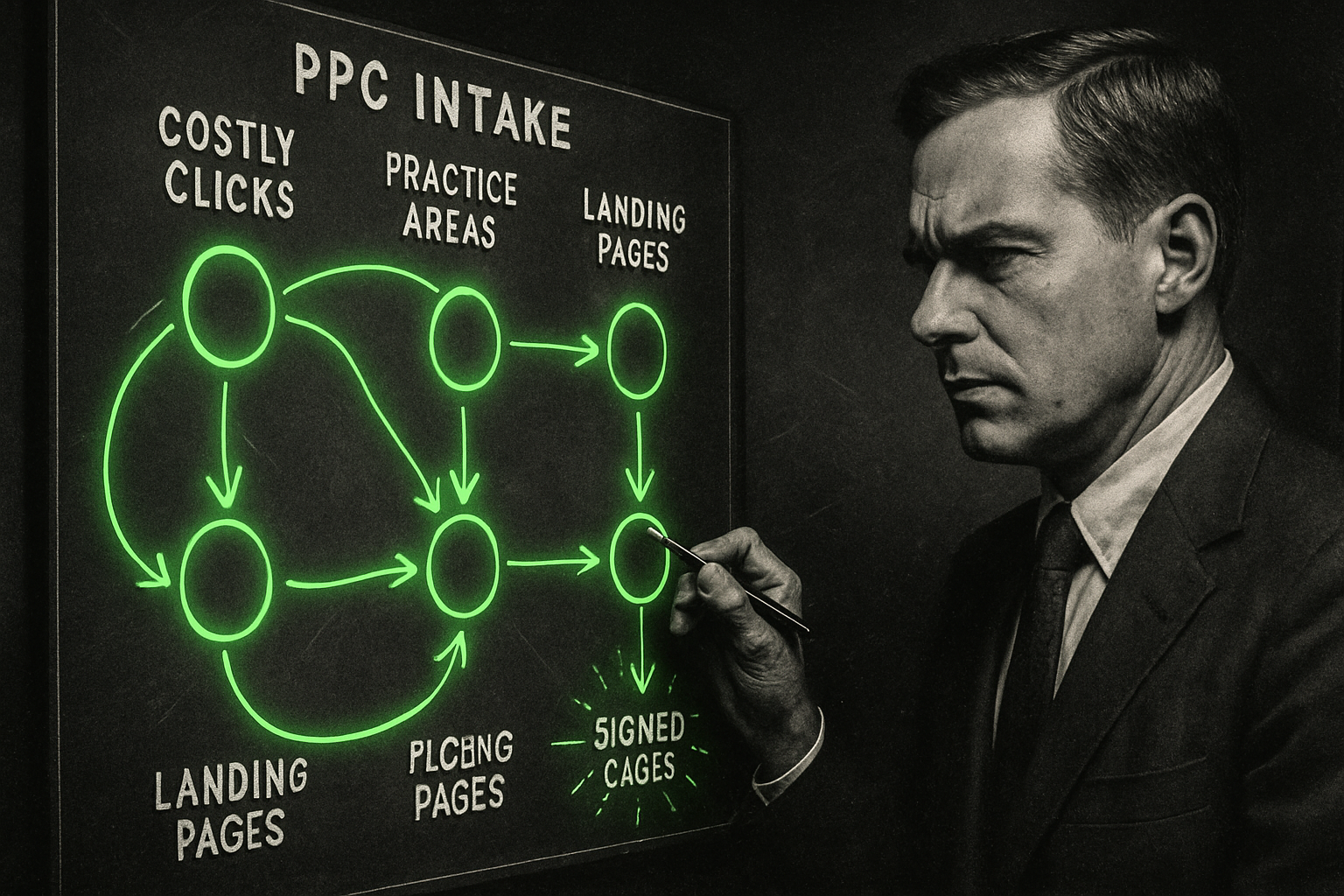
The fix is the Intent Map. Classify every search as a case worth taking, a tire-kicker, a current-client query, or a competitor doing recon, then put budget on the cases that actually pay. "DUI lawyer [city]" is a case. "How much can I sue for" is a researcher. "[Your firm] hours" is an existing client. They shouldn't share a campaign, an ad group, or a budget. When they do, Google optimizes for the average and every metric becomes a blend of three things pretending to be one.
"Someone searching 'car accident lawyer near me' and someone searching 'how long do injury settlements take' want completely different things. In most legal accounts they're in the same campaign, so Google optimizes for the average, and both experiences are wrong. Separate the intents and the same budget signs more cases."
Matthew Berman, founder, Emerald Digital
Next step
Turn legal ad spend into signed-case learning.
See how we turn legal ad spend into signed casesTrack to signed cases, not raw calls
A call isn't a case. A form fill isn't a client. Yet most law firm accounts optimize to call volume or form submissions, which means Google happily finds you more cheap, low-quality contacts that never sign.
Track every call and form through to the practice area, the keyword, and ultimately the signed client. Then feed that back into the account so Google optimizes toward the searches that produce retainers, not the ones that produce voicemails. Offline conversion imports are the basic mechanism. A cheap lead that never becomes a case costs you infinity dollars per client.
Match the page to the case
A DUI search shouldn't land on your homepage. A wrongful-death search shouldn't land on a generic "contact us" form. The search told you exactly what kind of case the person has. If the landing page doesn't match it, you paid $100 for a click and threw it away at the door.
Build a dedicated landing page per practice area, each one speaking to that specific case and built to turn an expensive click into a consultation. This is where most of the wasted spend is recovered.
Run Local Services Ads alongside search
Local Services Ads sit above everything else, carry a Google Screened badge, and bill you per lead instead of per click. For a lot of firms they're the single most efficient legal channel, because you're paying for contacts, not clicks.
The smart play isn't LSAs instead of search, or search instead of LSAs. It's both, with tight geo-targeting, so you own the top of the page with the Screened badge while your search campaigns capture the practice-area intent underneath.
Mind the Fake Lead Tax
Optimize for the cheapest cost per lead and the platform happily hands you the cheapest leads: people who fill out a form to comparison-shop, price-check, or were never serious. That's the Fake Lead Tax, and nobody on the average legal account is tracking it.
The antidote is to score leads by quality, not cost, and feed that signal back so the account chases your actual clients. A higher cost per lead that signs cases beats a low cost per lead that never picks up the phone.
Paid and SEO do different jobs
Google Ads is the fastest way to put your firm in front of a client who needs a lawyer today. That speed is exactly when paid earns its place. But paid stops the moment you pause it, and legal clicks only get more expensive.
SEO is the compounding asset. Organic and map-pack positions keep signing cases after the spend stops. The firms that win run both: paid for speed, SEO for the asset that compounds, and tracking to signed cases across both so every dollar is accountable to revenue.
What this looks like when it works
We do not have a per-channel attribution story to sell you, and we will not invent one. What we can show is that our paid media produces real, tracked pipeline. We drove 521 luxury leads for Christie's at a $15.96 cost per lead. We increased reservations for Villa Bella Vita 166% in 90 days at a $30.85 cost per lead. The discipline behind those numbers is the same one legal accounts need: map intent, clean up tracking, and optimize to the outcome instead of the dashboard.
See how we turn legal ad spend into signed cases: we will help you separate case intent from wasted clicks before the next dollar gets spent.