Most agencies that pitch themselves as a Shopify SEO agency run the exact same playbook they use for local plumbers and B2B software companies. They run an automated site crawl, install a third-party SEO app that bloats your theme JavaScript, and hand you a six-month calendar of informational blog posts.
Six months later, your blog traffic is up, your organic revenue is flat, and your best-selling collection pages are still buried on page two of Google.
Shopify is not a brochure website. It has specific Liquid theme behaviors, rigid URL folder rules (`/collections/`, `/products/`, `/pages/`), tag-filter crawl traps, and product schema requirements that a generalist agency never touches. Our ecommerce engineering team has recovered 14,000-page catalog indexation for [Dealmed](/case-studies/dealmed), grown organic traffic 800% in nine months for DuJour, and paired store conversion architecture with paid acquisition to drive a 15.63x ROAS for Eko.
Before you sign a retainer, run every prospective Shopify SEO agency through this seven-point operator checklist.
Red-flag agency pitches vs. operator answers
The fastest way to separate a real Shopify operator from a content mill is to ask how they handle your store's collection hierarchy and Liquid templates during month one. We cover the underlying platform mechanics in our complete Shopify SEO guide and our broader ecommerce SEO guide.
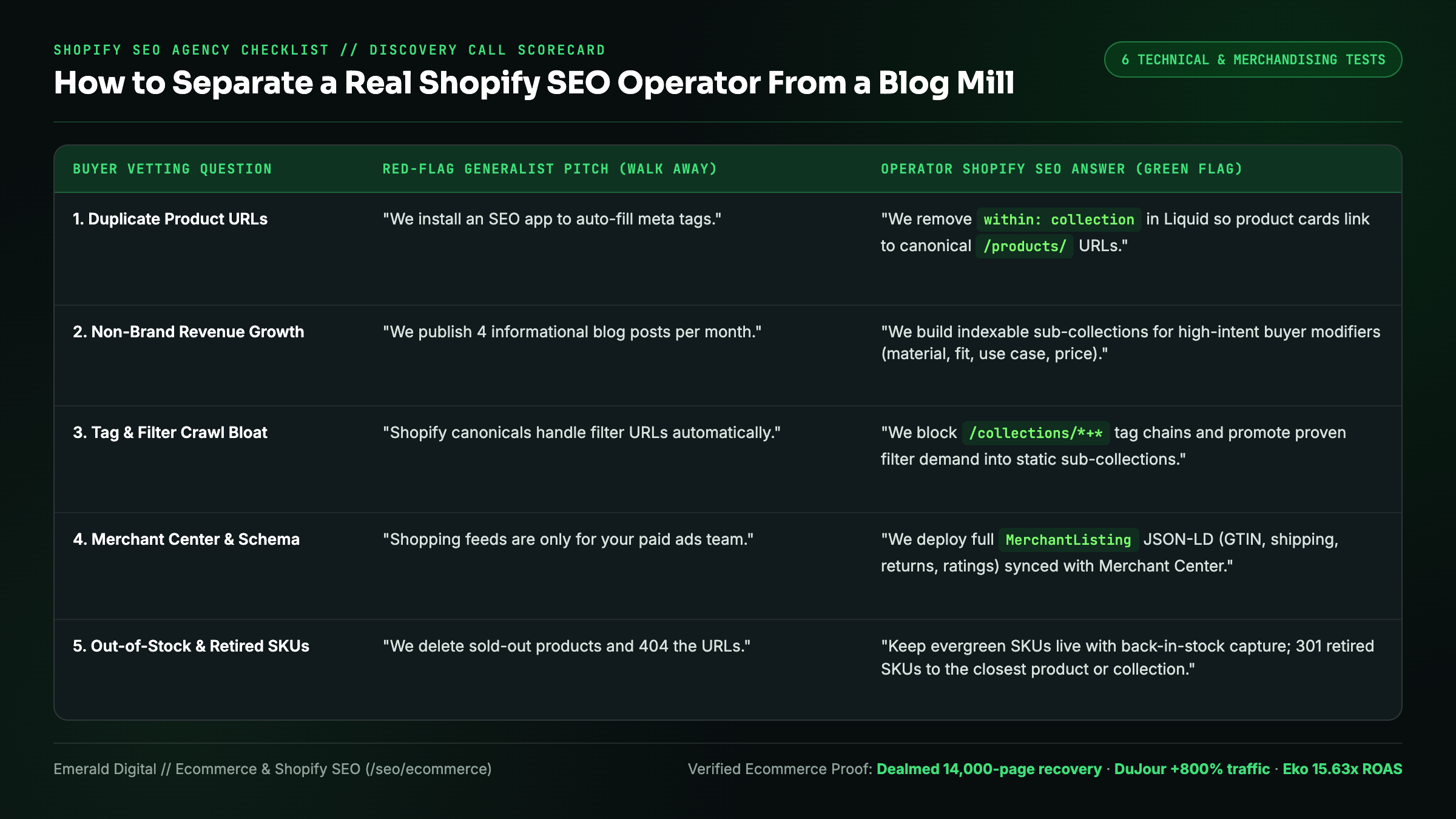
Use this table during your discovery calls to grade how each agency responds:
| Vetting Question | Red-Flag Generalist Pitch (Walk Away) | Operator Shopify SEO Answer (What You Want) |
|---|---|---|
| 1. "What do you fix first on our Shopify theme?" | "We install our preferred SEO plug-in to automate meta titles and image alt tags." | "We audit your Liquid product-card snippets (`card-product.liquid`) to remove `within: collection`, so every internal link points directly to the canonical `/products/` URL." |
| 2. "How will you grow our non-brand category traffic?" | "We will publish four 1,000-word blog posts a month targeting industry keywords." | "We mine your Strike Zone collection queries in Google Search Console and build dedicated sub-collections for high-intent modifiers (material, fit, use case, price tier)." |
| 3. "How do you handle Shopify tags and filter URLs?" | "Shopify handles canonical tags automatically, so filters are not an issue." | "We block `/collections/*+*` tag combinations and `?filter.*` parameters from wasting crawl budget, while promoting high-volume filter combinations into static, indexable sub-collections." |
| 4. "What is your plan for out-of-stock or seasonal SKUs?" | "We delete discontinued products and 404 or redirect everything to the homepage." | "Evergreen SKUs stay live with restock notifications; permanently retired SKUs with backlinks get 301-redirected to the closest matching product or parent collection." |
| 5. "How do you connect SEO to Google Shopping and AI search?" | "Organic SEO and Merchant Center feeds are completely separate departments." | "We synchronize `Product` and `MerchantListing` JSON-LD schema (GTIN, MPN, shipping, returns, aggregate ratings) with your Merchant Center feed so you win rich product snippets and AI shopping citations." |
| 6. "What happens if we get traffic but conversion drops?" | "Our job is bringing traffic; conversion rate optimization is up to your web designer." | "We diagnose where organic shoppers leak (wrong landing page type, slow mobile LCP from app scripts, or missing trust proof) and fix the template so traffic turns into carts." |
The 7 technical and commercial checks your agency must own
1. They fix the `/collections/*/products/*` Liquid trap in week one
By default, many Shopify themes link product cards inside a collection grid to `/collections/category-name/products/product-handle` while placing a canonical tag pointing back to `/products/product-handle`. That forces Googlebot to crawl thousands of duplicate URLs and splits internal link equity across three or four URL variations per SKU. A real Shopify SEO agency edits the theme snippet directly so every product link points to the clean root `/products/` URL.
2. They turn trapped filter demand into indexable sub-collections
Shoppers ready to pull out a credit card rarely search for a broad single noun like "mens boots." They search for specific attributes: *"mens waterproof leather chelsea boots"* or *"wide width steel toe work boots."* If those attributes only exist behind JavaScript filter checkboxes on your store, Google cannot rank them. Your agency should identify every modifier query with search volume and build dedicated sub-collection pages linked via crawlable HTML pills at the top of the parent collection.
3. They add buyer guidance to collection pages without pushing the product grid down
Stuffing 1,500 words of keyword copy above your product grid destroys mobile conversion rates. Leaving the collection page with zero text gives Google no semantic context. The operator pattern is a concise 40-to-60-word buyer positioning hook above the grid, paired with structured comparison copy and dynamic FAQ metafields below the product grid.
4. They audit app script bloat and Core Web Vitals on mobile
The average Shopify store carries 15 to 25 installed apps, including four or five that were "uninstalled" years ago but left render-blocking JavaScript snippets inside `theme.liquid`. Before publishing new pages, your agency should audit third-party script execution on collection and product templates so mobile Largest Contentful Paint (LCP) and Interaction to Next Paint (INP) stay fast.
5. They align organic landing pages with buyer conversion intent
Ranking a blog post for a transactional query is one of the primary reasons stores end up with Shopify traffic but no sales. When we scaled Dealmed's 14,000-page catalog and built full-funnel ecommerce growth for brands like Eko (15.63x ROAS), the rule was simple: commercial searches must land on shoppable collection grids or high-converting product pages, never dead-end editorial posts.
"Never let an SEO agency treat your Shopify store like a blog publishing business. Your collection pages and product templates are your digital shelves. Fix the architecture of the shelves first, and every product in your catalog compounds."
Matthew Berman, founder, Emerald Digital
What your first 90 days with a Shopify SEO agency should look like
If an agency cannot show you a concrete 90-day engineering and merchandising schedule before you sign, you are paying for trial and error.
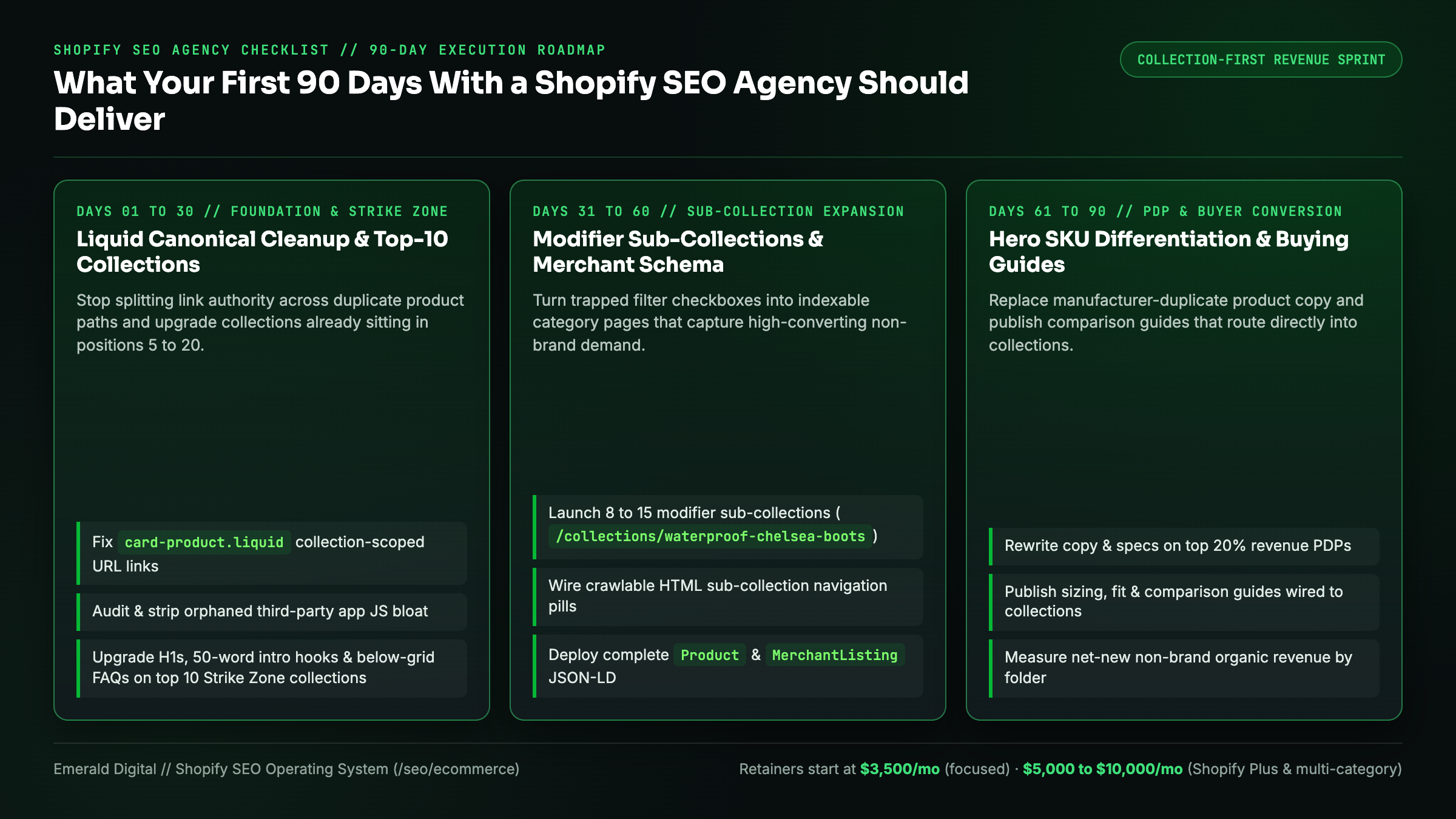
Here is the exact 90-day execution sequence you should hold your agency accountable to:
| Sprint Window | Technical & Theme Engineering | Collection & Merchandising Work | Measurement & Revenue Proof |
|---|---|---|---|
| Days 1 to 30: Foundation & Strike Zone | Remove `within: collection` Liquid links; clean up `/collections/all` and `/collections/vendors`; block tag/filter crawl traps; audit orphaned app scripts | Audit Google Search Console for Strike Zone collections (positions 5 to 20); upgrade titles, H1s, above-fold intro hooks, and below-grid FAQ metafields on top 10 collections | Baseline non-brand organic revenue by URL folder (`/collections/` vs. `/products/` vs. `/blogs/`) in GA4 and GSC |
| Days 31 to 60: Sub-Collection Expansion & Schema | Deploy complete `Product`, `Offer`, `AggregateRating`, and `MerchantListing` JSON-LD (shipping, return policy, GTIN/MPN); fix broken 301 redirects from retired SKUs | Build and launch 8 to 15 new high-intent modifier sub-collections; wire HTML sub-category navigation bars across parent collections | Track rich snippet eligibility in GSC Merchant Listings report; monitor position movement across Strike Zone and new sub-collection terms |
| Days 61 to 90: PDP Differentiation & Buying Guides | Optimize variant URL handling and image payload weights across top-selling product detail pages (PDPs) | Rewrite manufacturer-duplicate PDP copy on top 20% revenue SKUs; publish bottom-of-funnel comparison and sizing guides that link directly into target collections | Attribute net-new organic orders, assisted conversions, and category ranking lift; set next-quarter sub-collection roadmap |
How to evaluate your current Shopify SEO setup
Before you commit to a retainer, check your own store against three quick diagnostics:
- Hover over any product card inside one of your collection pages. If the URL preview includes `/collections/your-collection-name/products/your-product`, your theme is still splitting link authority across duplicate URLs.
- Open Google Search Console, filter by pages containing `/collections/`, and sort by impressions for queries ranking between positions 5 and 20. Those are your fastest revenue wins.
- Check how much of your organic traffic lands on `/blogs/` versus `/collections/` and `/products/`. If blogs drive 80% of your sessions and 2% of your revenue, your previous agency optimized for vanity traffic instead of buyers.
Our Shopify and ecommerce SEO retainers start at $3,500/month for focused single-category stores and $5,000 to $10,000/month for multi-category Shopify Plus brands and large SKU catalogs, powered by our open-source agentic search engine (the seo-kit on GitHub).
See our ecommerce SEO approach, explore our broader SEO system, or request a free Shopify SEO teardown. We will inspect your Liquid templates, map your highest-value sub-collection gaps, and show you the exact 90-day plan to grow non-brand organic revenue.