

In legal marketing, a single click on Google Ads for a commercial personal injury or criminal defense keyword regularly costs $85 to $300+. That economics problem is why managing partners invest heavily in SEO for lawyers: when your firm owns the top three spots in the Google Map Pack and the top organic practice-area listings, your cost per signed case drops every quarter instead of resetting every month.
The trap is that legal SEO is full of vendors who know how to make a monthly report look busy for twelve months without making your intake phones ring. They publish 500-word blog posts summarizing state statutes, celebrate national traffic spikes from out-of-state students, and lock your firm into a proprietary CMS you cannot leave.
Using our operator legal search system, we took [The Law Center](/case-studies/the-law-center) to #2 nationally in six months for "motorcycle accident lawyer" while generating 5,800+ contacts, and drove +154% organic impression growth and +50% click growth for Roden Law. Before you sign a retainer, run every prospective agency through this seven-point checklist.
The 7-point legal SEO checklist: signed cases vs. vanity traffic
When someone needs an attorney after a crash, an arrest, or a business dispute, they do not read five educational blog posts. They search a specific practice area plus their city or `"near me,"` scan the top three Map Pack firms and the top organic practice-area pages, check review counts and case results, and call the firm that looks most capable of winning.
If you are currently comparing vendors, pair this checklist with our teardown of the best law firm SEO companies and our breakdown of law firm SEO cost.
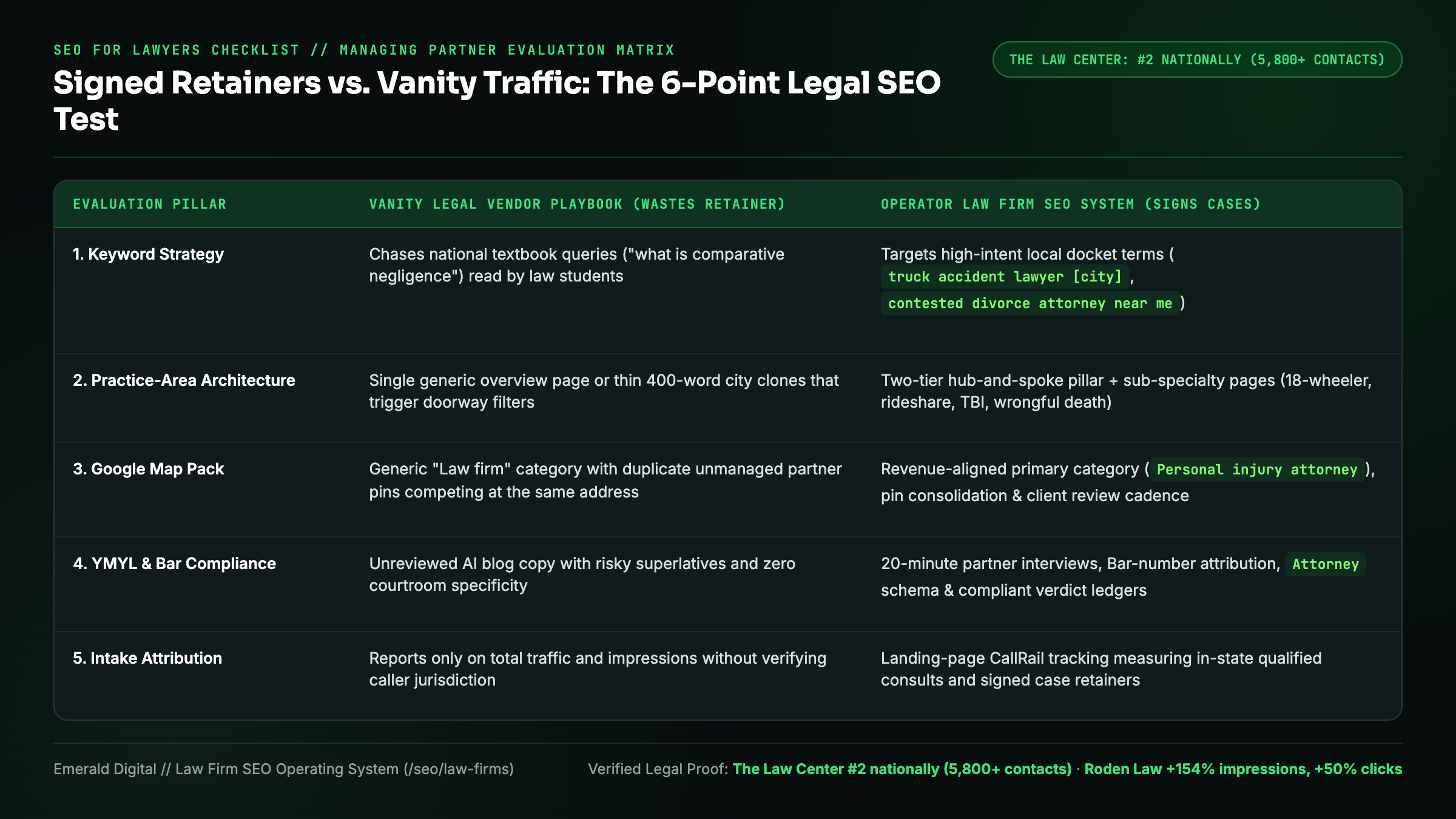
Use this matrix during your partner pitch meetings to separate signed-case operators from volume vendors:
| Checklist Dimension | The Vanity Vendor Playbook (What Wastes Budget) | The Operator Legal SEO System (What Signs Cases) |
|---|---|---|
| 1. Keyword & Case Mapping | Chases high-volume national definition terms ("what is negligence") that attract zero local clients | Maps every target practice area and sub-specialty to commercial local intent ("commercial truck accident lawyer [city]") |
| 2. Practice-Area Page Depth | Lumps ten case types onto one generic overview page or writes 400 words of brochure fluff | Builds 1,500+ word attorney-reviewed pillar and sub-practice pages covering local court procedures, liability proof, and fee structure |
| 3. Google Map Pack Engineering | Sets "Law firm" as the only category and posts generic holiday graphics to Google Business Profile | Aligns primary category (`Personal injury attorney`, `Divorce lawyer`) with core revenue, resolves practitioner pin conflicts, and drives review velocity |
| 4. YMYL & Bar-Compliant Editorial | Publishes anonymous AI-generated legal articles that risk state bar advertising violations | Conducts 20-minute attorney interviews, attaches partner bylines and Bar numbers, and enforces strict jurisdiction and disclaimer rules |
| 5. Digital PR & Link Authority | Buys cheap guest posts on irrelevant lifestyle blogs or private blog networks (PBNs) | Earns authoritative legal citations, local news placements, legal directories (Avvo, Justia, Super Lawyers), and university/community links |
| 6. Intake & Call Attribution | Reports on total website sessions and keyword rankings without checking if callers are in state | Wires CallRail or dynamic number insertion by landing page to track qualified in-market consults and signed retainers |
| 7. AI Search & Citation Readiness | Ignores how ChatGPT, Perplexity, and Google AI Overviews recommend local attorneys | Structures attorney credentials, verdict ledgers, and FAQ schema so AI engines cite the firm for local legal prompts |
Four non-negotiable pillars of high-converting lawyer SEO
1. Build a two-tier practice-area and sub-specialty architecture
Ranking for `"personal injury lawyer [city]"` or `"family law attorney [city]"` requires more than a single page. Search engines reward topical authority built through a clean hub-and-spoke hierarchy. Your main practice-area pillar page should link directly down to dedicated commercial pages for every high-value case type you want to sign: 18-wheeler accidents, rideshare crashes, traumatic brain injuries, contested child custody, or high-asset divorce. See how we structure this exact hierarchy in our guide to SEO for personal injury lawyers.
2. Treat attorney bios and case results as core YMYL trust assets
Legal services sit at the top of Google's Your Money or Your Life (YMYL) scrutiny. Both human prospects and search algorithms verify whether your firm has real trial and courtroom credibility. Every practice-area page should connect to detailed attorney bio pages featuring state bar admissions, court memberships, published verdicts or settlements (with compliant disclaimers), and `Attorney` and `LegalService` JSON-LD schema.
3. Win the Google Map Pack in every office jurisdiction
For urgent legal searches on mobile, the Google Map Pack captures the highest-converting phone calls before the prospect ever scrolls to organic links. Winning the Map Pack requires three operational disciplines:
- Selecting the exact primary category that matches your highest-margin docket (`Personal injury attorney` rather than generic `Law firm`).
- Consolidating duplicate or outdated individual partner GBP listings that split review equity at the same suite address.
- Building a systematic post-matter review request workflow so satisfied clients mention the specific attorney, case type, and city in their Google review.
4. Close the feedback loop between intake and search pages
Traffic that your intake desk rejects is wasted money. When we took [The Law Center](/case-studies/the-law-center) to #2 nationally in six months (5,800+ contacts) and scaled Roden Law (+154% impressions, +50% clicks), every content and technical decision was anchored to commercial case intent. Your agency should review call dispositions monthly: if a page is generating calls for a case type you refer out or a county you do not cover, the copy and targeting should be adjusted immediately.
"Law firm partners do not pay courthouse rent with keyword impression charts. If an SEO agency cannot trace their monthly page builds and Map Pack work directly to qualified intake calls in your target jurisdiction, they are running a content hobby on your retainer."
Matthew Berman, founder, Emerald Digital
Protect your firm from hostage contracts and exclusivity traps
The most expensive mistakes in legal marketing happen in the fine print of the agency agreement before a single page is published. Many legacy legal marketing conglomerates lock law firms into 24-month leases where the vendor owns the website template, the custom practice-area copy, and even the call-tracking phone numbers.
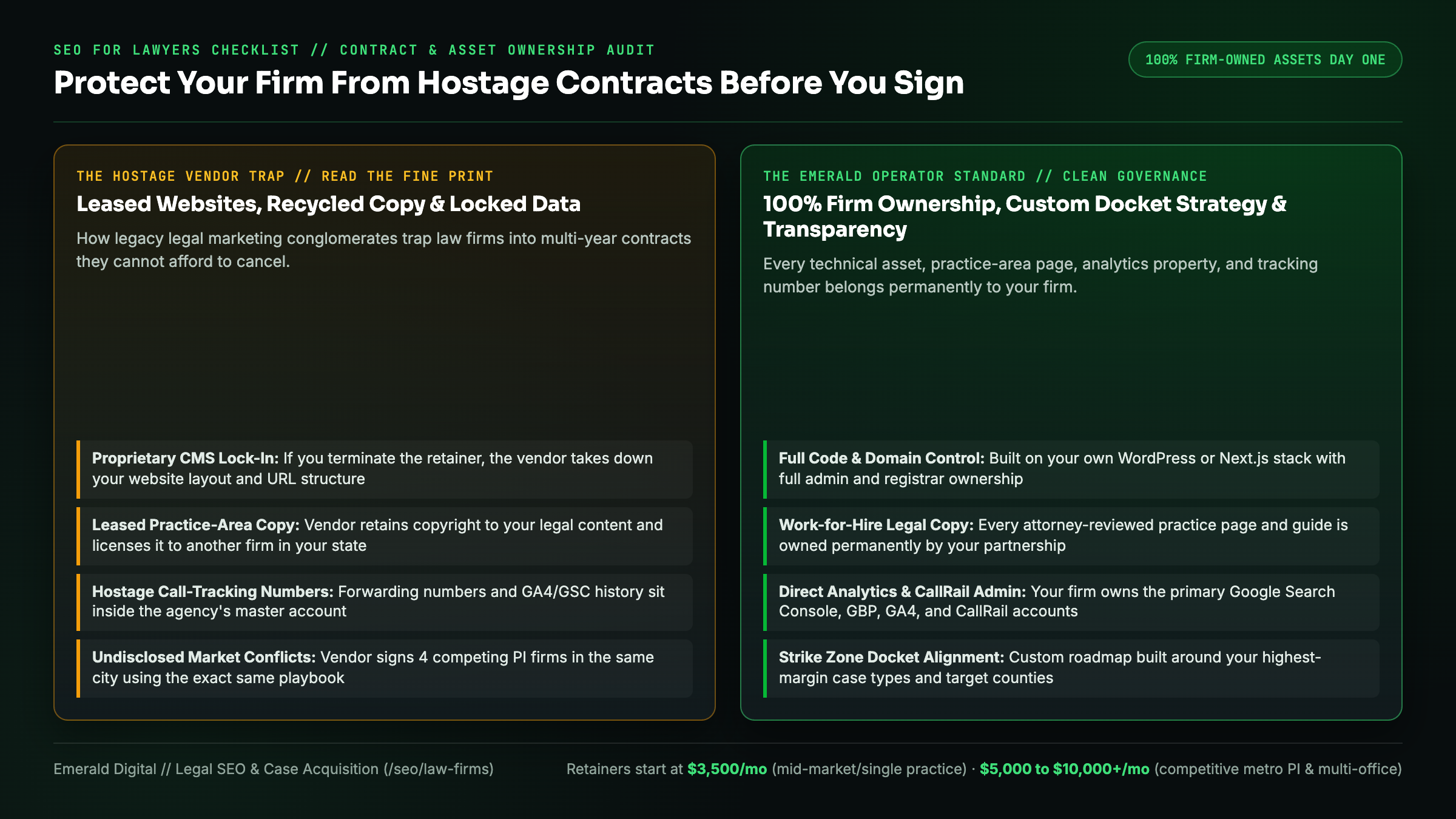
Before you sign any legal SEO agreement, require written confirmation across these five ownership and governance rules:
| Contract & Governance Check | Hostage Vendor Trap (Never Sign) | Operator Standard at Emerald Digital |
|---|---|---|
| Domain, CMS & Code Ownership | Agency hosts your site on a proprietary closed CMS; if you cancel, your website disappears overnight | You own your domain registrar, hosting, WordPress/Next.js codebase, and design 100% from day one |
| Attorney-Reviewed Copy Rights | Vendor retains copyright to the practice-area articles and re-licenses them to another lawyer when you leave | Every word of custom practice-area and city copy is work-for-hire owned permanently by your firm |
| Google Accounts & Call Numbers | Agency creates the GA4, Search Console, and CallRail accounts under their master login and refuses transfer | All analytics, Search Console, GBP, and call-tracking numbers live in your firm's direct admin accounts |
| Market Conflict transparency | Agency signs four personal injury firms in the exact same metro area and sells them the same keyword list | Clear upfront disclosure on market capacity and dedicated Strike Zone strategy tailored to your firm's docket |
| Bar Rule & Claim Governance | Copywriters publish unapproved "best lawyer" superlatives or guaranteed verdict language without partner sign-off | Strict pre-publish attorney review workflow ensuring compliance with your state bar's Rules of Professional Conduct |
How to audit your law firm's current SEO in 15 minutes
Before your next partner meeting, run this three-step audit on your current marketing setup:
- Check non-brand vs. brand clicks in Google Search Console: Filter out queries containing your firm's name or partners' last names. How many clicks and calls did your website generate over the last 90 days from people searching only for a practice area and city?
- Inspect your Strike Zone pages (positions 5 to 20): Find the commercial practice-area pages sitting on the bottom of page one or top of page two. Upgrading those pages with deeper attorney-reviewed analysis, local court context, and internal links is the fastest path to new retainers.
- Test your firm in AI search: Ask ChatGPT and Perplexity who the top attorneys are for your primary practice area in your city. If competitors are named and cited while your firm is invisible, your entity and citation footprint needs immediate work.
Our law firm SEO retainers start at $3,500/month for focused single-practice or mid-market firms and $5,000 to $10,000+/month for competitive metro personal injury, criminal defense, and multi-office practices, powered by our open-source agentic search system (the seo-kit on GitHub).
See our law firm SEO approach, explore our broader SEO system, or request a free legal SEO teardown. We will show you who owns the Map Pack and high-value practice-area queries in your jurisdiction today and hand you the exact roadmap to outrank them.