If you run a personal injury, criminal defense, family, or estate litigation firm, you do not need an agency to tell you that Google Ads is expensive. You can see it on your credit card statement every thirty days.
Competitive legal search terms regularly clear $100 to $300+ per click, and high-value injury terms in major metros can spike well past $500 for a single tap on a mobile screen. Worse, a click is not a client. If only one in ten paid clicks turns into a qualified intake call, and your intake team signs one in four of those callers, you are easily paying $4,000 to $12,000+ in raw ad spend per signed case before your agency management fee even hits the ledger.
And the moment you pause the card, the phones go dead the same afternoon.
That does not mean you should blindly shut off paid search tomorrow morning. It means you need to stop treating Google Search Ads as your firm's only growth engine, stop letting sloppy account structure burn half your budget on junk clicks, and systematically shift your customer acquisition cost into channels that compound.
Why Legal Google Ads Turns Into a Margin Trap
Google Ads is a live auction where the floor price is set by the most aggressive bidder in your zip code. In legal search, three forces push that auction into territory where smaller and mid-sized firms get squeezed:
- Private-equity-backed aggregators and mega-firms bid to dominate impression share. They are willing to break even or lose money on initial acquisition to starve local competitors of volume.
- Default Google Ads settings are built to spend your budget, not protect your margin. Broad match keywords, automated search partner networks, and blended Performance Max campaigns routinely match a $200 legal bid to people searching for free legal aid, court clerk phone numbers, law school definitions, or out-of-state accidents.
- Paid clicks rent attention for ten seconds. You pay the full auction price whether the visitor calls your office, bounces in three seconds because your landing page looks generic, or calls at 6:15 PM and hits your voicemail.
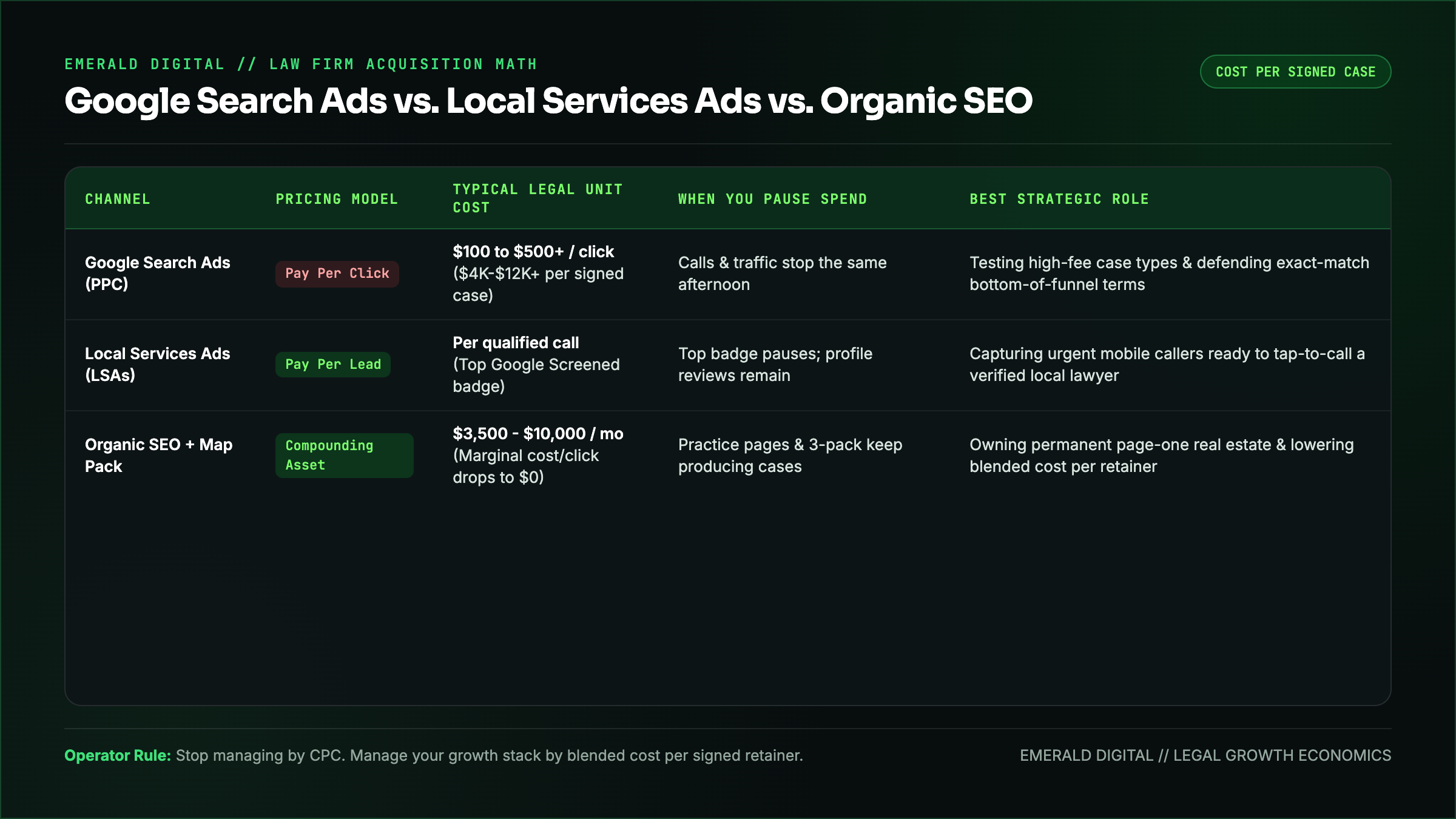
Compare Your Real Options: Google Search Ads vs. Local Services Ads vs. Organic Search
When partners tell us Google Ads has become unsustainable, the smart move is rarely an all-or-nothing flip. It is reallocating budget across the three high-intent search channels based on how each one is priced and how quickly it produces signed retainers.
| Channel | How You Pay | Speed to First Calls | What Happens When You Pause Spend | Best Role in a Law Firm Growth Stack |
|---|---|---|---|---|
| :--- | :--- | :--- | :--- | :--- |
| Google Search Ads (PPC) | Per click ($80 to $500+ in competitive legal markets, whether they call or bounce) | Immediate (as soon as campaigns launch) | Traffic and calls stop immediately | Testing high-margin case types, capturing immediate overflow capacity, defending exact-match bottom-of-funnel terms |
| Google Local Services Ads (LSAs) | Per lead / call (screened Google Guaranteed placement at the very top of mobile search) | Fast (once background check, license, and insurance verification clear) | Top-of-page badge disappears when budget pauses, though the reviews stay on your profile | Capturing high-intent mobile callers who want to tap-to-call a verified local attorney right now |
| Organic SEO + Google Map Pack | Monthly retainer investment (focused builds start at $3,500/mo; competitive metro campaigns run $5,000 to $10,000/mo) | 60 to 90 days for Strike Zone movement; 4 to 6 months for competitive primary terms | Rankings, practice pages, and Map Pack reviews keep generating cases month after month | Lowering blended cost per signed case and owning permanent digital real estate your competitors cannot outbid per click |
Four Moves to Make Before You Cut Your Ad Budget
If you are spending $10,000 to $50,000+ a month on legal Google Ads and feeling squeezed, run this four-step reallocation sequence so you cut the waste without starving your intake desk.
1. Audit Your Search Terms Report and Kill the Junk Bleed First
Before you abandon paid search entirely, check how much of your current spend is going to clicks that could never hire you. Pull your last 90 days of Search terms (not just the keywords you bid on, but the actual queries Google matched you to):
- Strip out competitor names you did not mean to buy. Bidding on another firm's name with broad match generates expensive clicks from existing clients trying to reach their current lawyer's portal or receptionist.
- Lock down location settings to "Presence: People in or regularly in your targeted locations." The default setting ("Presence or interest") lets people across the country trigger your $200 clicks when researching your city.
- Cut informational, pro bono, and job-seeker queries. Add aggressive negative keyword lists for terms like `free`, `pro bono`, `legal aid`, `salary`, `jobs`, `clerk of court`, `statute PDF`, `how to file yourself`, and `sample motion`.
- Fund only your highest-fee case types. If a standard misdemeanor or minor fender-bender cannot profitably absorb a $180 click, pull it out of Search Ads and reserve paid clicks strictly for catastrophic injury, trucking, high-asset divorce, or commercial litigation. If your clicks are still bouncing, run our full Google Ads non-converting diagnostic.
2. Shift Immediate Call Budget Into Google Local Services Ads (LSAs)
For most local practice areas, Google Local Services Ads sit above traditional Search Ads with the green Google Verified / Google Guaranteed badge, your star rating, and a direct tap-to-call button.
Because you pay per lead rather than per click, you stop subsidizing people who click your ad, skim two sentences, and hit the back button. To win in LSAs without overpaying:
- Answer live in under 30 seconds. Google's LSA ranking algorithm heavily rewards responsiveness. Missed calls and slow callbacks tank your ad placement even if your bid is high.
- Drive steady review velocity. Firms with fresh, detailed client reviews consistently earn more LSA impressions than firms coasting on twenty reviews from four years ago.
- Rate and archive every lead inside the LSA dashboard. Keep your job types and service areas tight so Google learns which calls turn into booked consultations.
3. Build the Organic Practice Pages That Replace Rented Clicks
Every month you spend 100% of your budget on paid clicks and 0% on organic assets, you guarantee that twelve months from now you will still be paying retail auction prices for every single lead.
The way out of the PPC trap is using your paid search data to build the exact organic pages that convert:
- Look at which non-branded search queries actually produced signed cases in your ad account over the last year.
- Build dedicated, deeply detailed practice-area and case-type pages for those exact searches on your website.
- Target Strike Zone queries (positions 5 through 20) in Google Search Console first so you capture page-one organic calls within 60 to 90 days instead of waiting a year.
- Fortify your Google Business Profile with the right primary category, practice-specific services, and a disciplined review cadence so you show up in the 3-pack right below the ads for free.
When we worked with The Law Center, they started with a brand-new domain in one of the most expensive paid search verticals in the country: motorcycle accident law. Instead of burning six figures a month in a perpetual bidding war, we built their organic authority from the ground up, taking them to #2 nationally for "motorcycle accident lawyer" in six months and generating 5,800+ contacts, 30+ qualified leads per day, and a 5x increase in signed cases.
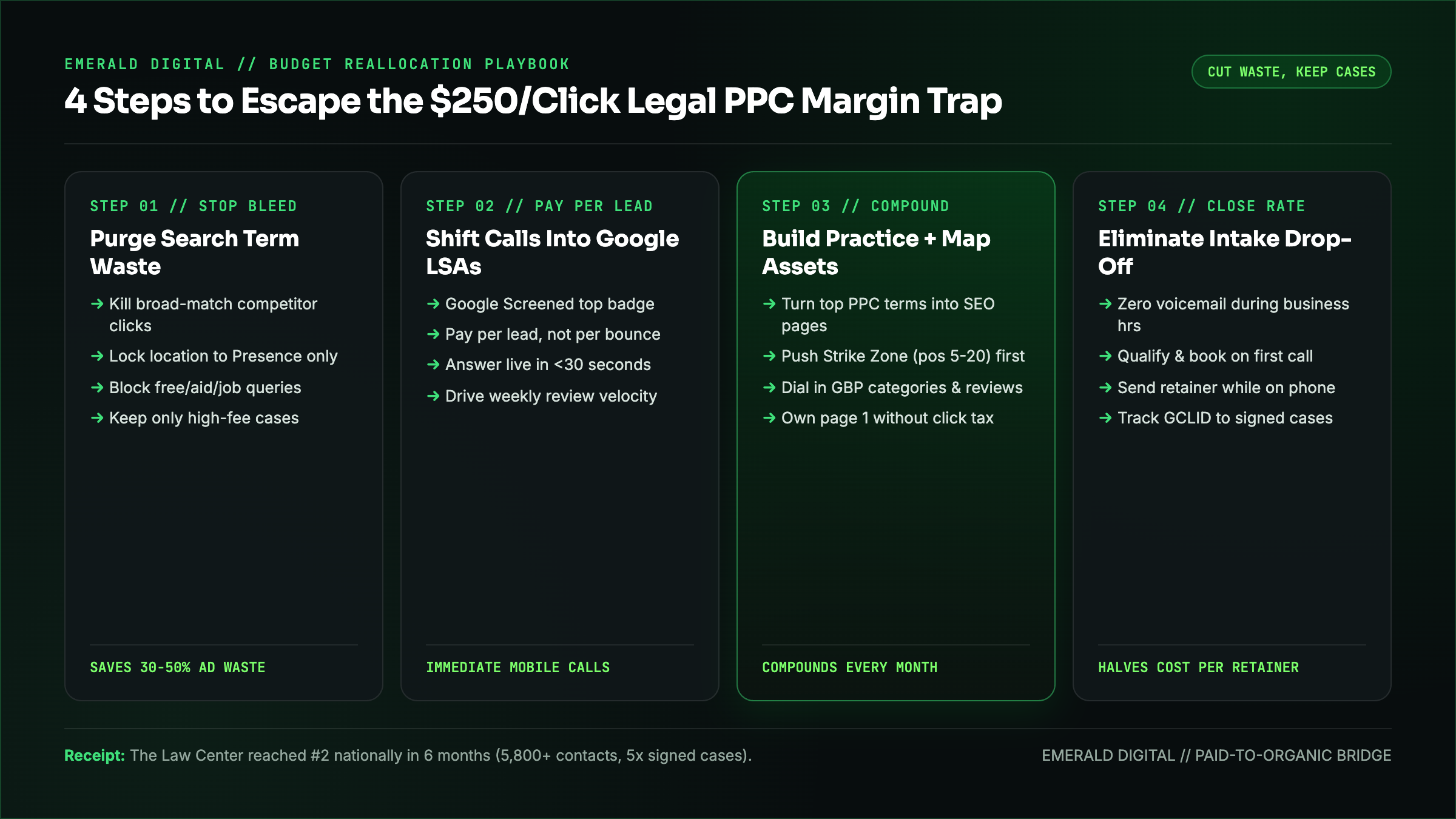
4. Fix the Intake Leak That Doubles Your Cost Per Case
Whether a caller comes from a $250 Search Ad, a Local Services Ad, or an organic practice page, your true cost per signed case doubles the moment your intake process hesitates.
When a prospective legal client is stressed and searching on their phone, they call the first firm that looks credible. If they hit an automated phone tree, a voicemail box, or an answering service that takes a name and promises "someone will call you back tomorrow," they hang up and call the next firm on the screen. Answer live, qualify the matter on the first call, and book the attorney consultation or send the retainer while the client is still on the line.
Want a Clear Plan to Lower Your Cost Per Signed Case?
You should not have to choose between feeding Google's ad auction forever and watching your intake pipeline dry up. Our legal SEO programs start at $3,500/month for focused single-market scopes, with typical multi-practice engagements running $5,000 to $10,000/month, and we also manage high-intent Google Ads when the unit economics make sense.
Explore our law firm SEO approach or request a free teardown. We will audit your current paid search waste, show you the organic practice-area and Map Pack searches you can win in the next 90 days, and lay out a realistic transition plan that brings your cost per signed case down.