Legal keywords sit at the top of Google's auction pricing for a simple reason: a single signed retainer can generate five, six, or seven figures in legal fees. In major metros, commercial queries like `car accident lawyer near me`, `truck accident attorney`, or `DUI lawyer [city]` routinely clear $100 to $250+ for a single click.
The question isn't whether Google Ads is expensive for law firms. It is. The question is whether your account is engineered to turn $150 clicks into signed retainers, or whether you're quietly donating thousands of dollars a month to Google by funding students, pro bono callers, and people looking for another lawyer's phone number.
Here is the exact operating playbook for law firm Google Ads, what legal PPC and Local Services Ads actually cost in 2026, and how to make the economics work.
How Google Search Ads, Local Services Ads, and SEO fit together
Before you touch bid strategies or ad copy, you have to understand how the three search channels on a legal SERP interact. Many firms treat Local Services Ads (LSAs), traditional Search Ads (PPC), and organic SEO as competing silos. In practice, they form a single acquisition stack.
| Channel | Billing Model | Typical Legal Cost Range | Best Use Case for Law Firms | Primary Limitation |
|---|---|---|---|---|
| Local Services Ads (Google Screened) | Pay per qualified lead (call or message) | $80 to $450 per lead depending on practice area and metro | Capturing urgent mobile callers at the very top of the page with review trust | Limited keyword control; volume depends heavily on proximity and review velocity |
| Google Search Ads (PPC) | Pay per click (CPC) | $75 to $250+ per click ($900 to $2,500+ per signed case) | Targeting exact high-value case types (`motorcycle accident`, `commercial truck wreck`, `high-asset divorce`) | Stops the day budget pauses; requires strict negative keyword and landing page discipline |
| Organic SEO & Map Pack | Monthly retainer investment | $3,500 to $10,000/mo typical retainer | Lowering blended cost per case over time by owning the Map Pack and commercial practice pages | Takes 3 to 6 months to compound into top-three commercial positions |
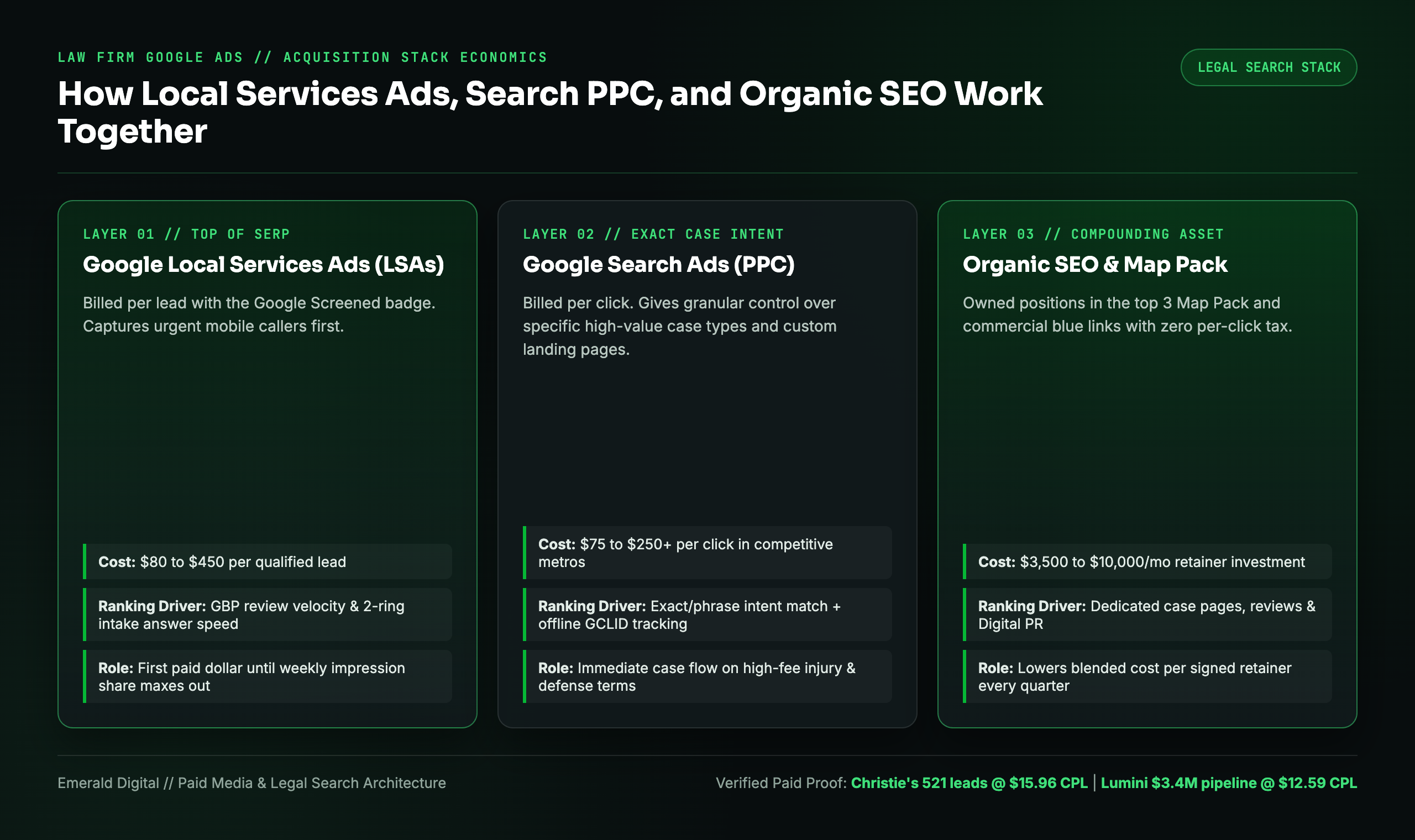
For most single-office or regional law firms, Local Services Ads should get the first paid dollar until you max out your weekly impression share, because you pay per contact rather than per click and carry the `Google Screened` badge. Google Search Ads layer right underneath LSAs so you can target the exact high-margin case types where LSA volume caps out. And law firm SEO builds the permanent organic and Map Pack foundation so you aren't hostage to rising auction CPCs forever.
Next step
Find the paid-media leaks before adding budget.
See how we turn high-CPC search spend into tracked pipelineYou win legal PPC on intent separation, not bigger bids
When we audit a struggling law firm ad account, the primary leak is almost never the bidding strategy. It's that the account blends four completely different search intents inside the same campaign and lets Google's automation spend the budget wherever clicks are cheapest.
If you bid on broad or unguarded phrase-match terms like `personal injury lawyer` or `divorce attorney`, Google will happily match your ads to searches for `free legal aid near me`, `how long does a settlement check take`, `county courthouse clerk phone number`, and your competitors' firm names. Because informational clicks are cheaper than commercial clicks, automated bidding floods your budget into the lowest-value traffic to make your average CPC look better on a report.
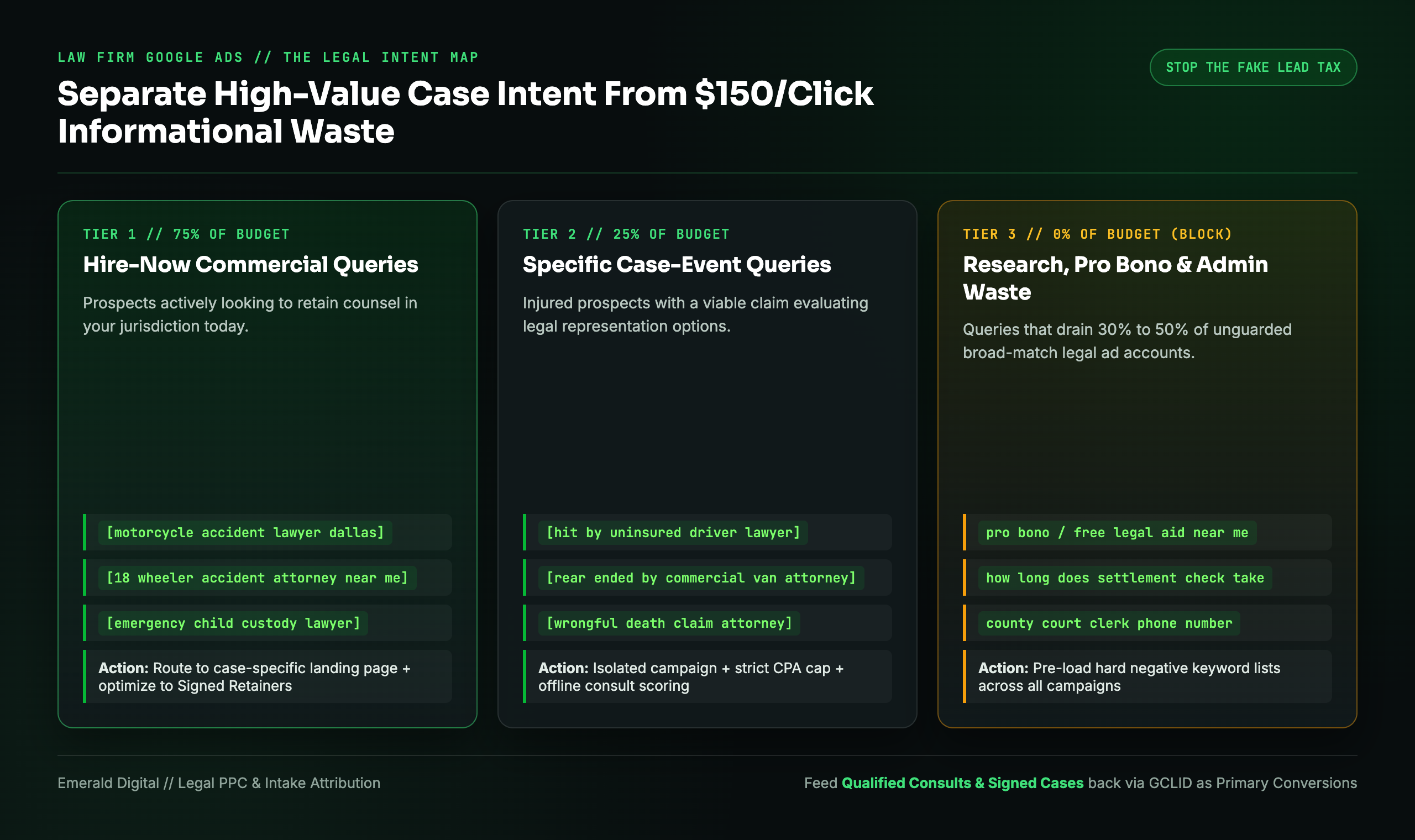
We fix this with a strict Legal Intent Map before spending a dollar:
- Tier-1 Hire-Now Commercial Intent (70% to 80% of budget): Exact and tightly guarded phrase-match queries signaling an immediate need for counsel, such as `[motorcycle accident lawyer dallas]`, `[18 wheeler accident attorney near me]`, or `[emergency child custody lawyer]`.
- Tier-2 Specific Case-Event Intent (20% to 30% of budget): High-intent problem queries where a prospect has a viable claim and is evaluating options, such as `[hit by uninsured driver lawyer]` or `[rear ended by commercial van attorney]`.
- Hard Negative Exclusions (0% of budget): Pre-loaded negative lists blocking `pro bono`, `free consultation no money`, `jobs`, `salary`, `law school`, `statute`, `forms`, `clerk`, `judge`, `settlement calculator`, and every existing client or competitor name you don't explicitly intend to conquest.
"Someone searching 'commercial truck accident lawyer near me' and someone searching 'how much can I sue for whiplash' want completely different things. In most law firm accounts they sit in the same ad group, so Google optimizes for the average and burns half the budget on callers you can't help. Separate the intents and the exact same spend signs dramatically more cases."
Matthew Berman, founder, Emerald Digital
If your CPCs already feel unsustainable, read our diagnostic guide on what to do when Google Ads for lawyers gets too expensive.
Track to signed retainers, not raw phone calls
A 30-second phone call is not a case. A form submission asking for free advice is not a retainer.
Yet most legal PPC agencies set Google Ads to count every 60-second call and every contact form submit as a primary conversion, then switch the campaign onto `Maximize Conversions`. That creates what we call the Fake Lead Tax: Google's algorithm learns which demographics and queries generate the easiest form fills and phone rings, and steers your $150 clicks toward people who call five firms looking for free answers.
To stop paying the Fake Lead Tax, wire your call tracking and intake CRM directly back into Google Ads:
- Capture `GCLID` on every call and form: Use CallRail, WhatConverts, or Lawmatics to attach the Google Click ID to every inbound inquiry.
- Score leads at intake: Have your intake team disposition every call into three clear buckets: *Unqualified / Wrong Practice Area*, *Qualified Consult*, and *Signed Retainer*.
- Feed only qualified consults and signed cases back as Primary Conversions: Keep raw phone calls as `Secondary (Observation Only)` metrics in Google Ads so Smart Bidding only optimizes toward the searches that actually sign retainers.
For a full walkthrough of fixing broken conversion signals and landing pages, see our guide on why your Google Ads aren't converting.
Match every ad group to a case-specific landing page
Never send paid legal traffic to your firm's homepage. When someone clicks a $180 ad for `motorcycle accident lawyer`, they just told you the exact wreck they were in. Dropping them onto a general homepage that talks about your firm's founding history and lists twelve unrelated practice areas destroys conversion rates.
Every practice-area ad group needs a dedicated, high-speed commercial landing page built for one job: turning an anxious caller on a smartphone into a live intake conversation.
| Landing Page Element | What Converts in Legal PPC | What Kills Conversion |
|---|---|---|
| Above-the-Fold Headline | Matches the exact case type and city from the search query (`Houston 18-Wheeler & Commercial Truck Accident Lawyers`) | Vague firm slogans (`Fighting for Justice Since 1998`) |
| Primary Mobile CTA | Sticky click-to-call button with live 24/7 intake expectation + short 3-field case review form | Buried contact link or a 12-field questionnaire asking for policy numbers |
| Case-Specific Proof | Verdicts and settlements in that exact practice area, trial credentials, and verified client reviews | Generic stock photos of gavels, scales of justice, or courthouse columns |
| Objection Handling | Plain-English explanation of contingency fees (`$0 upfront unless we recover`) and how medical bills get handled | Dense walls of statutory citations copied from state codes |
How Local Services Ads (LSAs) change the math
Local Services Ads deserve special attention because Google ranks and bills them differently than standard Search Ads. You don't bid on keywords in LSAs; you select your practice categories (`Personal Injury Lawyer`, `DUI Lawyer`, `Estate Planning Attorney`) and service areas, and Google ranks your profile based on:
- Proximity to the searcher's location.
- Review volume, recency, and rating on your connected Google Business Profile.
- Responsiveness to inbound LSA calls and messages (missed calls or slow replies tank your LSA impression share within days).
- Business hours and intake coverage.
If your intake desk lets LSA calls roll to voicemail at 5:15 p.m., Google throttles your visibility and hands the top three `Google Screened` slots to a competitor whose intake team answers in two rings. Treat LSA responsiveness and weekly review collection as core paid media operations.
What disciplined paid search looks like when it works
Across high-ticket, trust-heavy verticals, the formula that makes paid media profitable is identical: strict intent separation, conversion-engineered landing pages, and optimizing the algorithm to qualified pipeline rather than vanity clicks.
Using that exact system:
- For Christie's, we generated 521 qualified luxury leads at a $15.96 cost per lead.
- For Lumini, our search, content, and conversion architecture drove 324 qualified leads and $3.4M in pipeline in 60 days at a $12.59 cost per lead.
- For Villa Bella Vita, we increased reservations 166% in 90 days at a $30.85 cost per lead.
- And on the organic legal side, we took The Law Center to #2 nationally for "motorcycle accident lawyer" in six months, generating 5,800+ contacts and 5x signed cases.
See how we manage high-intent Google Ads alongside law firm SEO, or request a free audit of your legal ad account: we will show you the exact search terms draining your budget, where your conversion tracking is misfiring, and how to lower your cost per signed retainer.