
Most ecommerce SEO reports rely on a simple sleight of hand: they blend branded and non-branded organic traffic onto one chart, point at the rising line from your paid social campaigns, and take credit for people who were already typing your store's name into Google.
People searching your brand name already know who you are. Capturing them is table stakes, not growth.
Real ecommerce SEO wins non-brand commercial search: the moment a buyer types `merino wool base layer`, `solid walnut dining table`, or `low-acid cold brew concentrate` with a credit card in hand and zero loyalty to a specific store yet. Using the collection-first playbook below, we grew DuJour's web traffic by 800% over nine months, and generated 324 qualified leads and $3.4M in pipeline in 60 days at a $12.59 CPL for Lumini. Here is how the system works.
The money is in non-brand commercial search
Before you approve an SEO roadmap, open Google Search Console and apply a regex filter that excludes your brand name and common misspellings. What remains is your true non-brand organic footprint.
In almost every store we audit, non-brand traffic is a fraction of what leadership assumed, and the few non-brand clicks the store does earn land on old informational blog posts with a 0.1% conversion rate. If your store sells skincare and your top organic URL is a blog post about "what causes dry winter skin," you aren't running an ecommerce SEO program. You're running a free magazine for browsers who buy on Amazon.
Judge every action in your SEO retainer by a single test: does this help a collection or product page rank for a non-brand search from a ready-to-buy shopper?
Next step
Find the SEO opportunities you should own.
See how we rank ecommerce stores for non-brand buyersRank the pages that sell, in the right order
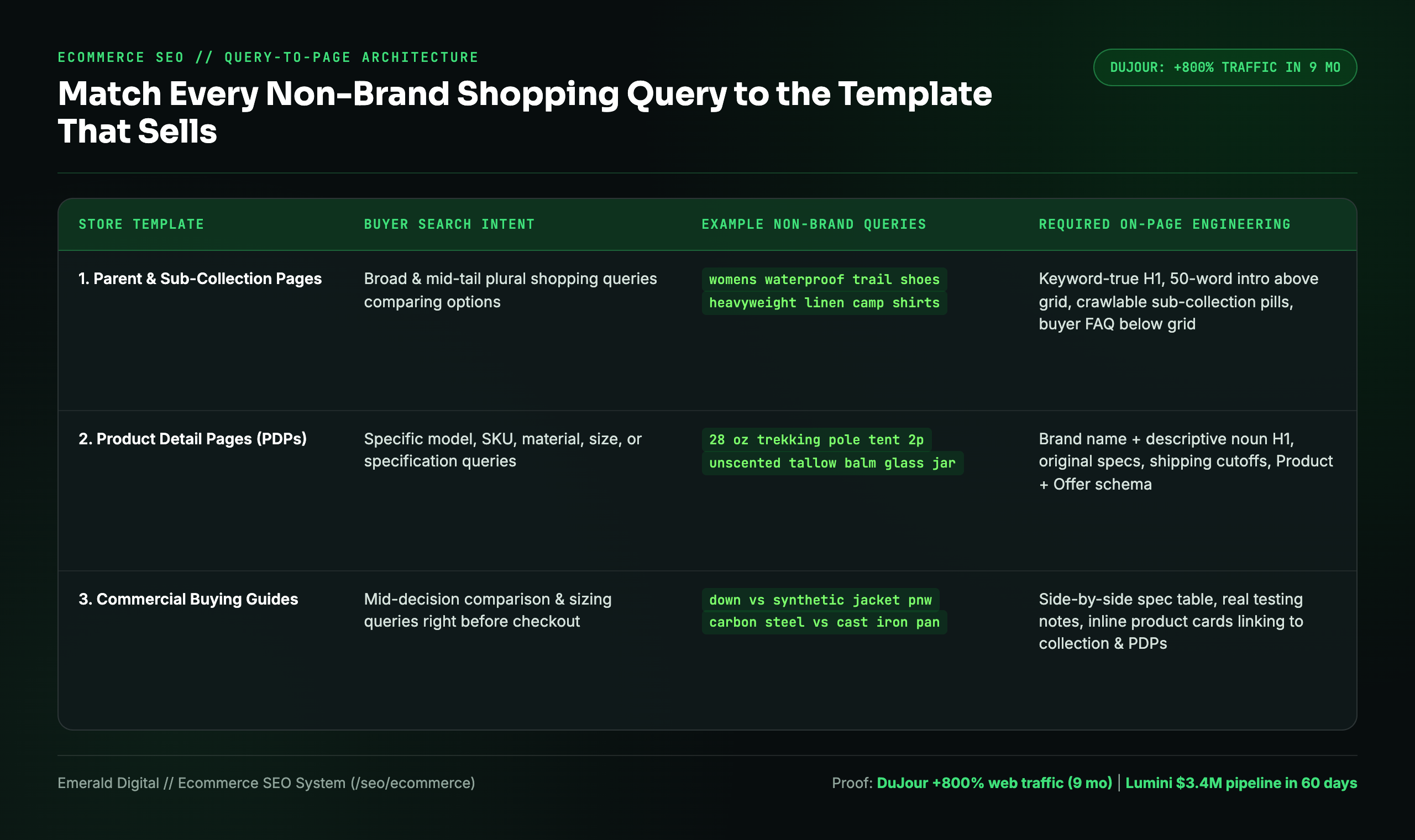
Three page templates carry an ecommerce domain, and most teams optimize them backward. They spend months rewriting individual product descriptions or cranking out top-of-funnel blog posts while leaving their collection architecture flat.
| Page Template | Target Buyer Search Intent | Example Queries | Core On-Page & Technical Elements |
|---|---|---|---|
| Category & Sub-Collection Pages | Broad & mid-tail plural shopping queries where buyers want to compare options | `womens waterproof trail running shoes`, `60 inch double sink bathroom vanities` | Keyword-exact H1, concise 60-word intro above/below grid, crawlable sub-collection pills, FAQ block, clean canonical URL |
| Product Detail Pages (PDPs) | Specific model, SKU, material, problem, or long-tail specification queries | `ultralight 2p trekking pole tent 28 oz`, `unscented tallow balm glass jar` | Distinct product title (not just an internal style name), original specs, shipping/return clarity, `Product` + `AggregateRating` schema |
| Commercial Buying & Comparison Guides | Mid-decision evaluation queries right before a shopper picks a product class | `down vs synthetic sleeping bag for pacific northwest`, `cast iron vs carbon steel skillet` | Direct comparison table, real testing insights, and inline product cards linking directly into the target collection and top PDPs |
1. Build sub-collections for how shoppers actually filter
A single top-level "Mens Shirts" collection will never rank for `mens heavyweight linen camp collar shirt`. Yet most stores leave those specific attributes trapped inside non-indexable JavaScript filter parameters (`?fabric=linen&collar=camp`).
Whenever DataForSEO or Google Search Console shows real monthly buyer volume for a material, style, use case, or room type, promote that filter combination into a permanent, indexable sub-collection URL with its own H1, title tag, internal links from the parent category, and curated product grid. For platform-specific implementation details, see our Shopify SEO guide.
2. Upgrade product pages so they rank and convert simultaneously
If your store sells products using a cute internal name like *The Sunday Crew* or *The Cloud Loafer*, Google has no idea what the item actually is. Name your product H1 and title tag with both the brand style name and the descriptive noun phrase buyers search: `The Sunday Crew | Men's 100% Cashmere Crewneck Sweater`.
Replace manufacturer-supplied copy with the specifics a skeptical buyer needs before checking out: exact dimensions, fabric weight, fit notes on a real model, care instructions, shipping cutoff times, and verified customer reviews. Validate your `Product`, `Offer`, and `AggregateRating` JSON-LD schema so Google displays your price, availability, and star rating directly inside the search snippet. If your store is already getting clicks that bounce before checkout, read our diagnostic on fixing Shopify traffic with no sales.
3. Only publish editorial content that routes directly into a collection
Top-of-funnel blog traffic is the most overrated vanity metric in ecommerce. It looks impressive on a monthly slide deck and converts like a tourist.
"Top-of-funnel blog traffic is the most overrated metric in ecommerce. It looks like growth and converts like a tourist. Tie every piece of content to a collection or product it should sell, or don't publish it."
Matthew Berman, founder, Emerald Digital
When we build supporting content for an ecommerce store, every URL is a buying guide, material comparison, or sizing breakdown mapped directly to a revenue collection. It answers the exact objection holding up the purchase and puts the top three matching products on the page with direct add-to-cart or collection links.
Technical SEO is a revenue lever on multi-SKU catalogs
On a 15-page service site, technical SEO takes an afternoon. On a 3,000-SKU ecommerce store, technical crawl architecture is the difference between a catalog that prints money and one that sits unindexed.
Run this technical ecommerce SEO audit checklist before writing a word of new copy:
| Technical Failure Mode | What Happens in Google Search | The Engineering Fix |
|---|---|---|
| Faceted Filter Crawl Bloat | Color, size, and price filter combinations generate 100,000+ near-duplicate URLs, exhausting crawl budget | Block low-value parameter combinations via canonical tags and `noindex`, while promoting high-volume attributes to clean static sub-collections |
| Collection-Scoped Product URLs | Linking to `/collections/sale/products/item` creates 4 duplicate URLs for 1 product, splitting link equity | Rewrite collection product-card templates to link directly to the canonical `/products/item` root URL |
| JavaScript "Load More" Grids | Googlebot cannot click JS-only infinite scroll buttons, leaving products past page 1 orphaned | Implement crawlable `<a href="?page=2">` pagination links alongside infinite scroll per Google Search Central ecommerce standards |
| Out-of-Stock 404 Churn | Deleting seasonal or temporarily out-of-stock PDPs destroys accumulated rankings and backlinks | Keep returning products live with an email waitlist and `OutOfStock` schema; 301-redirect permanently retired products to the closest replacement or parent collection |
| Orphaned Sub-Collections | New collections exist in the XML sitemap but have zero internal links from the mega-menu or parent categories | Add HTML breadcrumb hierarchies and cross-link sibling sub-collections directly on category templates |
Find the Strike Zone and compound
You never rank a 2,000-SKU catalog all at once. The fastest revenue lift in ecommerce hides in your Strike Zone: non-brand commercial collection and product queries where your store already ranks between positions 5 and 20.
A collection page sitting at position 11 on page two is already indexed and trusted by Google, yet captures less than 1% of the clicks. Moving that collection from position 11 to position 4 multiplies its organic traffic by 4x to 6x without waiting six months for a brand-new URL to mature.
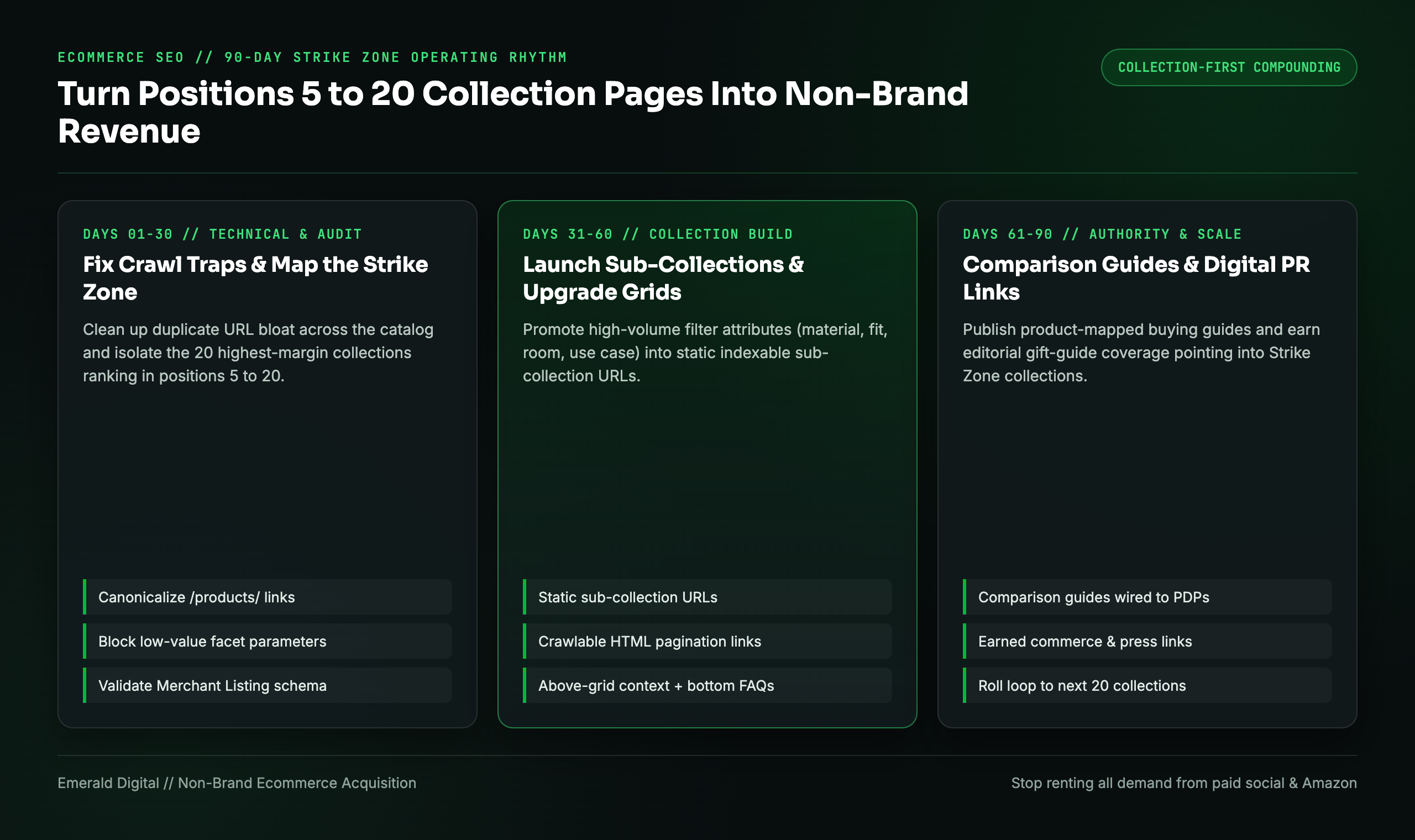
Our 90-day ecommerce operating rhythm runs on that exact Strike Zone loop:
- Days 1 to 30 (Crawl & Strike Zone Audit): Clean up duplicate variant/collection URLs, fix broken `Product` schema, and isolate the top 20 revenue collections ranking in positions 5 to 20.
- Days 31 to 60 (Collection Expansion & On-Page Architecture): Ship upgraded collection headers, sub-collection internal link hubs, and high-converting PDP templates for the Strike Zone cohort.
- Days 61 to 90 (Digital PR, Comparison Guides & Next Cohort): Build buying guides and earn editorial gift-guide and category links pointing directly into your priority collections, then roll the process to the next 20 collections.
What this looks like when it works
When you stop chasing generic blog traffic and engineer your catalog around non-brand buyer intent, the revenue compounds without paying Meta or Google an ever-rising tax per click:
- For DuJour, we grew organic web traffic by 800% over nine months by overhauling technical crawl paths, category architecture, and authority around high-intent search demand.
- For Lumini, a DTC beauty brand, our search, content, and conversion system generated 324 qualified leads and $3.4M in pipeline in 60 days at a $12.59 cost per lead.
See how we rank ecommerce stores for buyers, explore our core SEO system, or request a free ecommerce SEO teardown: we will show you how much of your current organic traffic is actually non-brand, which collection pages are stuck in your Strike Zone, and the exact roadmap to turn them into revenue.