
Roofing SEO is the difference between building your business on rented land and building something you actually own.
Shared leads can make the phone ring this week. I'm not going to pretend they never work. But if your whole pipeline depends on buying the next batch of names every month, you're exposed. The price can go up. The quality can go down. And if a bigger company or private-equity-backed rollup decides to buy the same attention faster than you can, you're the one getting squeezed.
That's fine if you've got the capital to push out the local market.
It's brutal if you're the local market.
You wouldn't tell a homeowner to rent the roof over their house and call it an investment. The whole point of the roof is protection. You buy it because it protects the thing underneath.
Marketing works the same way.
Shared leads are rented attention. Roofing SEO is slower, less dramatic, and harder to fake, but done right, it's how you build demand that compounds instead of demand you have to keep buying.
The 3 Numbers I Would Actually Watch
If you're reading this on your phone between calls, don't start with "we need more SEO."
Start with three numbers:
- How many real leads are you getting? Roofr cites Roofing by the Numbers 2025 saying 63% of roofing business owners named generating new leads as their #1 growth challenge. That tracks. Most roofers don't have a traffic problem first. They have a "where is the next real opportunity coming from?" problem.
- Do homeowners trust you before they call? BrightLocal's 2026 consumer review survey found 97% of consumers read reviews online and 85% say positive reviews make them more likely to use a business. For roofing, that means your reviews, job photos, and local pages aren't decoration. They're part of the sales process.
- How much time are bad leads stealing? Even a lead-buying company like ActiveProspect says wrong leads waste time and drain budget. That's the part people ignore. A lead isn't a job. A name and phone number can still waste your estimator's afternoon.
That's why SEO matters here.
Not because rankings are magical.
Because the right pages can pre-sell the job before the call hits your phone.
The Fast Answer
Shared roofing leads are useful when you need immediate volume and can handle the margin pressure. Roofing SEO is better when you want a durable system: service pages, local evidence, reviews, internal links, and content that helps homeowners find you before they enter a shared-lead marketplace.
Use shared leads for short-term coverage.
Build roofing SEO so you aren't dependent on them forever.
Why Shared Leads Feel Good At First
Shared leads have a clean pitch.
Pay money. Get names. Call fast.
If your crews have open days, that can feel like oxygen. You don't have to wait for Google. You don't have to build service-area pages. You don't have to collect project photos, rewrite thin pages, or fix a messy Google Business Profile.
You just pay and chase.
That's also the trap. The whole system trains you to think demand is something you buy each morning instead of something you build over time. The minute lead cost rises, call quality drops, or the marketplace changes the rules, you feel it in the schedule.
And because the lead source owns the demand, the platform has the power.
The Owned-Demand Way To Think About Roofing SEO
Roofing SEO isn't "write some blog posts."
That's the version people sell when they don't understand your actual problem.
A real roofing SEO system is built around the questions that turn into jobs:
- emergency roof repair
- roof replacement cost
- roof leak repair near me
- metal roof installer
- storm damage roof inspection
- roofer in a specific town
- commercial roof repair
- insurance roof claim help
Each search has a different level of urgency. Each one needs a different page, proof asset, and next step.
Your main service page is the center. Supporting articles show depth. Reviews build trust. Project photos show you actually do the work. Internal links help Google understand which pages matter. Local pages help homeowners understand whether you serve their area.
That's not content for content's sake.
It's the boring work that makes the phone ring later.
Why Most Roofing SEO Advice Misses The Point
Search `roofing seo` and you'll mostly see two kinds of pages.
One is the agency page, like Roofing Webmasters: packages, deliverables, rankings, reports, call us.
The other is the broad guide, like ServiceTitan's roofing SEO guide, that walks through local SEO, keywords, on-page fixes, and reviews.
Useful? Sure.
But if you're reading this between calls, none of that answers the real question:
"Will this help me book better jobs without buying the same lead as three other roofers?"
That's the whole thing.
If the answer is no, it's just more marketing homework.
The Practical Difference: Rented Demand vs Owned Demand
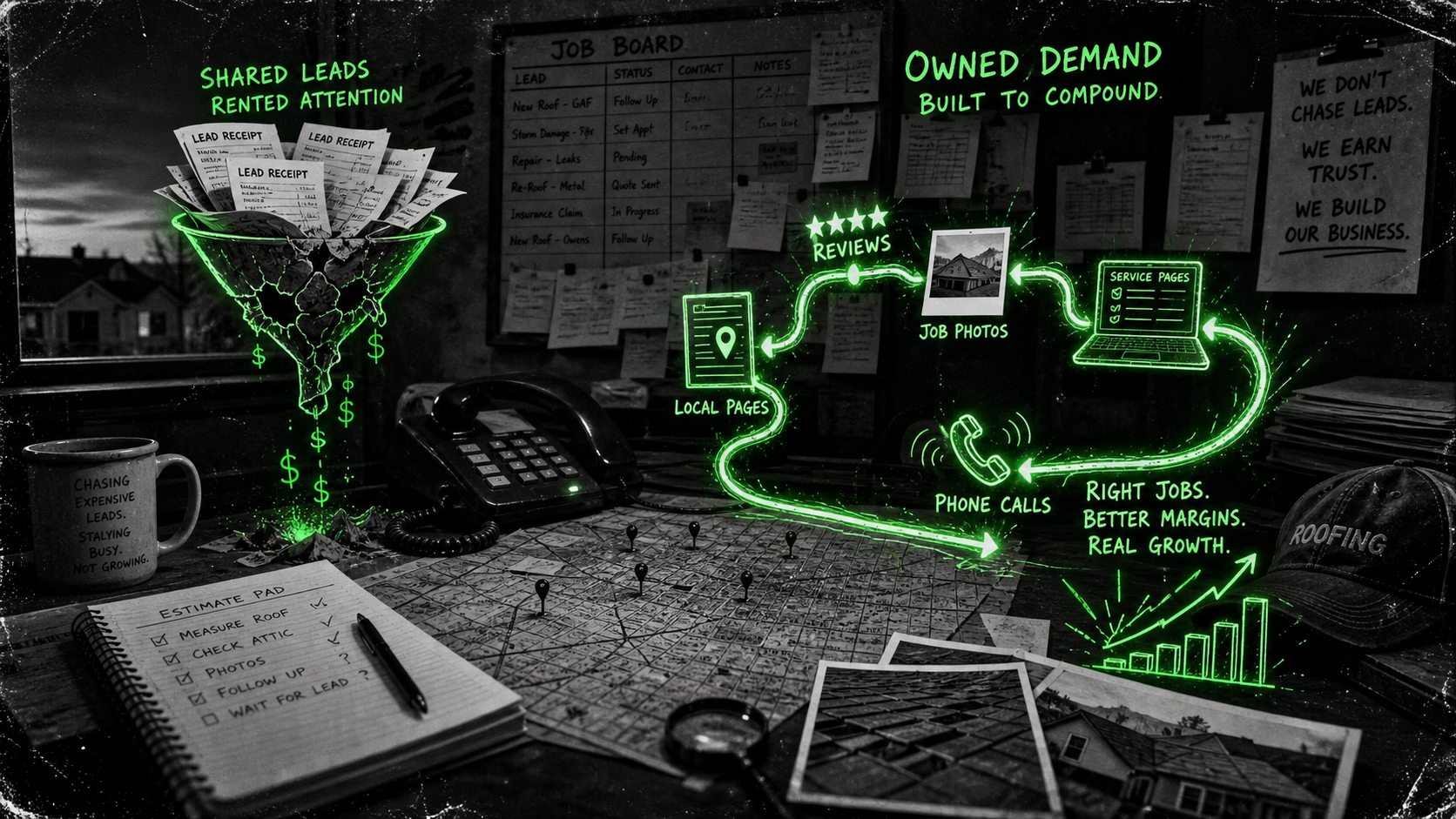
Here is the simplest way to think about it.
Question: When do calls start?. Shared leads: Usually faster. Roofing SEO: Slower
Question: Who owns the demand source?. Shared leads: The platform or marketplace. Roofing SEO: You, if the asset is built correctly
Question: What happens when spend pauses?. Shared leads: Lead flow usually pauses. Roofing SEO: Existing pages can keep earning visibility
Question: What improves over time?. Shared leads: Usually your follow-up process. Roofing SEO: Pages, authority, reviews, links, local proof
Question: Main risk. Shared leads: Margin pressure and lead quality. Roofing SEO: Waiting too long without a clear system
Shared leads are a faucet. Useful, but someone else controls the pipe.
SEO is more like building the well. It takes longer. It needs maintenance. But once it's working, it changes the economics of the business.
What Most Roofing SEO Gets Wrong
Most roofing SEO fails because it's generic.
The agency writes:
"Roofing services are important for protecting your home."
Nobody needed that sentence. Not the homeowner. Not Google. Not you.
The better article answers the questions you actually have:
- Why are we not showing up for roof replacement in our best towns?
- Why do competitors with worse websites outrank us?
- Which pages should exist before we spend another dollar on backlinks?
- Are our service-area pages useful or just doorway pages?
- What proof do we need on the page before a homeowner trusts us?
- Are we building a search asset or just publishing noise?
Those questions are closer to revenue.
The Part Most Agencies Skip
The raw material for your roofing SEO shouldn't come from an AI prompt.
It should come from what you already know.
What do homeowners misunderstand before they call? Which jobs are actually profitable? Which towns matter? What does a bad lead sound like in the first 30 seconds? What questions come up before someone books an inspection?
Then turn that into pages.
This part isn't complicated. It just takes more work than asking ChatGPT for "10 blog posts for roofers."
Start with the people who have actually dealt with the homeowner.
Your estimator knows the objections. You know which jobs make money. Your office manager knows which calls are junk. Your crews know what homeowners ask when they see the roof torn open.
That's the article.
Not all of it, obviously. But that's the part AI can't fake.
The rest is just formatting.
What To Build First
If you wanted to stop depending on shared leads, I wouldn't start with a 40-post blog calendar.
I would start here:
- Fix your main roofing SEO page. It should explain your services, locations, reviews, insurance/storm context where relevant, and why someone should call you instead of a marketplace. Here is the kind of page I mean: roofing SEO for contractors.
- Build the highest-intent service pages. Roof replacement, roof repair, storm damage, commercial roofing, metal roofing, and any high-margin specialty.
- Build service-area depth carefully. Don't publish 50 thin city pages. Build useful local pages for the towns that matter.
- Add evidence where a homeowner would hesitate. Project photos, before/after context, crew/process notes, warranties, financing, license/insurance signals, and reviews.
- Write supporting articles that answer buyer questions. Cost, timing, materials, insurance, emergency repairs, warning signs, map-pack visibility, and comparison questions.
- Link the system together. The article shouldn't be an island. If someone reads about roof replacement cost, storm damage, or shared leads, the next click should make sense. Send them to the relevant service page, your main roofing page, or the broader SEO services page.
That's the system.
Not "publish more."
Build the pages that help the buyer decide.
The point isn't to dunk on lead platforms. They have a place.
The point is to make you feel the difference between buying calls and building the thing that earns them.
FAQ
Is roofing SEO better than buying roofing leads?
Roofing SEO is better for long-term owned demand. Buying roofing leads can be better for short-term volume. The smartest approach is often to use paid or shared leads for immediate coverage while building SEO so the company becomes less dependent on rented demand over time.
How long does roofing SEO take?
It depends on the market, site quality, competition, reviews, content depth, and local evidence. A new or thin site shouldn't expect instant results. The safer expectation is to treat SEO as a demand-building program, then monitor impressions, rankings, calls, and qualified inquiries over time.
What pages does your roofing site need for SEO?
At minimum, you usually need a strong main roofing page, service pages for roof repair and roof replacement, pages for high-margin specialties, useful service-area pages, review/evidence sections, and supporting articles that answer buyer questions.
Should roofers publish blog posts?
Yes, but only if the posts support a real search job and link back to the service pages. Generic posts about "why your roof matters" are usually weak. Articles about cost, materials, repair timing, storm damage, service areas, and choosing a roofer are more useful.
What should a roofing SEO article link to?
A good supporting article should not leave someone stranded. If they are comparing shared leads, roof replacement demand, or local search visibility, the next click should point them toward the relevant service page, like the roofing SEO page.
Next Step
If you're still buying every roofing lead, don't turn that off tomorrow.
But start building the thing you will wish you had six months from now.
Look at the roofing searches that already matter. Build the pages that answer them. Add proof. Link the system together. Track the signal.
That's how the phone starts ringing from a system you own.