Most roofing marketing is a slow leak. You pay a lead-gen platform like Angi or HomeAdvisor for a "qualified homeowner," only to find out they sold that exact same phone number to four other roofers in your county ten minutes ago. Now you're in a race to the bottom on price before your truck even pulls into the driveway.
Roofing SEO fixes that leak permanently. When a homeowner has water dripping through their ceiling after a hailstorm or needs a $22,000 full replacement, they pull out their phone and type "roofer near me" or "roof replacement [town]" into Google. The roofing company sitting in the top three Google Map Pack spots and the top organic results gets the first call, owns the lead exclusively, and books the inspection without bidding against four competitors.
At Emerald Digital, our search system is built to win the hardest local and national fights on Google. We've taken a legal consortium to #2 nationally for one of the most competitive terms in search (The Law Center), multiplied phone-call leads 482% in 60 days for a service company (United Collection), and grown local restaurant traffic 2,000% in 30 days (Jerk House NYC).
Here is the exact roofing SEO playbook we use to turn search visibility into booked estimate appointments.
Step 1: Run the 15-Minute Roofing Search & Lead Diagnostic
Before you pay an agency to write 30 town pages or redesign your website, figure out where you are actually losing jobs right now.
Roofing search breaks down in one of six places. Pull up your Google Search Console and your last 30 call logs, and find your row in this table:
| What you see happening | What to check in 5 minutes | The immediate fix |
|---|---|---|
| You rank in Search Console, but the phone isn't ringing | Check your Google Business Profile on mobile from 3 miles away vs. your organic blue-link rank | 70%+ of emergency and local homeowner calls happen in the Google Map Pack. Fix your GBP categories, review velocity, and local landing page first. |
| Your crews want replacements, but you only get $250 shingle-patch calls | Look at which page ranks in GSC and what headline sits above the fold | Split Roof Replacement / Storm Restoration and Roof Repair into separate pages, and state your service scope clearly near the top of the page. |
| Homeowners call from 45 minutes outside your territory | Check your GBP service-area list and whether your town pages list zip codes you don't actually cover | Trim your GBP service areas to the exact counties/cities your trucks run profitably, and put your coverage map right above the estimate form. |
| Traffic hits your service pages, but nobody requests an inspection | Open your top service page on an iPhone and try to book an estimate in 15 seconds | Replace stock photos of random houses with real crew/truck photos, manufacturer badges (GAF Master Elite, Owens Corning), financing callouts, and a sticky tap-to-call bar. |
| You have 25 city pages, and 22 of them have 0 clicks | Compare the text across 3 of your city pages side by side | If 80% of the words are identical with only the town name swapped out, Google flagged them as thin doorway pages. Consolidate or rebuild them with real local job proof. |
| Search leads come in, but booked inspections stay flat | Check your speed-to-lead on web forms and missed calls after 5:00 PM | A homeowner with an active leak calls the next roofer on Google if they hit voicemail. Put live answering and sub-5-minute SMS/call follow-up in place immediately. |
If you want our team to run this audit against your top three local competitors, check out our SEO programs for roofers.
Step 2: Dominate the Google Map Pack (Without Getting Your Profile Suspended)
For searches like "roofing company near me", "roof leak repair [city]", and "hail damage roof inspection", the Google Local 3-Pack sits right below the paid ads and captures the lion's share of high-intent phone calls.
Google ranks the Map Pack on three signals: Relevance, Distance, and Prominence (see Google's local ranking guidelines). Most roofers either ignore their profile completely or follow terrible advice from black-hat agencies that gets their listing suspended.
Here is how to win the Map Pack cleanly:
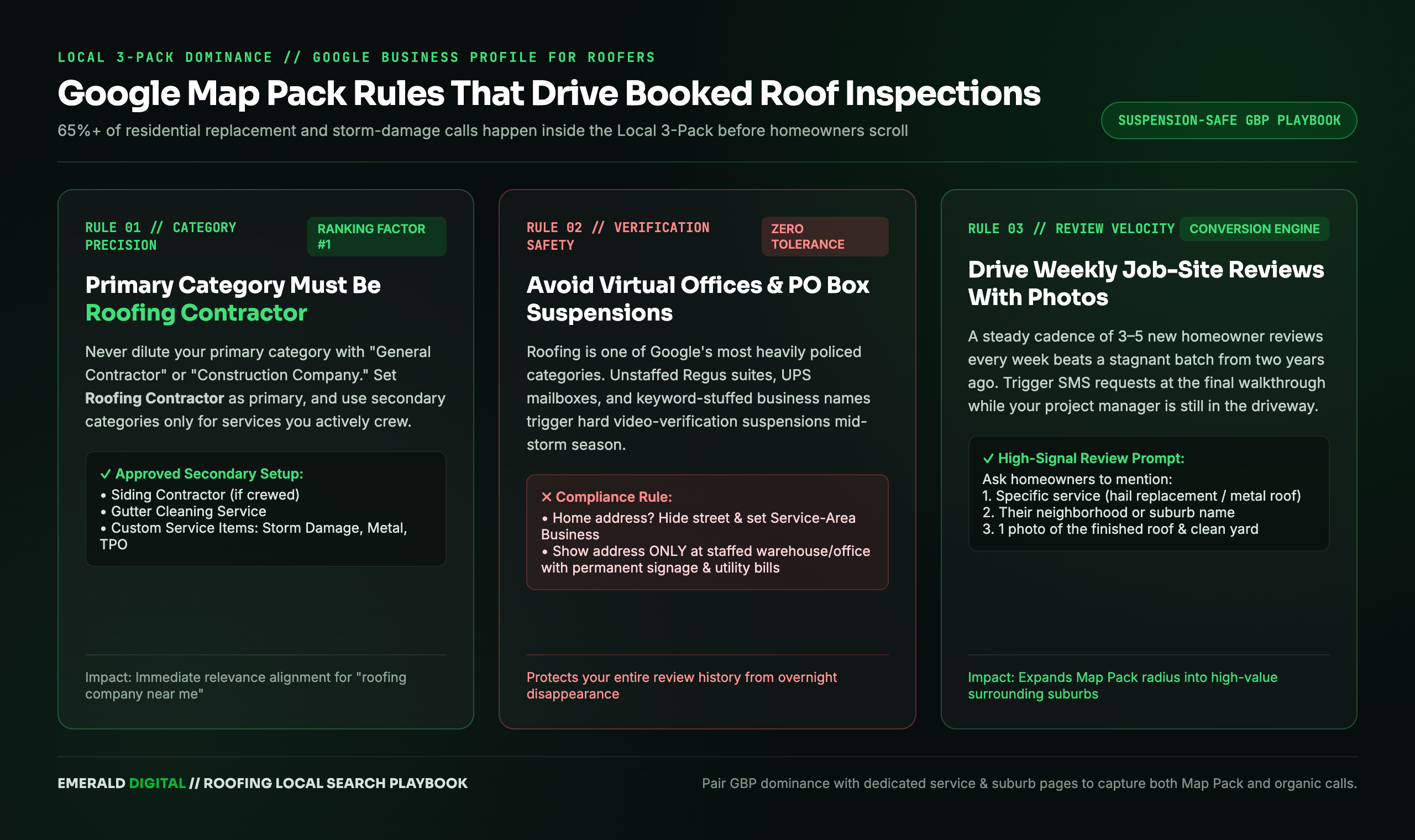
- Nail your primary and secondary categories: Your primary category must be
Roofing contractor. Only add secondary categories (Siding contractor,Gutter cleaning service,Waterproofing service) if your crews actually take those jobs. - Don't fake office pins (Follow the Service-Area Rule): Under Google's business representation rules, if you operate out of your house, an unstaffed warehouse yard, or a Regus virtual office, you must hide your street address and set up a service-area profile. Buying fake UPS Store addresses in five neighboring suburbs will eventually trigger a verification sweep that wipes out your reviews and your phone calls overnight.
- Engineer your review velocity and keywords: A roofer with 65 reviews who earns 6 new reviews every single month will outrank a stagnant competitor sitting on 120 reviews from 2022. When a job wraps and the homeowner is thrilled at the final walkthrough, have your project manager text them the review link on the spot and ask them to mention:
- What work was done ("full architectural shingle roof replacement", "metal roof install", "hail damage inspection")
- What town they are in
- Photos of the finished roof (reviews with homeowner photos stay pinned at the top of your GBP for months).
Step 3: Build Service & Town Pages That Actually Rank (And Don't Trigger Doorway Penalties)
A single generic "Services" bullet list will never rank for competitive commercial searches. Homeowners search by specific problem, material, and town:
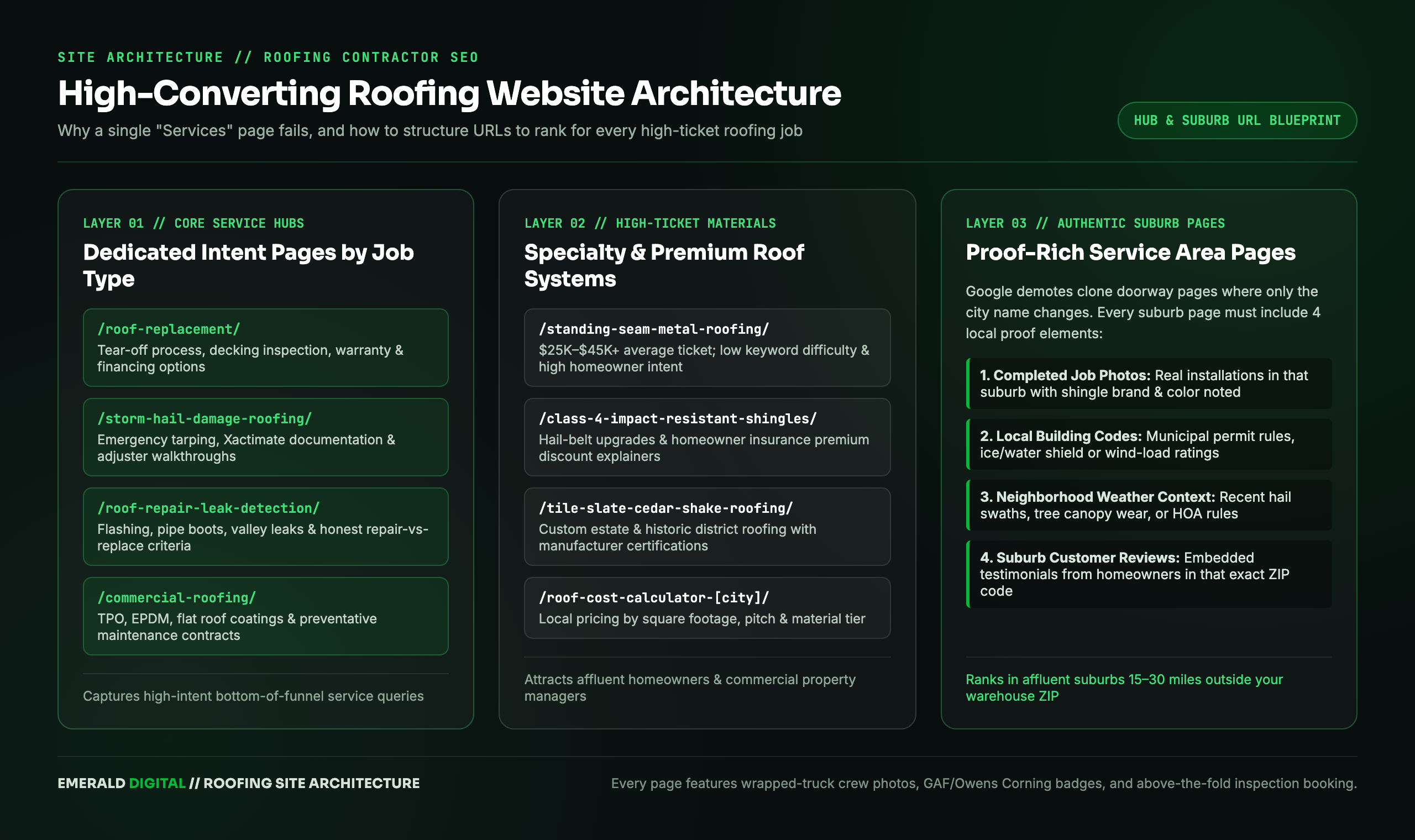
- Core Revenue Pages:
Roof Replacement,Roof Repair,Storm & Hail Damage Restoration,Roof Inspections,Commercial Roofing / Flat Roofs (TPO, EPDM) - Material Pages (High Ticket):
Metal Roofing Installation,Slate & Tile Roofing,Architectural Asphalt Shingles - Priority Town & Suburb Pages: The 5 to 15 highest-value cities and suburbs where your crews want to stay booked.
How to avoid the "City-Swap" trap
The worst thing you can do in roofing company SEO is publish 40 identical town pages where the only difference is changing "Austin" to "Round Rock." Google explicitly targets this in its doorway abuse spam policies.
Every town page on your site needs to look like it was written by a project manager who has actually been on a ladder in that town:
- Show real job-site photos of roofs your crew completed in that specific city or subdivision (never stock houses with palm trees if you roof in Ohio).
- Mention local building codes, HOA shingle requirements, or regional weather realities (wind-rating zones, ice damming, hail corridors).
- Embed reviews from homeowners in that specific town and link directly to the relevant service pages.
Step 4: Turn Your Service Pages Into High-Trust Estimate Machines
Getting a homeowner to click your link is only half the battle. Letting a roofer tear off the top of your house is a $15,000 to $40,000+ trust decision. If your page looks like a cheap template from 2016, they will hit the back button and call the competitor with 300 Google reviews.
Every core roofing service page needs five elements above the fold on mobile:
- A crystal-clear scope headline: Name the exact service and service area ("Full Roof Replacement & Storm Restoration in [City]") and state plainly whether you handle insurance claims, retail replacements, or repairs.
- Real trucks and real people: Put a photo or 30-second video of your actual owner, project managers, and wrapped trucks right at the top. Homeowners hire people, not logos.
- Hard credentials: Manufacturer certifications (GAF Master Elite, Owens Corning Platinum Preferred, CertainTeed), license/insurance numbers, workmanship warranty terms, and financing options.
- Zero-mystery next step: Don't use a vague "Submit" button. Tell the homeowner exactly what happens when they reach out: "Request a Free 20-Point Roof Inspection (Same-Week Appointments, Drone Photo Report Included)."
- Tap-to-call + 3-field form: Name, phone/email, address/zip code, and "Repair or Replacement?" That's it.
Step 5: Attack Your "Strike Zone" Keywords First
You don't have to wait 12 months to see ROI from SEO for roofers. The fastest money on your website right now is hiding in your Strike Zone: the commercial keywords where your site already ranks between positions 5 and 20 in Google Search Console.
Why positions 5 to 20?
- A page sitting at position #11 (top of page two) is already indexed and trusted by Google, and it gets almost zero clicks.
- Moving that page from position #11 to position #4 doesn't require a year of blogging. Usually it takes upgrading the title tag, expanding the page with real project photos and local FAQs, adding internal links from your homepage and related service pages, and pointing 2 to 3 local links at it.
- That single jump from page two into the top five multiplies clicks and phone calls within weeks.
We run roofing SEO in repeatable sprints: pull the Strike Zone queries in Search Console, upgrade the money pages closest to page one, track the exact phone calls and booked inspections they produce, and repeat for the next town on your expansion map.
Step 6: Catch Homeowners Before the Storm With Field-Tested Content
Once your core service and town pages are converting, build supporting articles around the exact questions your estimators answer at the kitchen table every day:
- How much does a 2,500 sq. ft. roof replacement actually cost in [State/Metro] in 2026? (Give real price ranges by material: 3-tab vs. architectural shingle vs. standing-seam metal.)
- Should I file a homeowners insurance claim for hail or wind damage, or pay out of pocket?
- How to tell if your roof needs a $600 flashing repair or a full replacement.
Write these from real job-site experience with photos of actual damaged shingles, flashing leaks, and decking rot your crews have photographed. That is the exact "experience moat" AI search engines (ChatGPT, Google AI Overviews) and skeptical homeowners trust. Every article should funnel the reader directly into booking an inspection on your service page.
Want to see which roofing searches your competitors are stealing in your service area right now? Check out our Roofing SEO & Local Growth Programs or request a free SEO teardown. We'll show you your Map Pack gaps, your Strike Zone keywords, and the exact plan to own your backyard.