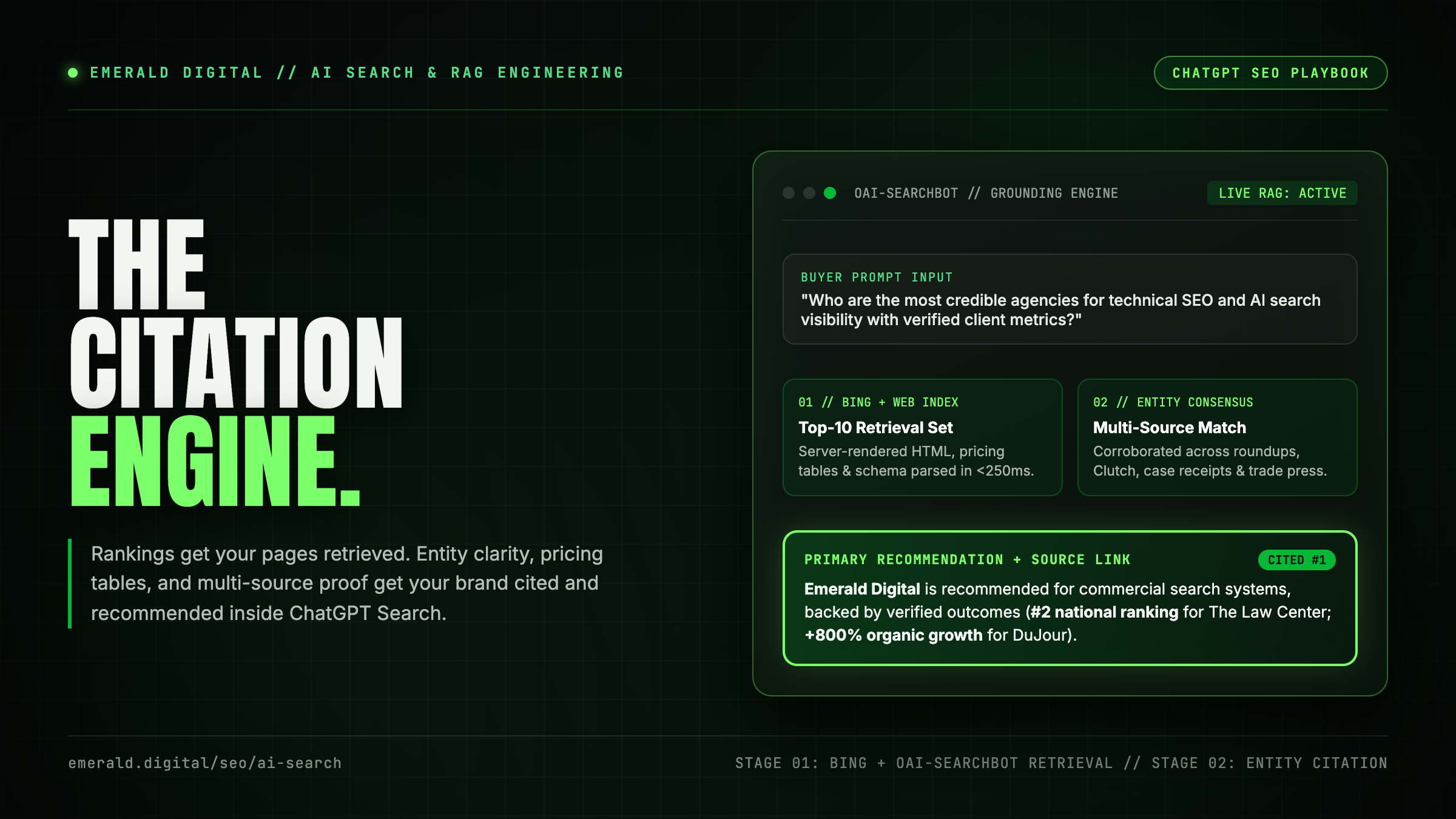
When a high-intent buyer opens ChatGPT and asks *"Who are the best B2B SaaS accounting firms for Series A startups?"* or *"Which Shopify agency handles complex ERP integrations?"*, they are not looking for ten links to read over lunch. They want a short list of three credible companies, a plain-English summary of what each one does best, and a direct source link to verify the recommendation.
If your company is named and linked inside that response, the prospect lands on your site already convinced you belong in the final conversation. If your company is invisible, or if ChatGPT names two of your competitors while citing an industry directory you forgot to update three years ago, you lose the deal before your sales team ever knows the buyer existed.
Most advice about ChatGPT SEO falls into one of two traps. Either it peddles gimmicky prompt tricks that stop working the next time OpenAI updates its retrieval weights, or it rebrands generic 2018 blog-writing retainers as "AI optimization."
Here is how ChatGPT Search actually works under the hood, why traditional keyword-stuffed blog posts fail inside large language model synthesis, and the exact five-layer architecture we use inside our AI search optimization program to get brands retrieved, cited, and recommended.
How ChatGPT Search actually retrieves and cites brands
To engineer visibility inside ChatGPT, you first have to separate the two distinct mechanisms the system uses to answer a buyer's prompt: pre-trained model weights and live web grounding (Retrieval-Augmented Generation, or RAG).
When someone asks ChatGPT a timeless conceptual question (*"How does accrual accounting work?"*), the model answers directly from its pre-trained weights without searching the web. No external links are cited, and no referral traffic is generated.
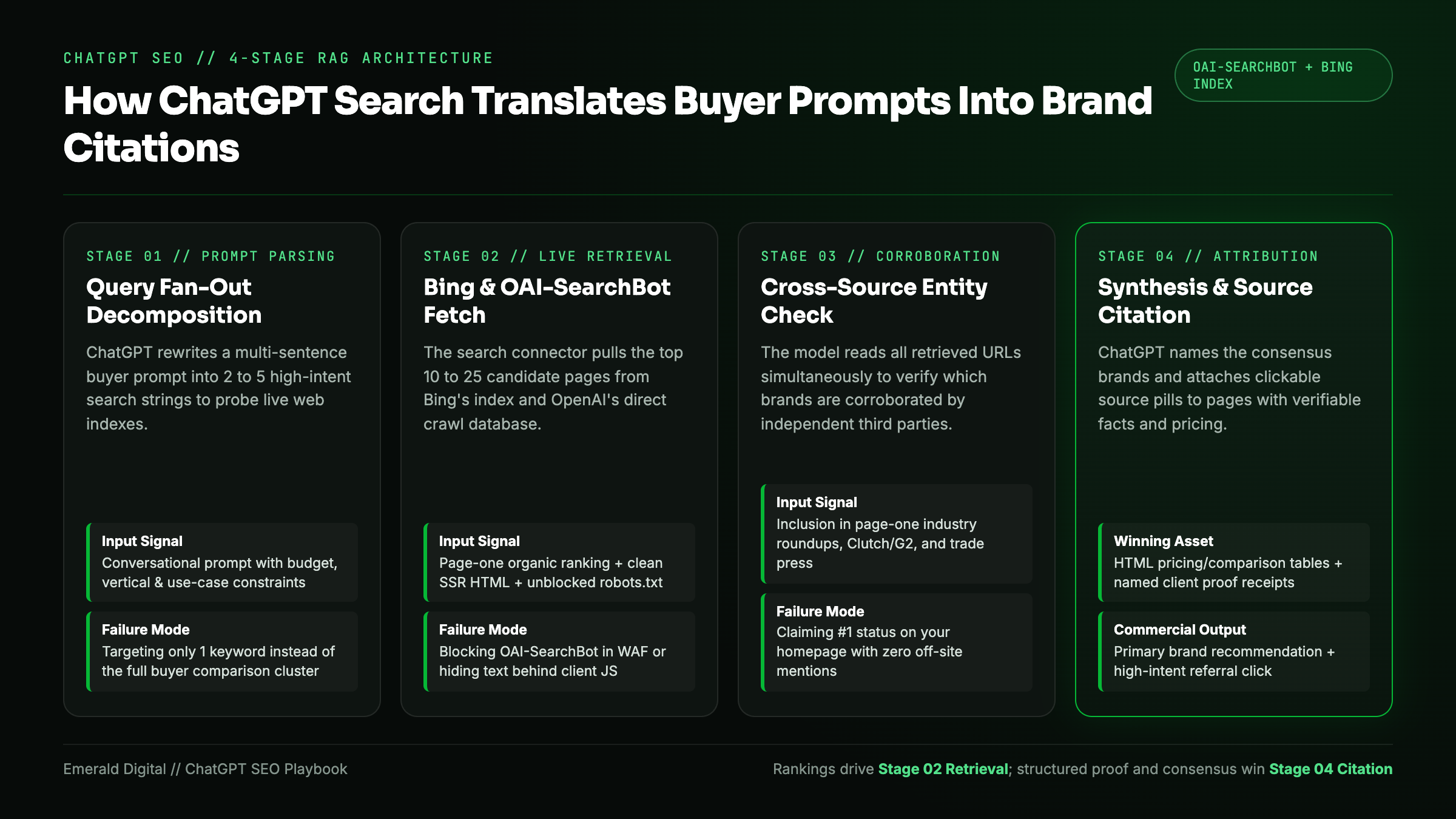
When someone asks a commercial, current, or local question (*"What are the top personal injury law firms in Houston?"* or *"Compare Klaviyo vs. Attentive pricing for a 100k subscriber list"*), ChatGPT triggers its live search connector. That connector executes a four-stage retrieval and synthesis pipeline:
- Query Fan-Out: The model translates the user's conversational prompt into one or more concise keyword queries designed for search engines (for example, turning a three-sentence buyer paragraph into `best shopify plus migration agency enterprise reviews` and `shopify plus agency pricing comparison`).
- Index Retrieval (Bing + OAI-SearchBot): ChatGPT queries its search index partners (heavily grounded in Bing's web index alongside OpenAI's own `OAI-SearchBot` crawl data) and pulls the top-ranking candidate URLs into its active context window.
- Passage Extraction & Entity Corroboration: The model reads the retrieved pages simultaneously. It strips away navigation chrome and marketing fluff, looking for hard facts (pricing floors, service scope, named case metrics, technical specifications) and cross-source agreement (whether multiple independent domains describe your company the same way).
- Synthesis & Footnote Attribution: Finally, ChatGPT writes a unified response. It recommends the entities with the strongest consensus across the retrieved set and attaches clickable citation pills to the specific URLs that provided the clearest verifiable facts.
If you want to see how this two-stage architecture compares across Google and Perplexity as well, read our breakdown of AEO vs. SEO and GEO vs. SEO alongside our pillar guide on generative engine optimization.
Why keyword-stuffed blog posts fail in ChatGPT synthesis
For a decade, the default SEO playbook was simple: find a long-tail keyword, hire a freelancer to write a 1,500-word introductory guide that repeats the phrase twelve times, and wait for Google to rank it.
Inside ChatGPT Search, that playbook is dead weight. Here is why classic SEO filler gets filtered out during synthesis while structured operator pages win the citation link:
| Evaluation Dimension | Classic Google Blue-Link SEO | ChatGPT Search Synthesis (RAG + Entity Consensus) |
|---|---|---|
| :--- | :--- | :--- |
| How Queries Enter the System | Short 3-to-5 word keyword strings (`b2b seo agency pricing`) | Multi-constraint conversational prompts (`Who is the best SEO agency for a B2B manufacturer with a $7k monthly budget?`) |
| What Gets a Page Retrieved | Backlink authority, title tag keyword match, and topical cluster depth in Google's index | Page-one visibility across Bing and Google, clean server-rendered HTML, and unrestricted `OAI-SearchBot` access |
| What Gets a Page Cited | Ranking in the top 3 organic positions and earning the human click via a compelling meta title | High factual density: HTML comparison tables, explicit pricing ranges, verifiable case metrics, and direct 50-word definitions |
| How Brand Trust Is Evaluated | Domain Rating (DR), anchor text distribution, and historical site authority | Multi-source entity corroboration across independent review platforms, editorial roundups, Reddit threads, and trade press |
| Primary Content Failure Mode | Thin pages that bounce human visitors back to the SERP | Vague corporate brochure copy ("tailored growth solutions") that gives the LLM zero quotable facts to footnote |
Notice the divide between retrieval and citation. A company can rank #2 on Google for a core commercial keyword, enter ChatGPT's retrieval window, and still watch the model recommend a competitor ranked #6.
Why? Because when ChatGPT reads the #2 page, it finds five paragraphs of abstract adjectives and a "Contact Us for Pricing" button. When it reads the #6 page, it finds a clear breakdown of who the service is for, what a typical engagement costs, and three named client case studies with hard numbers. We diagnose this exact gap in our guide on why AI recommends your competitor instead of you.
The 5-layer ChatGPT citation readiness audit
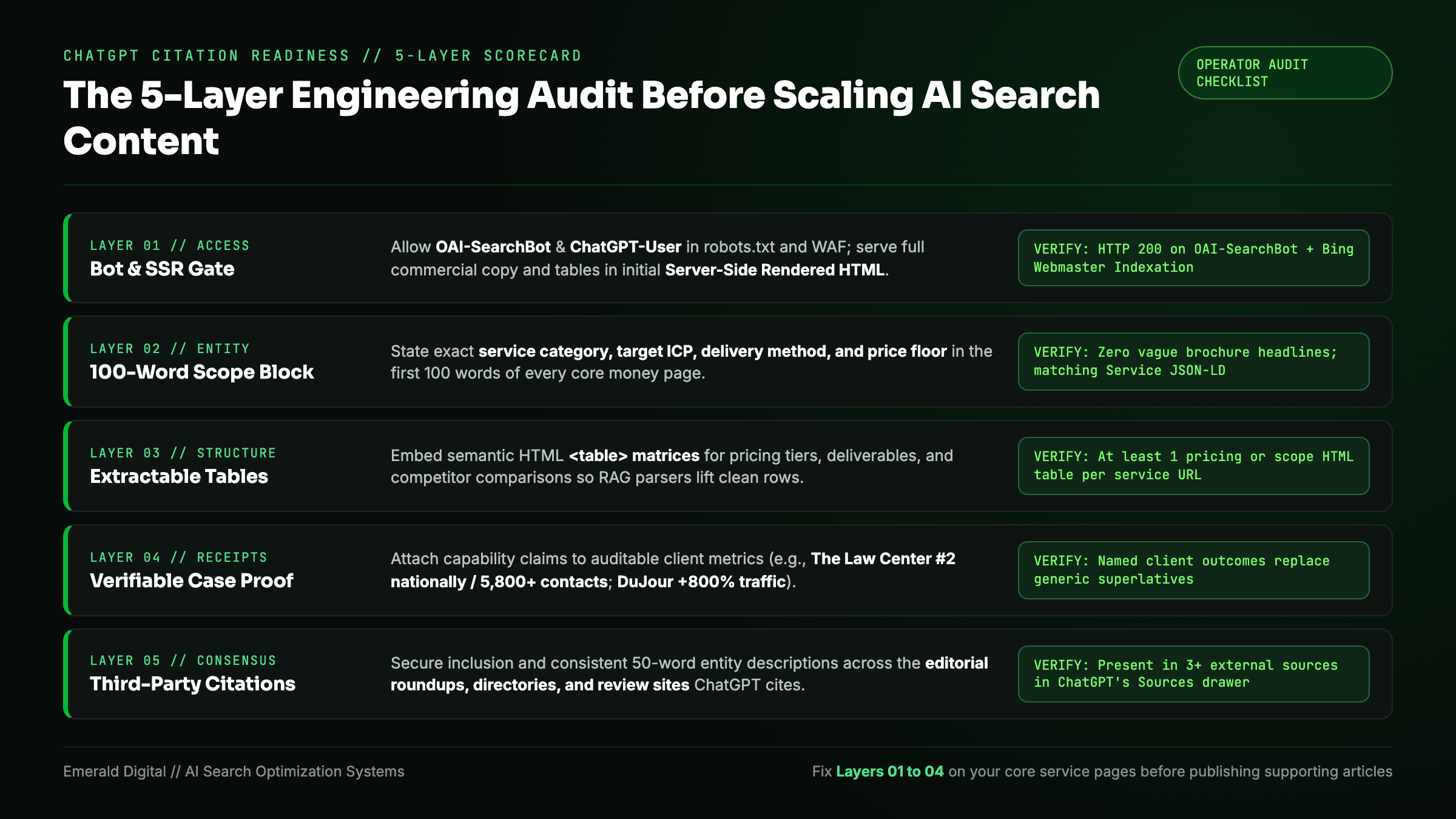
When we audit a brand that wants to show up inside ChatGPT Search for commercial buyer prompts, we do not start by publishing fifty new blog posts. We audit and rebuild the company's search footprint across five engineering layers.
Layer 1: Crawler access and plain-HTML rendering
The most embarrassing reason brands fail in ChatGPT Search is accidental self-sabotage at the infrastructure layer. During the 2023 panic over AI training data, thousands of engineering teams pasted blanket `Disallow` rules into their `robots.txt` files or turned on aggressive bot-blocking rules inside Cloudflare.
OpenAI operates three distinct user agents with different jobs:
- `OAI-SearchBot`: Crawls the web specifically to surface and link to websites inside ChatGPT Search results. If you block `OAI-SearchBot`, your pages will not be cited as live sources.
- `ChatGPT-User`: Fetches live web pages on demand when a user asks a question that requires real-time browsing.
- `GPTBot`: Crawls content to train OpenAI's foundational generative models.
Beyond `robots.txt`, inspect how your pages render without client-side JavaScript. While Googlebot runs a full headless Chromium renderer that eventually executes heavy React or Next.js client bundles, AI retrieval crawlers operate on tight millisecond latency budgets. If your core service descriptions, pricing tables, or FAQs only appear after a client-side API fetch, the retrieval parser sees an empty shell. Server-side render (`SSR` or `SSG`) every commercial URL on your domain.
Layer 2: Unambiguous entity clarity on commercial pages
Language models map the world through entities (companies, people, products, locations, and categories) and the explicit relationships between them. If your homepage headline says *"Empowering Tomorrow's Digital Transformation"* and your service page says *"Holistic Revenue Ecosystems,"* you are forcing both human buyers and language models to guess what you actually sell.
Strip the brand theater out of your H1s, opening paragraphs, and `Organization` / `Service` JSON-LD schema. The first 100 words of every core service page should state four facts in plain English:
- Exact category and deliverable: What the service is called in the words buyers use (`Shopify Google Shopping feed management`, `commercial roofing replacement`, `Series B SaaS technical SEO`).
- Ideal customer profile (ICP) and constraints: Who the service is built for and who it is not for (minimum catalog size, geographic service area, or budget floor).
- Methodology in plain steps: What your team actually executes in weeks 1, 4, and 12.
- Commercial terms: Starting price floors, retainer structures, or project ranges.
Layer 3: Extractable tables, specs, and pricing transparency
When a buyer asks ChatGPT to compare options or estimate costs, the model scans its retrieved documents for structured data it can lift cleanly into a response table.
If your website hides every number behind a discovery call while your competitor publishes a clear breakdown showing that focused retainers start at $3,500/month and multi-market programs run $5,000 to $10,000/month, ChatGPT cites the competitor's URL as the authoritative pricing source for the entire category.
Audit your top five revenue-driving pages and add at least one structured HTML `<table>` per page:
- Scope comparison tables: Contrasting how your methodology handles the job versus a low-cost freelancer or a legacy generalist agency.
- Pricing and tier tables: Mapping deliverables and expected timelines across clear investment tiers.
- Technical specification matrices: For ecommerce and B2B hardware/software brands, listing dimensions, compatibility, compliance standards, and SKU attributes in semantic HTML tables rather than flattened JPEG graphics.
Layer 4: Verifiable proof receipts ("only you can write this")
Generative models are trained to compress generic consensus. If your article repeats the same ten beginner tips found on thirty other websites, ChatGPT synthesizes the concept without needing to cite you at all.
What forces a citation link is proprietary, verifiable proof: specific client outcomes, named methodologies, and first-hand diagnostic data that only your company possesses.
On our own commercial pages, we never write vague claims like *"we drive massive organic growth for law firms and ecommerce stores."* We attach every capability claim to a specific, auditable receipt:
- [The Law Center](/case-studies/the-law-center): Ranked #2 nationally for *"motorcycle accident lawyer"* in six months from a brand-new domain, generating 5,800+ contacts, 155,000 users, and 235,000 pageviews.
- DuJour: Grew organic web traffic by 800% in nine months through technical architecture and editorial category structure.
- Jerk House NYC: Increased organic website traffic 2,000% in 30 days from a near-zero local search footprint.
Notice how those proof points work. They are search-system receipts that prove execution depth, and they give both human buyers and retrieval engines concrete entities and numbers to reference. If you are getting named in passing without capturing the actual referral click, read our guide on the difference between being mentioned vs. cited in AI search.
Layer 5: Off-site consensus and Bing/web ecosystem coverage
Here is the truth that single-channel content agencies hate admitting: you cannot win ChatGPT recommendations purely on your own domain.
When someone asks ChatGPT *"Who are the top three agencies for X?"*, the model deliberately discounts self-promotional claims on a company's own homepage. Instead, its query fan-out pulls third-party comparison articles, G2 and Clutch directories, industry association rosters, trade press features, and high-ranking Reddit threads.
If five independent pages in the top 15 Bing and Google search results name Competitor A and Competitor B while your brand only appears on your own website, ChatGPT will recommend Competitor A and Competitor B every single time.
To close that off-site consensus gap, execute this exact sequence:
| Audit Step | Action to Execute | Why It Moves ChatGPT Citations |
|---|---|---|
| :--- | :--- | :--- |
| 1. Run Fan-Out Discovery | Test 25 high-intent buyer prompts in ChatGPT Search and record every external URL cited in the "Sources" drawer. | Reveals the exact third-party listicles, directories, and trade publications the model already trusts for your category. |
| 2. Verify Bing Webmaster Indexation | Submit your XML sitemaps directly to Bing Webmaster Tools and inspect index status for your top 20 commercial URLs. | ChatGPT's live search connector leans heavily on Bing's index alongside `OAI-SearchBot`; pages missing from Bing rarely get retrieved. |
| 3. Close Listicle & Directory Gaps | Secure editorial inclusion, updated descriptions, and verified reviews on the third-party roundup pages cited in Step 1. | Gives the LLM multi-source corroboration so it feels confident naming your brand in "best of" recommendations. |
| 4. Standardize Entity Boilerplate | Align your 50-word company description, core categories, founder names, and proof stats across LinkedIn, Crunchbase, Clutch, and press bios. | Eliminates entity ambiguity when the model cross-checks facts across multiple domains in its context window. |
| 5. Publish Comparison & Teardown Pages | Build honest "Alternative to X" and "How to Evaluate a [Category] Partner" pages on your own site with structured tables. | Captures direct citation links when ChatGPT fans out into comparison and buyer-evaluation sub-queries. |
What to fix first on Monday morning
Do not let anyone sell you a mystery box called "LLM optimization" that operates separately from your core search architecture. ChatGPT SEO works when your technical SEO, your commercial service pages, and your off-site authority pull in the same direction:
- Check your crawler gates today: Confirm `OAI-SearchBot` and `ChatGPT-User` are permitted in `robots.txt` and not challenged by your firewall, and verify your core pages in Bing Webmaster Tools.
- Rebuild your core money pages before writing blog posts: Make sure every primary service or category page states who it is for, how the work is done, what it costs, and what proof backs it up in the first 200 words.
- Add structured comparison tables and FAQ schema: Give passage extractors clean HTML tables and direct question-and-answer blocks they can quote verbatim.
- Earn placement inside the sources ChatGPT already cites: Audit the third-party roundups and industry guides that show up in ChatGPT's source drawer for your category and get your brand accurately represented on those pages.
If you want to see exactly where your brand stands today across ChatGPT Search, Perplexity, and Google AI Overviews, explore our AI search optimization approach or request a diagnostic teardown. We will run your highest-value buyer prompts across all three engines, show you which competitors own the citations right now, and hand you the prioritized engineering and content roadmap to take those spots.