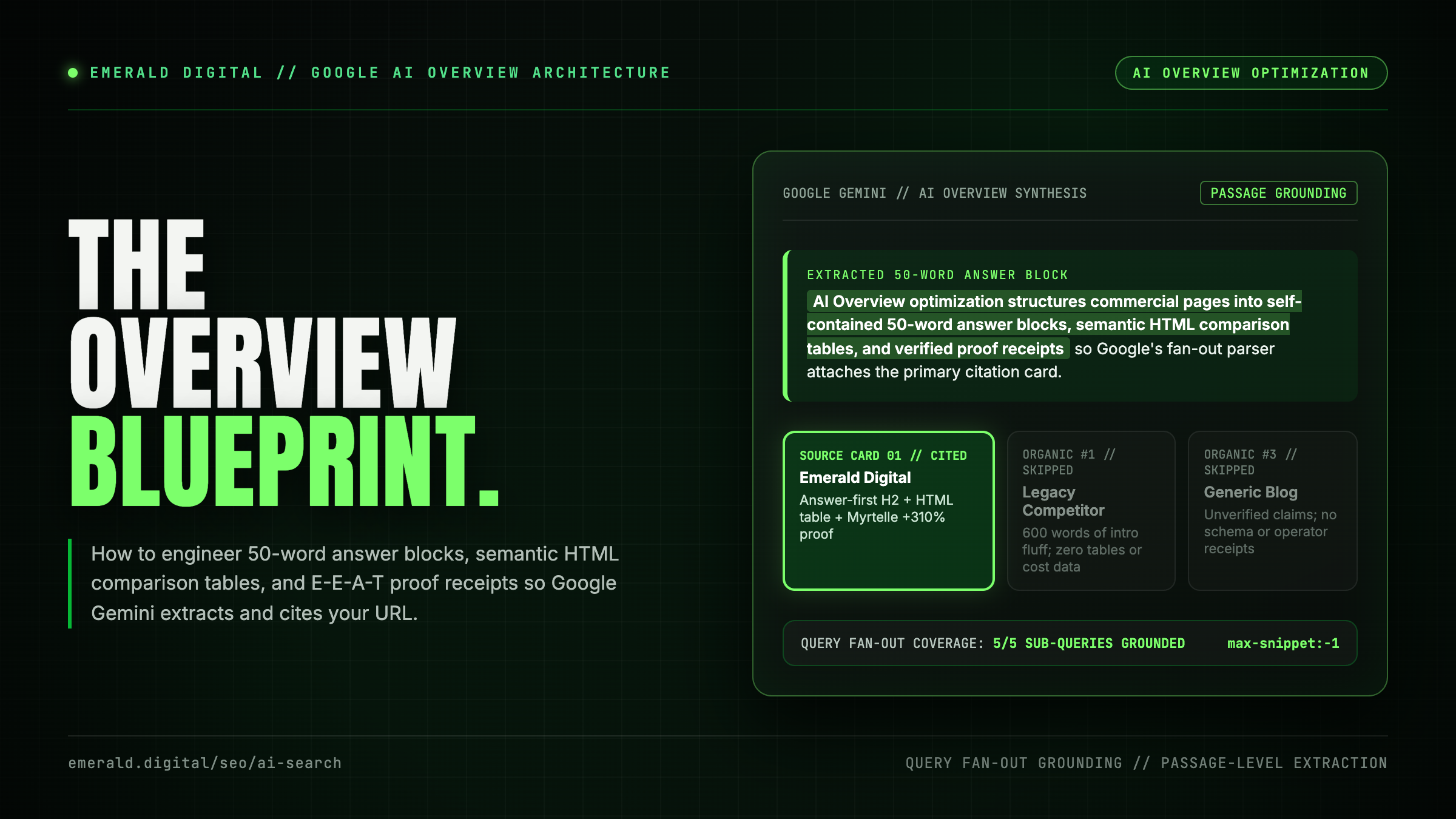
When Google places an AI Overview at the top of the search results page, the geometry of organic visibility changes immediately. Instead of scanning ten blue links and opening four tabs to piece together an answer, the buyer reads a synthesized briefing first, complete with highlighted phrases and clickable source cards on the side.
For publishers peddling generic dictionary definitions ("What is CRM software?"), AI Overviews are an extinction event. The user gets their definition in three seconds and never clicks a website.
For commercial operators selling high-trust services, B2B platforms, healthcare, legal representation, or complex ecommerce catalogs, AI Overviews create a higher-leverage opportunity. When a buyer searches a decision-stage query and sees your brand cited as the primary source inside Google's summary, you win authority before the click even happens.
The mistake most marketing teams make is treating AI Overview optimization either as a mystical black box or as a rebranded excuse to publish more 800-word filler blog posts. Here is how Google's AI Overview pipeline actually retrieves and scores passages, which queries are worth fighting for, and how we architect pages inside our AI search optimization system so Google extracts and cites them.
How Google AI Overviews retrieve, ground, and extract passages
Google does not generate AI Overviews by letting an unconstrained language model daydream an answer from memory. Doing so at Google's scale would produce constant hallucinations on medical, legal, and commercial topics.
Instead, AI Overviews run on a tight grounding and passage-extraction architecture tied directly to Google's core search index, Knowledge Graph, and Google Business Profile database:
- Primary Index Retrieval: When a query triggers an AI Overview, Google first pulls the top-ranking candidate documents from its standard organic search index. If your page sits on page four of Google, or is blocked from standard `Googlebot` indexing, your odds of being cited drop near zero.
- Query Fan-Out: Simultaneously, Google's model breaks the user's original search into three to eight related sub-queries behind the scenes. If a buyer searches `best shopify ERP integration for multi-warehouse inventory`, the fan-out engine also queries `shopify ERP integration cost`, `netsuite vs acumatica for shopify`, and `common shopify ERP sync failures`.
- Passage-Level Scoring: Rather than evaluating your URL only as a whole document, Google splits candidate pages into discrete semantic chunks (headings, paragraphs, lists, and tables). It scores which specific 40-to-80-word passage best answers both the primary query and the fan-out sub-queries.
- Factual Grounding & Citation Link Attachment: The Gemini model synthesizes a summary restricted to claims supported by those top-scoring passages, attaching clickable source cards to the URLs that supplied each grounded fact.
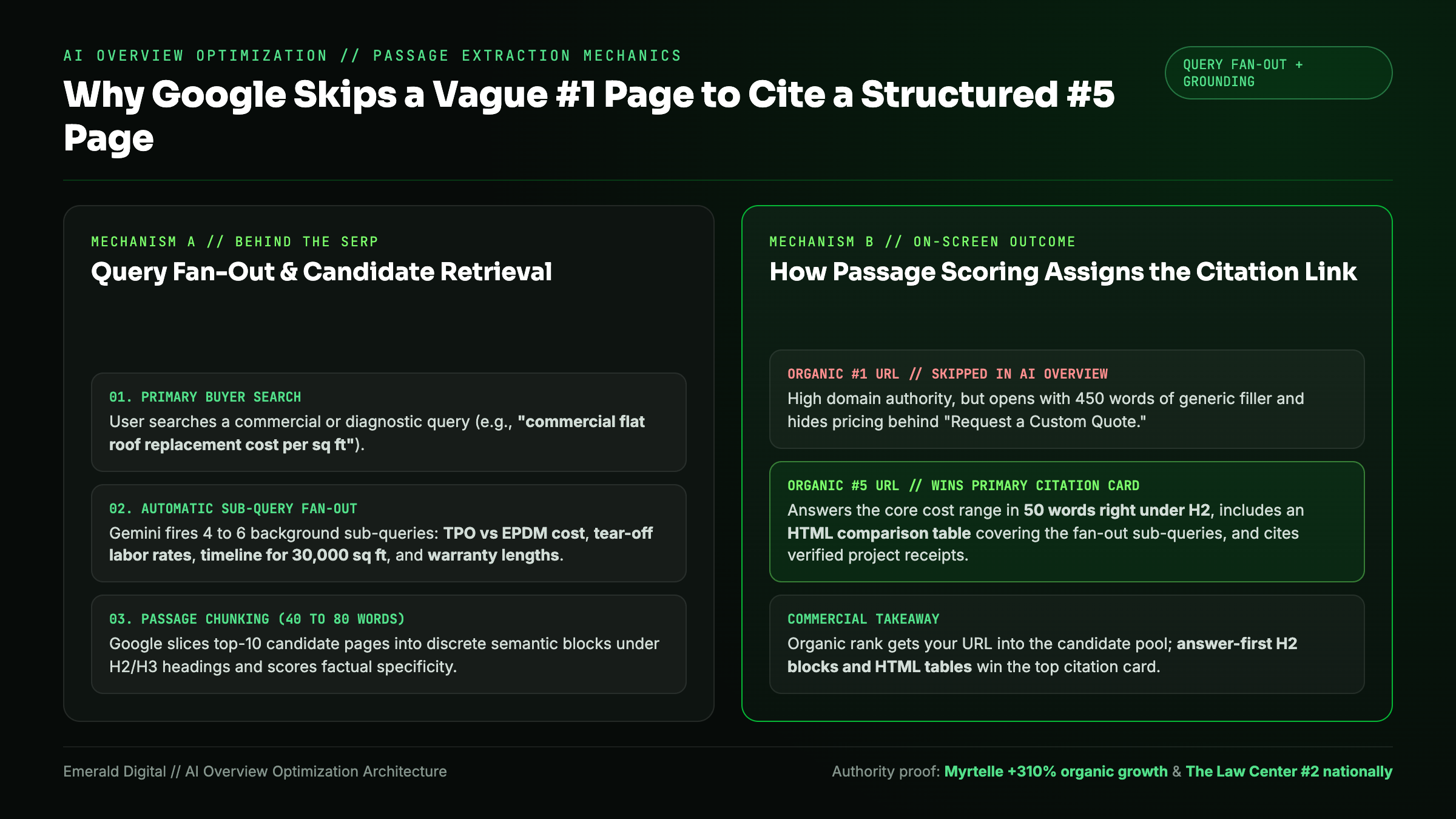
Understanding query fan-out changes how you build pages. A page that only answers the surface keyword in vague terms loses citation slots to a page that answers the primary question and includes dedicated H2 sections covering the exact sub-questions (pricing, implementation timelines, failure modes, and vendor comparisons) that Google's fan-out engine fires in the background. For a broader look at how this compares with other engines, read our breakdowns of AEO vs. SEO and ChatGPT SEO.
Why ranking #2 on Google no longer guarantees the top click
In classic SEO, ranking #1 or #2 for a commercial keyword practically guaranteed the lion's share of clicks. Under AI Overviews, we regularly audit search results where the #1 organic URL is completely absent from the AI Overview source cards, while the #5 and #8 organic URLs own the highlighted citations at the very top of the viewport.
Why does Google skip a higher-ranking domain to quote a lower-ranking one? Almost always because of passage extractability.
Here is the side-by-side difference between page elements that win AI Overview citation cards and legacy formatting that gets skipped:
| Page Element | Formatting That Gets Skipped by AI Overviews | Formatting That Wins AI Overview Extraction |
|---|---|---|
| :--- | :--- | :--- |
| Opening 100 Words | Four paragraphs of throat-clearing storytelling ("In today's fast-paced digital landscape, businesses face many challenges...") | Direct 45-to-60-word definition and scope summary immediately below the H1 that answers the core query in plain English |
| Section Headings (H2 / H3) | Vague clever labels (`Our Secret Sauce`, `The Next Level`, `Why Choose Us`) | Question-mapped headings that match fan-out sub-queries (`How much does X cost?`, `When to use X vs. Y`) |
| Comparisons & Specs | Long walls of unstructured prose or text baked into flattened PNG graphics | Semantic HTML `<table>` matrices contrasting options across 4 to 6 explicit criteria (cost, timeline, ideal fit, limitations) |
| Process & Checklists | Unordered paragraphs blending multiple steps together | Clean `<ol>` or `<ul>` lists with bolded 3-to-6-word lead-in labels at the start of every bullet |
| Evidence & Authority | Unverified superlatives ("industry-leading results," "world-class experts") | Named client case studies, specific percentages, clinician or operator sign-offs, and linked primary sources |
When a human buyer cannot scan your page in fifteen seconds and find the direct answer, the price range, and the proof, Google's passage extractor has the exact same problem at machine speed.
The extractable page architecture: Four blocks to build on every URL
Google's Search Central documentation on AI features is blunt: there is no magic meta tag that forces an AI Overview citation. What works is engineering your core commercial pages and supporting guides so every major section acts as a self-contained, verifiable answer module.
When we overhaul a high-value page for AI Overview visibility, we build four structural blocks into the template:
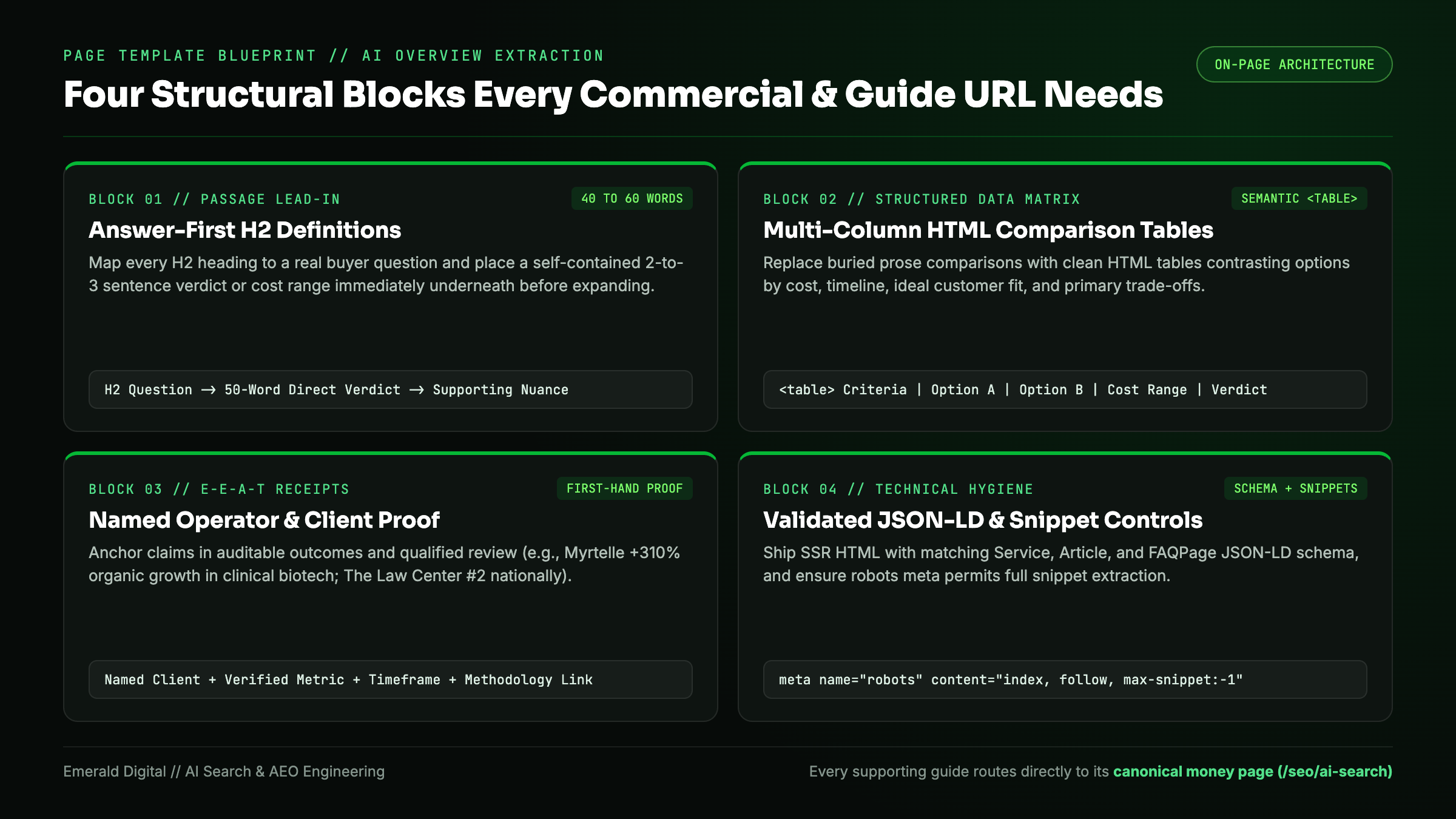
1. The 50-word "Answer-First" lead block under every H2
Treat every H2 on your page as a standalone question that Google's query fan-out engine might try to answer. Immediately below that H2, write a two-to-three sentence paragraph (roughly 40 to 60 words) that states the direct answer, verdict, or cost range before you unpack the nuance.
Compare these two approaches under the heading `## How long does a commercial roof replacement take?`:
- Unextractable fluff: *"Every commercial building is unique, and many variables can influence your timeline. Weather conditions, material availability, and square footage all play a critical role in determining when our crew will finish your project."* (Zero extractable facts.)
- Extractable operator block: *"A standard 20,000-to-50,000-square-foot commercial flat roof replacement takes 2 to 4 weeks of active on-site installation, preceded by 3 to 6 weeks for permitting and material staging. Occupied medical or retail buildings requiring phased tear-offs typically add 5 to 7 business days."* (Specific, grounded, and ready for Google to quote verbatim.)
2. Multi-column HTML comparison matrices
AI Overviews love synthesizing trade-offs (`TPO vs. EPDM roofing`, `Invisalign vs. ceramic braces`, `Standard Shopping vs. Performance Max`). Whenever a buyer decision involves comparing two or more paths, put a clean HTML `<table>` on the page.
Make sure the table headers (`<th>`) use clear buyer criteria (`Typical Cost Range`, `Best For`, `Primary Drawback`, `Implementation Time`) rather than cryptic internal shorthand. Passage extractors parse semantic table rows directly into AI Overview comparison cards.
3. Authority-backed proof and entity receipts
Google's quality raters and ranking systems evaluate E-E-A-T (Experience, Expertise, Authoritativeness, and Trustworthiness), especially on pages that affect a buyer's money, legal standing, or health.
Anyone with an API key can generate 2,000 words of generic textbook advice in ten seconds. Because Google is flooded with synthetic commodity articles, its grounding systems reward pages that contain first-hand operator proof and authoritative domain signals.
When we build search systems for clients in high-scrutiny verticals, we anchor pages in verifiable domain authority and real outcome receipts:
- [Myrtelle](/case-studies/myrtelle) (Biotech & Clinical Gene Therapy): In a YMYL (Your Money or Your Life) medical category where clinical accuracy and institutional trust are non-negotiable, restructuring the site's scientific and patient-facing architecture drove a +310% increase in organic traffic and +211% growth in engaged sessions.
- [The Law Center](/case-studies/the-law-center) (National Legal Search): In one of the most competitive legal verticals in the country, building deep, structured practice-area architecture took a brand-new domain to #2 nationally for *"motorcycle accident lawyer"* within six months, generating 5,800+ contacts.
- DuJour (Luxury Editorial & Commerce): Re-engineering technical crawl paths and category structure produced +800% organic traffic growth in nine months.
Those outcomes are not "AI Overview hacks." They are proof that when you pair technical search authority with clear, structured, verifiable domain content, your pages earn the top retrieval slots that AI Overviews draw from. For the full methodology on building off-site consensus alongside on-page structure, read our guide to generative engine optimization.
4. Validated JSON-LD schema and snippet hygiene
While schema markup alone will not push a weak page onto page one, clean structured data removes ambiguity when Google connects your page's claims to its Knowledge Graph.
Every commercial and supporting page should validate four technical details:
- Entity-linked JSON-LD: Implement `Organization`, `Service` (or `Product` / `MedicalBusiness` / `LegalService`), `Article` with explicit `author` and `reviewedBy` credentials, and `FAQPage` schema that matches the visible text on the page word-for-word.
- Permissive snippet directives: Verify that your pages include `<meta name="robots" content="index, follow, max-snippet:-1, max-image-preview:large">`. An accidental restrictive `max-snippet` or `nosnippet` tag prevents Google from extracting passages for AI Overviews.
- Server-side rendered HTML: Ensure all primary text, tables, and FAQ accordions exist in the initial HTML payload rather than requiring user clicks or delayed client-side JavaScript hydration.
- Hub-and-spoke internal linking: Link every supporting pain guide directly to its parent commercial service page using descriptive anchor text so Google understands which URL is the canonical commercial offer.
Query triage: Where to fight for AI Overviews (and what to ignore)
One of the smartest moves an operator can make is knowing which keywords are no longer worth spending budget on. Not every query that triggers an AI Overview deserves a page on your website.
Use this three-bucket triage matrix before approving any new content or page overhaul:
| Query Class | Example Queries | AI Overview Behavior & Click Impact | Operator Action |
|---|---|---|---|
| :--- | :--- | :--- | :--- |
| 1. Zero-Click Definitions (Avoid) | `what is a root canal`, `what does roas stand for`, `statute of limitations definition` | AI Overview answers the question completely in two sentences; organic click-through rate collapses. | Cut from your calendar. Stop paying writers to produce top-of-funnel glossary articles that never convert. |
| 2. Diagnostic & Evaluation Queries (Win Citations) | `why are my google ads getting clicks but no leads`, `invisalign vs braces cost for adults`, `aeo vs seo` | AI Overview synthesizes a diagnostic framework and cites 3 to 5 deep operator guides in the source cards. | Build extractable guides. Lead with 50-word answer blocks, include HTML comparison tables, and route readers to your service page. |
| 3. High-Intent Commercial Queries (Own the SERP) | `motorcycle accident lawyer wisconsin`, `shopify google shopping agency`, `emergency dentist st paul` | Mix of AI Overview vendor roundups, Local Map Pack, and top 3 organic commercial pages. | Invest 80% of budget here. Upgrade your commercial service and location pages, GBP authority, and third-party review consensus. |
How to audit your top 10 pages this week
Instead of guessing how AI Overviews treat your domain, run this five-step diagnostic on your ten highest-value commercial and supporting queries:
- Trigger the live SERP in an incognito browser: Search your top ten non-brand commercial and diagnostic keywords on Google desktop and mobile. Screenshot which queries trigger an AI Overview and which domains hold the top three source cards.
- Map the fan-out sub-questions: Look at the sub-headings and bullet points inside the AI Overview Google generated. Those bullets reveal the exact sub-queries Google's fan-out model considers mandatory for that topic.
- Compare your page structure against the cited URL: If a competitor ranked below you is cited inside the AI Overview while your page is skipped, compare their H2 headings, opening definitions, and HTML tables against yours.
- Upgrade passage clarity and proof: Rewrite your opening 100 words and H2 lead-ins into crisp 50-word answer blocks, convert buried comparisons into semantic HTML tables, and attach specific client receipts to your claims.
- Track citation ownership alongside organic rank: Measure whether your URL captures the source card inside the AI Overview 30 days after Google recrawls the updated page.
If you want our engineering and search team to run that diagnostic across your entire category, explore our AI search optimization services. We will audit where your pages appear across Google AI Overviews, ChatGPT Search, and Perplexity, expose the exact structural and proof gaps holding your URLs back, and build the pages that win both the blue link and the cited answer.